
Iran clings to uranium enrichment with the West’s broken promises fresh in mind
Trump attributes the lack of an agreement in Islamabad primarily to Tehran’s refusal to comply with this demand, which the Islamic Republic considers a ‘sovereign right’
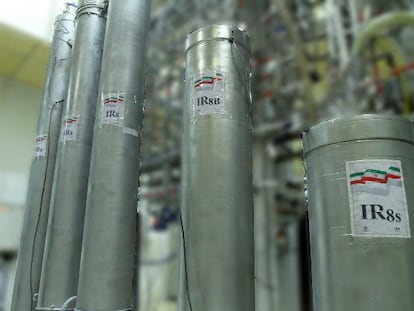

The 2015 Joint Comprehensive Plan of Action (JCPOA) — the nuclear agreement between Iran and world powers that Donald Trump abandoned in 2018 — achieved in its three years of full implementation what neither threats, nor war, nor even Saturday’s brief peace negotiations in Islamabad have managed to accomplish now. Back then, after 10 years of European mediation, two years of negotiations, and the signing of that pact, Tehran opened its nuclear facilities to a strict regime of international inspections, eliminated 97% of its highly enriched uranium stockpile, and committed to not enriching that mineral above 3.75% (the level necessary to produce electricity, but not nuclear weapons), in exchange for relief from international sanctions.
The unilateral withdrawal from that pact, which the U.S. president brought to its knees when Iran was scrupulously complying with it, as acknowledged by the International Atomic Energy Agency (IAEA), is not the only promise Tehran considers broken by the West. Other previous agreements, such as the one to supply enriched uranium to the Asian country, which fell apart after the proclamation of the Islamic Republic in 1979, also weigh heavily on the minds of a nation that now considers producing its own nuclear fuel a “sovereign and inalienable right.” Following the Islamabad negotiations on Saturday, the U.S. president posted a message on his social media account, Truth: “There is only one thing that matters: IRAN IS NOT WILLING TO GIVE UP ITS NUCLEAR AMBITIONS!” In that post, Trump failed to mention another major obstacle: Iran’s crucial blockade of the Strait of Hormuz.
Iran has for decades claimed that it enriches uranium for civilian uses, especially for electricity generation, and has always denied any intention of becoming a nuclear power. It insists that it is a signatory to the Treaty on the Non-Proliferation of Nuclear Weapons (NPT), which restricts the possession of such weapons to five powers (the United States, Russia, the United Kingdom, France, and China) and prohibits them for all other signatories. Tehran also points to the double standards of the West, which does not sanction countries like India, Pakistan, and especially Israel, which possess nuclear weapons outside of this framework. Neither they nor other nuclear powers, such as North Korea, have signed the NPT.
Neither these arguments nor the fatwa (edict) issued in 2003 by the previous Supreme Leader Ali Khamenei, which prohibited nuclear weapons as contrary to Islam, have convinced Washington, which continues to believe that Tehran is enriching uranium to acquire atomic bombs. Before Saturday’s meeting in Pakistan, the Iranian delegation announced a gesture of détente, stating that the new Supreme Leader Mojtaba Khamenei, whose whereabouts are unknown, has pledged to respect this religious edict, which many considered moot after Israel and the United States killed Ali Khamenei in a bombing raid on the first day of the war on February 28.
This gesture appears to have had no effect. The United States continues to demand that Iran hand over the more than 400 kilograms of uranium enriched to 60% — close to the 90% required to produce atomic bombs — believed to still be buried deep underground at facilities in Isfahan or Natanz, both in central Iran. These facilities were bombed during the 12-day Israeli-led offensive against the Asian country in June of last year.
Above all, the U.S. is demanding what is known as “zero enrichment”: that Iran renounce the production of nuclear fuel. One of Washington’s arguments is that to operate civilian nuclear power plants, it is not necessary to enrich uranium, much less to enrich it to 60%, a level of purity that has no possible use other than for military purposes. This is unless one considers the intention — which some experts have attributed to Iran — of using it as a negotiating and pressure tactic.
The United States maintains that this strategic metal can be imported. On paper, this is true. Spain, for example, does this; despite having the second-largest uranium reserves in Europe, it imports all the enriched uranium that fuels its five active nuclear power plants.
The difference is the chasm that separates the geopolitical and strategic position of a full democracy like Spain, a member of the European Union and NATO, from that occupied by the despotic Iranian political system, isolated and subjected to severe sanctions for decades.
Every European country knows it has a guaranteed supply of enriched uranium; Tehran has no such safety net. The reasons for this fear have much to do with an ideology in which opposition to “Western imperialism” is central, but which also stems from a history of failed agreements with the West on this issue, dating back to the time of the deposed Shah Mohammad Reza Pahlavi.
A US reactor
In a historical paradox underscored by this war, it was the United States that delivered the Shah’s pro-Western regime its first nuclear reactor: the Tehran Research Reactor, which the country received in 1967 to produce medical radioisotopes. Washington, along with several Western countries, then offered to build nuclear power plants for this allied regime to generate electricity and convinced the autocrat to abandon uranium enrichment and import the fuel.
The political police of the Pahlavi monarchy imprisoned, tortured, and killed political opponents, while the West rolled out the red carpet for him. That same autocratic regime had granted France a loan of $1 billion to participate in Eurodif, the acronym for European Gaseous Diffusion Uranium Enrichment Consortium, a company that is now a subsidiary of the French firm Orano. This disbursement entitled France to receive 10% of the uranium produced at the Tricastin plant in southeastern France. When the Iranian Revolution overthrew the Shah in 1979, the Islamic Republic proclaimed its intention to break the contract and recover the investment, even before receiving a single gram of uranium.
The Eurodif affair sparked a diplomatic war between Tehran and Paris that has marked their bilateral relationship ever since, culminating in the taking of French hostages in Iran and terrorist attacks and assassinations in the 1980s, which French authorities suspected were orchestrated by the Islamic Republic. Iran only recouped its investment more than 10 years later, after reaching a final agreement with France, under which Paris paid it $1 billion in December 1991.
Following Iran’s announcement of its withdrawal from Eurodif in 1979, the German company Kraftwerk Union, a subsidiary of Siemens, which was building the Bushehr nuclear power plant in southwestern Iran, withdrew from the project. The plant could not be completed until 2011, when Iran’s only nuclear power plant was finally connected to the grid after Russia finished its construction. The French company Framatome also abandoned its plans to build two power plants in Iran, a project it had been commissioned to undertake in 1977.
“Iran insists on enrichment for both historical reasons and nationalism,” says Sina Azodi, author of Iran and the Bomb: The United States, Iran and the Nuclear Question, as quoted in an analysis by Barbara Slavin, a researcher at the Stimson Center. This expert believes that the Iranian experience “has shown them that Europeans and the rest of the world would not supply them with fuel” if they needed it.
There is another reason why Iran is unlikely to abandon its nuclear program. Tehran has invested billions of dollars in facilities, training scientists — dozens of whom Israel has killed — and developing the technology locally. In addition to the direct costs, this has resulted in international sanctions that, between 2011 and 2022 alone, caused economic losses of at least $1.2 trillion, according to an estimate of both the aggregate and per capita costs by the Economic Research Forum. This is a higher price than the war with Iraq between 1980 and 1988, and one paid more by its impoverished population than by the regime itself.
Sign up for our weekly newsletter to get more English-language news coverage from EL PAÍS USA Edition









































