
The death of Ayatollah Khamenei, an unprecedented case in contemporary history
While it is not the first time a head of state or government has been assassinated, it is the only time that responsibility lies with another country and without a declaration of war
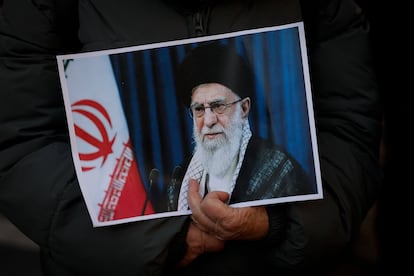

Ali Khamenei died last Saturday at the age of 86 as a result of the airstrikes launched against Iran by the United States and Israel. His death is an unprecedented event in contemporary history. While it is not the first time a head of state or government has been assassinated, it is the only time that responsibility lies with another country. Until his death, the supreme leader had represented the highest authority in Iran since 1989, when his predecessor and founder of the Islamic Republic, Ruhollah Khomeini, died.
Although the exact circumstances of his death are unknown, several experts consulted by EL PAÍS agree that it is an unparalleled event. “I can’t think of a similar case to the execution of a head of state by a bombing raid from another country, without any declaration of war,” says Javier Chinchón Álvarez, professor of international law and international relations at the Complutense University of Madrid, in an email.
Details surrounding the assassination of the Iranian ayatollah are still emerging. Israeli sources first confirmed Khamenei’s death on Saturday night, stating that his body had been found in a bunker. Shortly afterward, U.S. President Donald Trump echoed the statements of his Middle East ally. Iranian television confirmed the leader’s death that same night.
Joaquín González Ibáñez, a doctor of law at the same Madrid faculty, told EL PAÍS in a WhatsApp conversation that, of the assassinations prior to Khamenei’s that he recalls, there is no case similar to Saturday’s events. “They are not comparable to the Iranian case,” he emphasized. “It is a crime of aggression under international law committed by Israel and the United States, apart from the war crimes we are already identifying at the girls’ school,” the expert opined, referring to the joint U.S.-Israeli strike on the Shajareh Tayyebeh girls’ primary school, which left at least 148 people dead.
“An act of aggression is one of the four quintessential international crimes. [There is] the crime of aggression, the crime against humanity, the war crime, and genocide,” explains the academic. González considers this act to be the “most important,” since the other three types of crimes (war crimes, crimes against humanity, and genocide) “are committed within the framework of the crime of an act of aggression.”
Chinchón, for his part, considers it an “extrajudicial execution,” in line with the UN definition of the matter, that is, “deliberately killing a person outside of any legal framework.” “[Israel and the U.S.] are once again confirming that they are acting not only outside the bounds of current international law, but in constant, open, and undisguised direct violation of their most essential obligations,” he states.
Among the most similar cases is the 2011 death of Libyan dictator Muammar Gaddafi, who was captured in a water pipe outside Sirte, his hometown, and subsequently shot dead by members of the National Transitional Council (NTC), Libya’s rebel forces. The similarity in this case is that, at the time of his capture, Gaddafi had already been wounded in a NATO airstrike. The Alliance had supported the NTC in the seven months prior to his death in its efforts to end Gaddafi’s regime.
In August of last year, Israel killed Yemen’s Houthi prime minister, Ahmed Ghaleb al-Rahawi, in another airstrike. The Houthi movement is one of the pro-Iranian armed groups present in the Middle East, along with the Palestinian militia Hamas and the Lebanese group Hezbollah. The Houthis control Sana’a, the capital of Yemen, and the northwest of the country, but they are not recognized by the international community, unlike the Yemeni government. Therefore, Prime Minister Al-Rahawi was not considered legitimate at the time of his assassination.
The deaths of Dzhokhar Dudaev, leader of the Chechen Republic of Ichkeria, in 1996, and his successor, Aslan Maskhadov, in 2005, also reveal similarities to the case of Khamenei. However, the Chechen Republic of Ichkeria has never been recognized as a state by the international community. Following the dissolution of the Soviet Union in 1991, Dudaev unilaterally declared the territory’s independence. The Russian Federation, then under the leadership of former president Boris Yeltsin, never recognized this independence. Dudaev died in a Russian airstrike, launched by Moscow after he was located via satellite through a phone call. His successor died in a similar fashion, during a Russian military operation in Chechnya.
Other notable assassinations of heads of state include that of Congolese leader Patrice Lumumba in 1961, who was shot by a firing squad in a forest in the eastern region of Katanga. At the time of his death, Lumumba had already been overthrown in a coup orchestrated by the CIA and Belgium. “Nor does it serve as a mirror to the situation of the Iranian attacks,” González acknowledges.
Successive Indian prime ministers, Indira and Rajiv Gandhi, mother and son, also died by gunfire. She was shot by three members of her personal guard, including her bodyguard Beant Singh, in 1984. Her assassination was the result of Operation Blue Star, a military intervention that coincided with a major Sikh religious event. Several civilians were killed in the assault.
As for Gandhi’s son, he was campaigning for the 1991 general election as the main opposition leader when a suicide bomber detonated a device in a plot orchestrated by the Liberation Tigers of Tamil Eelam (LTTE), an armed separatist group in Sri Lanka. He was no longer in power at the time of his assassination.
Former Lebanese Prime Minister Rafik Hariri died in a 2005 attack, along with 21 others, when a car bomb struck the convoy in which he was traveling in Beirut. The only person convicted for the attack, tried in absentia by the Special Tribunal for Lebanon, was Salim Hamil Ayyash, a member of Hezbollah. Twenty-one years later, the tribunal has still not found evidence that Syria or the militia were directly involved in the bombing, although it acknowledged the existence of possible motives. The other three defendants — Hussein Hassan Oneissi, Assad Hassan Sabra, and Hassan Habib Merhi — were acquitted.
The 2021 assassination of then-Haitian president Jovenel Moïse by Colombian hitmen is another example of political assassinations in the 21st century. An investigation by The New York Times revealed that he was killed for attempting to send the United States a list of politicians and businesspeople involved in drug trafficking. The identity of the mastermind behind Moïse’s murder remains unknown.
Sign up for our weekly newsletter to get more English-language news coverage from EL PAÍS USA Edition









































