
Trump’s pressure, partisan tactics, and Black‑voter suppression: The all-out battle for the November midterms
Republicans are rushing to implement the Supreme Court ruling that curtailed minority rights before the November vote. ‘It will be the least free and fair election in decades,’ says one expert


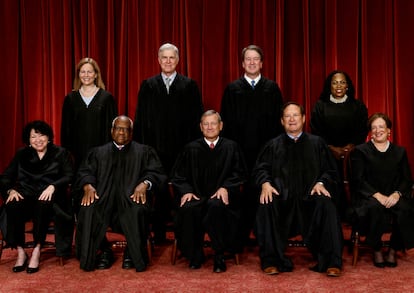
The Voting Rights Act, one of the most enduring legacies of the civil rights era, prohibited racist politicians in the southern U.S. states from using underhanded tactics to suppress the votes of Black citizens. Last Wednesday, the Supreme Court’s conservative supermajority completed the task of dismantling that law, which had already been severely weakened by two previous rulings. The new decision declares the design of Louisiana’s majority-Black 2nd District unconstitutional and opens the door to a potentially Republican-friendly change in democratic rules in other Southern states.
Beyond the long‑term consequences of the court’s decision — which will make it harder for minority communities to see themselves reflected in the politicians who represent them — the Supreme Court is stepping into a battle that conservatives and Democrats have been waging for nearly a year over which party can better shape the terrain ahead of next November’s vote.
These are the midterm elections, in which the entire House of Representatives and one-third of the Senate are up for election. Polls suggest Republicans are heading into them at a disadvantage, with the war in Iran, gas prices, the cost of living, and the unpopularity of their leader, Donald Trump, all threatening to take a toll.
Last week, the Republican Party received extra ammunition from the Supreme Court, and Trump, who openly celebrated the news—“that’s the kind of ruling I like!“ — has set his people to work to redraw electoral maps wherever the decision allows. The goal is to contain losses in November at all costs. Because, beyond the question of racial justice and the promotion of equality in a society founded on the original sins of slavery and the genocide of Native Americans, a district where a minority is in the majority is usually a Democratic-leaning district.
It is unclear whether every state will have time to do so now, but no one doubts that those changes will shape the 2028 elections. For the moment, Louisiana has postponed its primaries until mid‑July in order to redraw the district that triggered the lawsuit filed by a group of white voters. The primaries had been scheduled for next week, so the Supreme Court did manage to act in time for that. With few exceptions, rulings from the Supreme Court are released at the end of June. By moving this one up to late April, everything suggests that its six conservative justices did not want to miss the chance to influence the elections in that Deep South state.
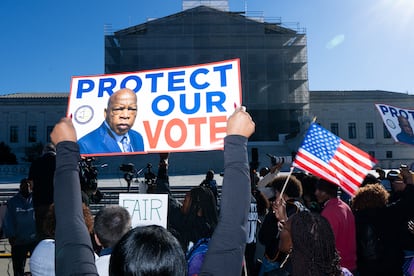
And beyond Louisiana. The Republican governors of Alabama and Tennessee convened their respective state legislatures on Friday for extraordinary sessions to redraw the electoral maps in light of the ruling, and no one is ruling out Georgia and South Carolina following suit. The Florida legislature, for its part, approved last week a map that awards four more seats in Washington to the Republican Party by virtue of the undemocratic technique of gerrymandering.
These latest moves expand the conservative push in Texas, Ohio, Missouri, and North Carolina, as well as the response from California and Virginia, where Democratic leaders asked voters whether they wanted to introduce rule changes that would benefit their own party — and voters said yes.
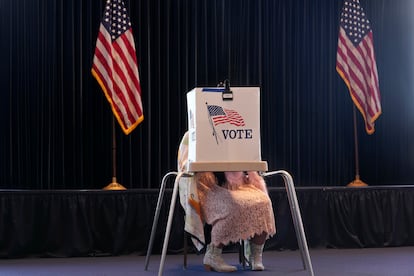
The picture is further complicated by Trump’s calls to “nationalize” the elections, stripping states of a right granted to them by the Constitution; his statements that it would be better if the elections were not held at all; the suspicion that he may deploy Immigration and Customs Enforcement (ICE) agents around polling places; the issuance of an executive order encouraging the postal service not to accept mail-in ballots; and his obsession with passing legislation that would tighten voting requirements.
Everything feeds into an extraordinarily tense pre‑election climate in the United States, which is preparing to vote for the first time with Trump in the White House since he encouraged an insurrection after refusing to accept an electoral defeat in the 2020 presidential race — a defeat he still does not acknowledge. Neither he nor many of his supporters. Last week, during their Senate confirmation hearings, three federal judges appointed by the president described the assault on the Capitol as “a politically controversial matter” and referred to Joe Biden not as the winner of that election, but as “the one who was certified the winner.”
“I think the midterms will be free and fair, but also that they will be less so than they have been in the last 20 or 30 years,” explained influential analyst Fareed Zakaria, columnist for The Washington Post and CNN anchor, via videoconference on Friday. “In the 1960s and 70s, the party in power in the United States had many resources to discourage voter turnout. If the outcome is clear, I don’t think it will be possible to suppress a decisive number of votes in November.”
Zakaria points out, however, that the country’s “greatest danger” is how clearly divided it is ideologically. “You only need to select five or six states and, within them, choose five or six specific areas with what are known as swing voters to influence the outcome,” the expert says.
Anti-democratic tradition
That a democracy of 350 million inhabitants is decided by a handful of votes is not the only anomaly of a system that has been frozen in place for more than two centuries. Another of its features, dating back to the beginning of the 19th century, is gerrymandering, named after Elbridge Gerry, the fifth vice president of the United States, who, to favor a friend, drew a district in the shape of a salamander (hence the second part of the term).
Every ten years, with the updated U.S. census, the 435 seats in the House of Representatives are redistributed — a fixed number that has been frozen since 1929. States that gain population pick up seats, and those that lose population give them up.
It is also the time for politicians in power, Democrats and Republicans alike, to review their maps, and to do so for their own electoral benefit, drawing constituencies in impossible shapes, grouping together voters who have no relation to each other, or diluting the representation of minorities.
The district that the Supreme Court struck down resembles a snake and had been in effect since 2022. It was designed to create the second majority-Black constituency in a state where one-third of the population is African American. In 2024, voters from this district elected Cleo Fields, producing an outcome that had long been in line with Louisiana’s demographics: two of its six representatives in Washington would be African American. The other four are white.
There is also what is known as “mid-decade gerrymandering,” which occurs between censuses. It is usually implemented by court order when maps are challenged in court. “What we are seeing now, this widespread unilateral redrawing, is unprecedented,” explained Kareem Crayton from the Brennan Center for Justice, a leading nonpartisan organization on election law in the United States, in a telephone interview. “Maps have never been changed before due to pressure from the White House, as happened in Texas last summer.”
The governor of Texas, Greg Abbott, designed a map that was intended to give Republicans five more seats. That marked the beginning of what quickly became known as the “gerrymandering wars.”California joined first — led by Gavin Newsom, who champions the Democratic school of thought that argues for “fighting fire with fire” — and then Virginia, whose new, more liberal map is now being challenged before the state’s Supreme Court. With so many additions and subtractions, it is unclear whether the end result will cancel itself out; neither Republicans nor Democrats may ultimately benefit. “What is certain,” laments Crayton, “is that all of this will add confusion for many voters, who won’t be sure which district is theirs.”
The Supreme Court’s ruling adds yet another layer of uncertainty by holding that “racial gerrymandering” is unconstitutional. The majority opinion argues that the founding document — which these justices tend to read literally, nearly 240 years after it was written — is “color blind.”
The ruling, however, sees no problem with partisan gerrymandering. “Not only are they condoning this type of manipulation, but they have essentially endorsed partisanship as the sole criterion from now on,” Paul Collins, a law professor at the University of Massachusetts and an expert on the politicization of the high court, said in an email. “What they have done is basically put political interests front and center in the mapping process,” Crayton warns.
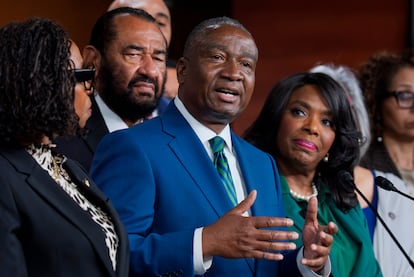
Black Democratic lawmakers have strongly criticized the court’s decision. Senator Raphael Warnock of Georgia called the ruling “Jim Crow in new clothes,” a reference to the legal system that perpetuated racial discrimination in the South by other means after the abolition of slavery. The House minority leader, Hakeem Jeffries, for his part, listed the setbacks of recent years: affirmative action in universities, undermined by a 2023 Supreme Court ruling; diversity, equity and inclusion programs, banned by executive order under Trump; and “racial tolerance.” “We will not allow their scheme to rig the midterm election be successful,” he warned his rivals.
A couple of weeks ago, the New York congressman made headlines with remarks that again showed Democrats have also taken off the gloves in this fight.
A couple of weeks ago, this New York politician made headlines with remarks that proved once again that Democrats have also thrown caution to the wind in this fight. “Fuck around and find out,” Jeffries told Florida Republicans, who, anticipating the Supreme Court’s ruling, submitted an electoral map to the Tallahassee legislature that colors the entire state red except for a handful of blue dots. It’s ready, awaiting Governor Ron DeSantis’s signature.
Jeffries is confident that the protest vote against Trump will be so overwhelming, two years after the victory that took him back to the White House, that not even these obstacles will prevent the Democrats from winning in that state, where they recently obtained a series of resounding victories in elections held in Trump strongholds.
A Democratic victory in Florida seems unlikely, although Trump appears determined to leave nothing to chance in order to prevent one or both chambers from falling into hostile hands — a scenario that could jeopardize the second half of his term and, some observers note, might even expose him to a third impeachment.
For months, he has been pressuring his allies on Capitol Hill to secure passage, before the midterms, of a bill called the SAVE America Act, and, if necessary, to eliminate the filibuster — the supermajority threshold required in the Senate for major reforms. The law would hinder democratic participation for millions of people under the guise of preventing voter fraud by undocumented immigrants.
In March, Trump said at an event in Miami that passing the law would “guarantee” not only victory in November, but also that Democrats would “probably won’t win an election for 50 years and maybe longer.” He did not seem troubled by how undemocratic the idea sounded.
Sign up for our weekly newsletter to get more English-language news coverage from EL PAÍS USA Edition









































