
What we know about the SAVE America Act, the bill that could change voting rules in the United States
The legislation remains stalled in the Senate. Although Republicans control the Senate with 53 seats, the bill needs 60 votes to overcome a filibuster and move toward a final vote
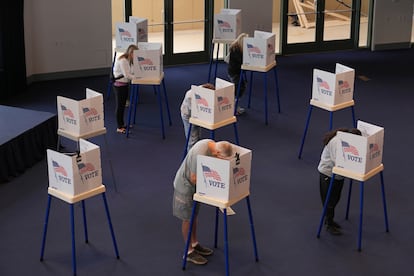

The latest legislative battle over voting rules in the United States continues to center on the SAVE America Act, a bill championed by President Donald Trump that seeks to tighten the requirements for registering to vote and participating in federal elections. The bill passed the House of Representatives in February but remains stalled in the Senate due to a lack of support. In response, Republicans are now exploring a new strategy to push through some of its provisions via a budget reconciliation package.
Trump has intensified pressure on Congress in recent weeks. During an address to the nation on July 16, he called on Americans to contact their representatives and senators to demand passage of the bill and claimed that those who oppose it are seeking to “cheat” in the elections. The president has also insisted that the legislation is necessary to strengthen election security ahead of the November midterm elections.
What does the SAVE America Act propose?
The SAVE America Act—whose full name is the Safeguard American Voter Eligibility Act—proposes to change the rules for federal elections by imposing stricter requirements on voters.
Among its main provisions are:
- Requiring documentary proof of citizenship, such as a passport or birth certificate, to register to vote or update voter registration
- Requiring voters to present a valid government-issued photo ID when casting their ballot
- Requiring states to share their voter rolls with the Department of Homeland Security to verify voter eligibility using the federal SAVE database
- Establishing penalties for election officials who register voters without the required documentation
Currently, federal law already stipulates that only U.S. citizens may vote in federal elections and requires voters to certify, under penalty of perjury, that they meet this requirement. However, it does not require voters to present documents proving citizenship during registration, a requirement of the SAVE America Act.
Republican push
Supporters of the bill, primarily Republican lawmakers, argue that the measure will strengthen electoral integrity and restore public confidence in the voting system. Senator Mike Lee, the bill’s main sponsor in the Senate, has described the initiative as important legislation.
President Trump—who has also called for “nationalizing the elections”—has repeatedly praised the bill and insisted that its passage would prevent election fraud such as that which, without verified evidence, he has alleged regarding the 2020 election he lost to Democrat Joe Biden. On his social media platform Truth, he has for months reiterated his intention to push for the ID requirement for the upcoming midterm elections, even if he faces legislative resistance.
In another message delivered in March, the president insisted that the bill should be passed “immediately” and argued that elections should require both voter identification and proof of citizenship, in addition to restricting mail-in voting except in specific cases such as military service, illness, disability, or travel.
Some of the proposed measures have public support. A poll conducted by The Washington Post, ABC News, and Ipsos in February found that 61% of Americans support requiring documentary proof of citizenship to register to vote, while 22% oppose it. Another poll by the Pew Research Center showed that 83% of adults support requiring photo ID when voting.
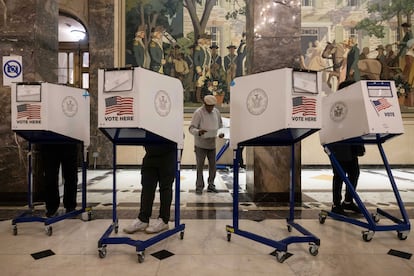
However, the legislation faces strong opposition from Democrats and civil rights organizations. Senate Minority Leader Chuck Schumer has compared the measure to the Jim Crow laws—which enforced racial segregation in the U.S.—stating that it could deprive millions of citizens who do not have immediate access to the required documents of their right to vote. According to estimates cited by organizations such as the Brennan Center, which is dedicated to defending democracy, approximately 21 million Americans do not have easy access to documentary proof of citizenship, and about 2.6 million lack any form of official photo ID.
Democrats have also warned that Trump’s stance of blocking the signing of other bills until the initiative is approved could lead to a “total stalemate” in the Senate and paralyze other legislative efforts.
Critics also warn that married women who have changed their last names, naturalized citizens, rural voters, tribal communities, low-income individuals, and other groups could face greater obstacles to registering or voting.
They also point out that voting by non-citizens in federal elections is already illegal and that the cases detected represent an extremely small proportion of the total votes cast.
Why is it still stalled in the Senate?
Although Republicans control the Senate with 53 seats, the legislation needs 60 votes to overcome the filibuster and move toward a final vote. Republican Majority Leader John Thune has acknowledged on several occasions that there is not enough support to reach that threshold and has also ruled out eliminating the filibuster, as Trump has suggested.
In addition, some Republican senators have expressed reservations about the proposal. Lisa Murkowski previously voted against opening debate on the bill, while Thom Tillis, Mitch McConnell, and Susan Collins have opposed various attempts to incorporate it into other legislative measures.
Could it be implemented before the November elections?
Several lawmakers believe that scenario is unlikely. Republican Senator Thom Tillis has stated that more than 10,000 government entities would have to adapt their procedures to implement the new requirements and argues that this process could not be completed before the midterm elections.
Even if part of the proposal were to pass through budget reconciliation, the allocated funds would not begin to be distributed until fiscal year 2027, which would limit its immediate impact on the November elections. However, Trump and his allies are still exploring alternatives.









































