
Stalemate in Congress foreshadows shutdown of Department of Homeland Security
Democrats are demanding that immigration agents show their faces and that warrants be required for arrests, two requirements that Republicans flatly reject
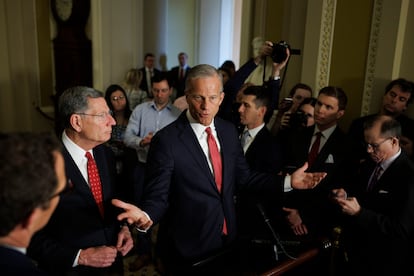

There is no sign of an agreement in Congress, and without one, the Department of Homeland Security (DHS) will shut down. Democrats and Republicans have made no progress in the talks they have been holding since February 2 on how immigration laws should be implemented, and the deadline for reaching an agreement expires this Friday, after which the department’s funding is no longer guaranteed. On Saturday, several DHS agencies, such as the Transportation Security Administration, which is responsible for airport security, the Federal Emergency Management Agency, and the Secret Service, will shut down if funding for their continued operation has not been approved. President Donald Trump agreed to the Democratic demand that the DHS be separated from a broader spending bill that was passed last week. That package extended the department’s funding only until February 13.
Republican Senate Majority Leader John Thune acknowledged that he didn’t see how an agreement could be reached this week and proposed temporarily expanding the budget to keep the DHS operating. That’s not the solution all Republicans support. Nor does it convince the Democrats.
“Dramatic changes are needed at the Department of Homeland Security before a DHS funding bill can move forward,” said Hakeem Jeffries, Democrat of New York and the minority leader, Monday morning. The negotiations center on the procedures followed by agents of Immigration and Customs Enforcement (ICE), the Border Patrol, and other agencies involved in migrant detentions. The brutality of raids carried out as part of Trump’s anti-immigration crusade and the deaths of U.S. citizens Renee Good and Alex Pretti, shot by immigration agents last month in Minneapolis, prompted the Democrats’ demands, which they outlined in a 10-point proposal.

One of the sticking points in the talks is the use of face masks by agents, which has been standard practice since Trump launched his campaign to achieve the largest deportation effort in history. Democrats are demanding that agents remove their face coverings, but Republicans argue that this puts officials at risk.
Another seemingly insurmountable obstacle is the requirement for a judicial warrant to make arrests. ICE agents have been ordered to enter homes and arrest residents even with just an administrative warrant, which is issued by the same agency. Democrats argue that a court warrant is necessary, as guaranteed by the Fourth Amendment, which protects citizens from unreasonable police action.
The Trump administration responded with a counterproposal on Monday, but Democrats rejected it, calling it insufficient. Both sides have been vague about exactly what the White House is offering, but lawmakers said a major sticking point remains the Democrats’ demand that ICE and Border Patrol agents obtain a judge’s authorization to issue warrants before entering homes or businesses.
Senator Ron Johnson, a Republican from Wisconsin, called the proposal “completely unworkable” in an interview with CNBC. On the Democratic side, the chairman of the Congressional Hispanic Caucus, Adriano Espaillat, confirmed the lack of agreement.
Other demands from the Democrats include mandatory identification for officers; protection of sensitive locations such as schools, hospitals, churches, and polling places; an end to racial discrimination in arrests; and adherence to standards for the use of force. These are all practices that have been commonplace in the raids that have taken place in recent months, bringing terror to immigrant communities and outrage to a large segment of society.
So far, the only point on which there seems to be an agreement is that agents will wear body cameras, but Homeland Security Secretary Kristi Noem had already announced that they would do so after Pretti’s death.
Paradoxically, if DHS has to shut down due to lack of funding, this would not affect ICE, the main cause of the disagreement, since the immigration agency has sufficient funds, approved in the “big, beautiful bill” that passed last summer, to continue operating for, in theory, four more years.
Sign up for our weekly newsletter to get more English-language news coverage from EL PAÍS USA Edition









































