
Local and state authorities block ICE plans to turn warehouses into detention centers
The Trump administration wants to buy facilities to house detained migrants, but it is facing citizen protests, owners who don’t want to sell, and legal barriers
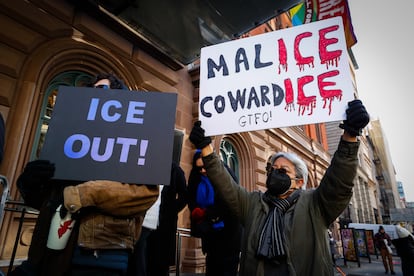

In addition to the growing street protests across the country and the debates in the U.S. Congress, the battle against Donald Trump’s immigration agenda is being fought on a logistical front. Immigration and Customs Enforcement (ICE) is struggling to find space for the thousands of detainees it has overcrowded in its detention centers.
The Department of Homeland Security has been trying to buy properties — specifically warehouses — to convert them into detention centers or to build new ones on empty lots. But these plans have not been well received. Citizens have protested the presence of ICE facilities in their communities, Democratic and Republican mayors have opposed their placement in their jurisdictions, property owners have refused to sell, and legislators in several states have passed proposals to prohibit the construction of new detention centers.
In New Mexico, Governor Michelle Lujan Grisham signed the Immigrant Safety Act last week, which — in addition to prohibiting public agencies from entering into agreements to detain people for immigration violations — mandates the termination of any existing such agreements and bans the use of public property as ICE detention centers.
Angelica Rubio, one of the Democratic legislators who championed the new law, had been trying to get it passed for 10 years. Only the opposition sparked by the aggressiveness of Trump’s policies led to its approval. “Deportations have become more violent and more visible, and I think that’s what changed the minds of the legislators, who, year after year wouldn’t let us pass this law. Seeing what has happened in Minnesota, Chicago, and Los Angeles, and knowing that we are part of that system, is what finally allowed us to get it passed,” Rubio said in a phone interview.
New Mexico has three such detention centers, which, according to the American Civil Liberties Union (ACLU), have facilitated a “system of harm, with documented cases of excessive use of solitary confinement, inadequate medical care, lack of clean drinking water and food, and five deaths in custody in recent years.” Republicans have warned that closing the facilities will result in layoffs and lost revenue, and the Otero County Attorney, whose district attorney oversees one of the facilities, has already announced he will sue the legislature.
Rubio explains that the three active centers are not expected to close. However, starting on May 20, they will no longer be allowed to hold migrants detained for civil immigration violations — only those held for criminal offenses. Rubio acknowledges that the state has no control over ICE, but is confident that the ban on using its facilities will reduce raids in the state. “We can’t tell the federal government that it can’t continue deportations. They’re going to keep going and find other ways to do it, but we made the decision that we don’t want them using our resources,” she says.
In Kansas City, Missouri — where the government planned to locate one of the largest detention centers — the city council passed a resolution in January prohibiting the construction of such facilities in the city for five years. In Maryland, Howard County has revoked the building permit for a private detention center that was being renovated in Elkridge, about 10 miles from Baltimore. The renovations had been underway for months without anyone knowing that the complex was intended for ICE use. As soon as the intended purpose became known, the county official announced he would push for legislation to block it.
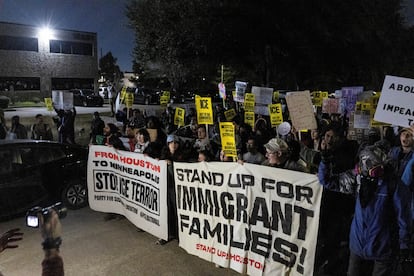
ICE’s needs have skyrocketed since the start of Trump’s crackdown on migrants, which is aimed at being the largest deportation effort in U.S. history. According to the latest federal data, by mid-January more than 75,000 migrants were in ICE custody, nearly double the 40,000 held when Trump took office a year earlier. During that time, the number of detention centers used by ICE has doubled, reaching 225 facilities across 48 states and territories. Most of this expansion came through existing contracts with local sheriffs or agreements to use available beds in county jails. But overcrowding in the agency’s facilities — where detainees have reported inhumane conditions, including lack of medical care, insufficient food, and mistreatment — has become an even greater problem as detentions increase.
To increase the number of available beds, the administration has an approved budget of $45 billion, included in Trump’s “big, beautiful bill” passed last summer. In December, The Washington Post reported that the administration has a plan to renovate industrial warehouses to house more than 80,000 detainees. Last year, dormant prisons were reopened, sections of military bases were converted, and tent camps were built in remote areas. Some of the planned new facilities are so large they could house up to 8,000 detainees at a time, according to a Department of Homeland Security spreadsheet with more than 20 potential locations, which was verified by NBC. The largest federal prison in the United States, for example, has a capacity of about 4,000 inmates.
Refusing to sell to ICE
Two recent projects — one in Oklahoma City and the other in Salt Lake City, Utah — have been thwarted because the sellers, private owners, backed out. In both cases, the mayors celebrated the withdrawal.
In Salt Lake City, the warehouse was slated to have a capacity for 7,500 people. On the same day that immigration agent gunfire ended the life of U.S. citizen Alex Pretti in Minneapolis, Democratic Mayor Jenni Wilson said: “I am deeply relieved to hear that the Ritchie Group will not sell or lease a warehouse in Salt Lake City that was a designated site for an ICE detention facility.” Meanwhile, Oklahoma City Mayor David Holt, a Republican, thanked the owners for breaking off sales talks with the agency and called on “every single property owner in Oklahoma City exhibit the same concern for our community in the days ahead.”
Public opposition hasn’t been enough to stop ICE everywhere. The agency has recently completed property purchases in Maryland, Pennsylvania, and Arizona. In Arizona, in the city of Surprise, the Department of Homeland Security spent more than $70 million on a warehouse roughly the size of seven American‑football fields. City officials said they were unaware that the transaction was underway and emphasized that, in any case, they had no authority to block it. “While we do not participate in ICE operations, we also cannot interrupt or prevent their operations,” city officials said in a statement.
ICE has also paid $102 million for a warehouse in Washington County, Maryland, and $84 million for one in Berks County, Arizona.
Turning warehouses — originally built for storing and distributing goods — into detention centers raises serious concerns about whether they are suitable for holding people. These buildings lack essential infrastructure such as proper ventilation and temperature‑control systems needed to house thousands of detainees. Detention facilities require reliable access to transportation, water supply, sewage systems, electricity, staffing, medical care, and emergency services.
Concerns are now appearing even within the Republican Party. Mississippi Republican Senator Roger Wicker sent a letter on February 4 to Homeland Security Secretary Kristi Noem opposing the plan to build an ICE detention center in the town of Byhalia. “The ICE detention facility would have a capacity exceeding 8,500 beds,” he said in the letter. “Existing medical and human services infrastructure in Byhalia is insufficient to support such a large detainee population. Establishing a detention center at this site would place significant strain on local resources.” Community members met with activists and a local organization to urge the owner of the Byhalia facility not to cooperate.
I strongly oppose DHS's proposed plan to turn a warehouse in Byhalia, Mississippi, into an ICE detention center. I am all for immigration enforcement, but this site was meant for economic development and job creation. We cannot suddenly flood Byhalia with an influx of up to…
— Senator Roger Wicker (@SenatorWicker) February 4, 2026
Plans to convert a jail in Hudson, Colorado, into an ICE detention center have sparked protests from migrant‑rights organizations because the facility would be located more than 40 minutes from Denver and is inaccessible to people without a car.
In Hutchins, Texas, residents protested last Wednesday over rumors that an ICE center might be built there — one large enough to hold more people than the city’s entire population of about 8,000. Local officials said they have received no formal requests or communication from federal agencies, but also acknowledged they would have no authority to stop such a project because they lack jurisdiction over federal matters.
On January 30, the Department of Homeland Security issued a statement confirming its expansion plans. “DHS law enforcement is conducting law enforcement activities across the country to keep Americans safe,” it said. “It should not come as news that ICE will be making arrests in states across the U.S. and is actively working to expand detention space. Thanks to the One Big Beautiful Bill, ICE has new funding to expand detention space to keep these criminals off American streets before they are removed for good from our communities.”
Sign up for our weekly newsletter to get more English-language news coverage from EL PAÍS USA Edition









































