
Trump uses Supreme Court ruling that weakens minority voting rights to improve his chances at the polls
The US president is pressuring Republican governors to change voting districts in time for the November midterms
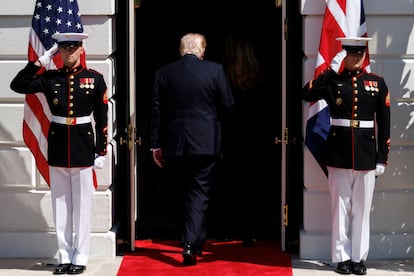

The Supreme Court ruling that on Wednesday undermined the Voting Rights Act of 1965 — and with it the electoral representation of minorities in the United States — had its first consequence the following day, with the announcement that Louisiana is preparing to postpone its primary elections. Originally scheduled for mid-May, these primaries were the first step in the process that will lead to the midterm elections in November. In those elections, the country will elect all members of the House of Representatives and one-third of the Senate.
The ruling sided with a group of white voters who had challenged the redistricting of a majority-Black electoral district — the second such district in that southern state, where one‑third of the population is African American. The Supreme Court’s conservative bloc (6–3) deemed it unconstitutional because it had been drawn using racial criteria. In light of that ruling, which carries enormous implications, Louisiana Governor Jeff Landry declared on Thursday that the current map is illegal and therefore cannot be used in the primaries.
Samuel Alito, the justice who wrote the majority opinion, clarified in his argument that the Supreme Court intended the ruling to apply exclusively to Louisiana, but most analyses assumed its reach would extend well beyond Louisiana’s borders. They also argued that its effects alter the democratic rules that have governed the United States since the civil‑rights era of the 1960s, one of whose major achievements was the now-weakened Voting Rights Act.
Analysts predicted a rush by Republican‑controlled states, especially in the South, to act on the Supreme Court’s decision, particularly given polling that suggests Democrats are highly likely to regain control of the House of Representatives. That chamber alone determines how congressional districts are drawn. Senators, by contrast, are elected through statewide vote totals.
That is exactly what happened. In a message on Truth Social, U.S. President Donald Trump said he had spoken with Tennessee’s Republican governor, Bill Lee, who confirmed his intention to work hard to “correct the unconstitutional flaw” in that state. The message added that doing so “should give us one extra seat [in the House of Representatives], and help save our country from the Radical Left Democrats.”
Earlier this year, Trump had proposed nationalizing elections to prevent his organization from depending on the states — particularly those run by Democrats.
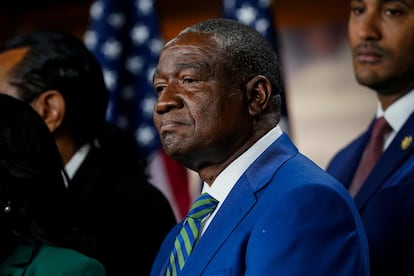
Trump enthusiastically welcomed the Supreme Court’s ruling on Wednesday, which arrived just in time. The court’s term ends in late June or early July, and its decisions are usually released then, with few exceptions. The fact that its conservative supermajority chose to publish this one early suggests they wanted the ruling to take effect before the primaries. The first contests are scheduled for next Tuesday in Ohio.
Speaker Johnson
House Speaker Mike Johnson, a Republican, also made his party’s intentions clear. “We want constitutional maps,” he told reporters at the Capitol on Thursday. “I think all states who have unconstitutional maps should look at that very carefully, and I think they should do it before the midterms.”
The Supreme Court ruling strikes down Section 2 of the Voting Rights Act, which prevents the design of electoral districts (the practice known as gerrymandering) from discriminating against the voting power of Black, Hispanic, Native American, and Asian Americans, who have traditionally voted Democrat. Until this Wednesday, it was constitutional to prioritize the voting rights of these minorities through government institutions, ensuring they see themselves reflected in the politicians who represent them.
The district at the heart of the lawsuit was approved in 2022. It comprises a narrow, elongated strip of land stretching from Louisiana’s capital, Baton Rouge, to Shreveport, and was won by African American politician Cleo Fields. Until the Supreme Court ruling, it was one of two Louisiana districts known as “majority-minority” districts, meaning that a minority group in the country’s overall demographic makeup, such as African Americans, represents more than 50% of the district’s population.
For the Supreme Court, it is constitutional for politicians — who are tasked with revising their maps every ten years after the release of the new census — to do so using partisan criteria, but not to use that process to deliver racial fairness. The court’s six conservative justices subscribe to the “color‑blind” school of thought, an ideology prevalent in U.S. conservatism that holds that the best way to promote equality is to ignore a person’s race or cultural background.
They also argue that it is time to move past an adjustment that was necessary in the 1960s in a country with a terrible history of slavery — wounds that, according to anti‑racist movements, have yet to heal.
A couple of years ago, following that same line of reasoning, the Supreme Court dealt a fatal blow to affirmative action in universities with a ruling that struck down the admissions systems at Harvard and the University of North Carolina. In practice, it ended decades in which Black and Latino students were given an advantage based on the idea that educational institutions should offer them greater opportunities in the interest of a more diverse society — and more diverse centers of power.
The court’s decision has helped intensify the hostilities in what, in this election year, is already being called the “gerrymandering war.” The two sides have been locked in battle since last summer, when Texas announced it would revise its map to favor Republicans in November. Democratic responses followed in California and Virginia, and conservative counter‑moves came from Florida, Ohio, Missouri and North Carolina.
Democratic Representative Alexandria Ocasio‑Cortez of New York said on Thursday that this crossfire was a necessary evil, even if it is unclear whether it will ultimately produce a zero‑sum outcome, with seats lost and gained by both parties. Nor is it clear how much the powerful ammunition the Supreme Court handed Republicans on Wednesday will tilt the battlefield in their favor.
Sign up for our weekly newsletter to get more English-language news coverage from EL PAÍS USA Edition









































