
Genetics reveals that the fall of the Roman Empire shaped Europe’s population
Hundreds of individuals buried along Rome’s northern frontier challenge the idea of barbarian invasions: they had already been inside for centuries
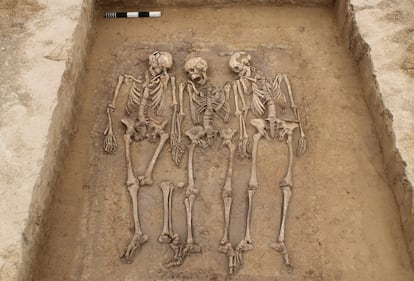

For centuries, along the entire northern border of the Roman Empire, local inhabitants coexisted with Roman citizens and their slaves, as well as the legionaries who guarded the Roman Limes, the imperial frontier. But there is no evidence that they mixed extensively. However, everything changed with the fall of Rome: a study of bodies buried in some 20 cemeteries in Germania shows that, without the rule of lex romana, local inhabitants, citizens, slaves, and legionaries began to intermingle. The study, published in Nature, also describes the families of these groups, their life expectancy, and the prevalence of orphanhood among young children at the beginning of the Middle Ages.
“Before the fall of the Western Roman Empire, there were distinct social groups inhabiting Roman territory,” says Professor Joachim Burger, a geneticist at Johannes Gutenberg University Mainz in Germany and senior author of the study, which is based on the analysis of the genomes of hundreds of individuals buried along the German frontier. “For the first time, we have genetically characterized both groups: one had ancestors from Northern Europe and likely lived as an endogamous minority in rural areas, working as agricultural laborers, possibly on land allocated by the Roman administration,” he explains. The second group lived in Roman cities, villas, and military settlements. “They represented almost all the genetic diversity of the Roman frontier, from Britain to the Balkans,” he elaborates.
By combining genetic analysis with the study of bones, grave goods, isotopes in the remains, and other information from various archaeological sites, researchers were able to clearly distinguish between the periods before and after the Roman Empire. After the collapse of Roman state structures around 470 AD, the Roman group lost its institutional base.
“Many had to seek new homes and migrated throughout the territory, where they encountered farmers of northern ancestry. From the outset, they began to mix,” Burger notes.
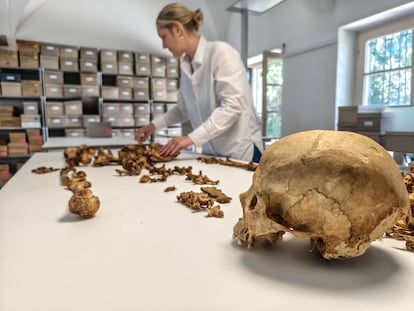
In the cemetery of Altheim, in what is now the district of Landshut in Lower Bavaria, researchers recovered bodies dating from the very year of the empire’s fall up to 620 AD. They observed how this mixing increased over time. In the end, more than three-quarters of those buried there had northern European ancestry (34%), but there were also significant proportions of lineage from central Italy (16%), the southeastern Roman territories — especially the Balkans (20%) — and even northern Britain (9%).
Everything suggests that the fall of the Roman Empire shattered the social structure from within, rather than being caused by barbarian invasions. As soon as Roman power disintegrated, the Franks filled the vacuum in southern Germania, where the study is focused. However, the authors found no genetic trace of their dominance. In fact, their results challenge the image of waves of barbarian invaders bringing down the Roman frontier.
“People from the northern regions had already migrated south in small groups long before the fall of the Western Roman Empire and had gradually adopted Roman customs,” says Jens Blöcher, a population geneticist also at Johannes Gutenberg University and one of the study’s two first authors, in a statement. The northerners appear to have lived separately from the rest of the population, probably as agricultural workers, and tended to marry within their own groups, thus preserving the genetic traces of their ancestors.
The study’s other lead author, Leonardo Vallini, from the same university, adds that Roman administrative practices may have contributed to this separation. “Land was often allocated to newly arrived groups under specific conditions, including restrictions on marriage, to manage integration and maintain control,” he says. After 476 AD, this legal and social framework collapsed.
Life expectancy of 40 years
The study has also revealed a great deal of demographic information about the early Middle Ages. Infant mortality was high, but lower than it would become in later centuries. More boys died than girls — about 10 compared to eight before reaching the age of seven. However, among adults, the ratio is reversed, likely due to the risks associated with childbirth, the authors note. On average, men had a life expectancy of 43.3 years, compared to 39.8 for women. Today, women typically have a higher life expectancy.
Using genetics, researchers were able to reconstruct family relationships. According to Burger, the rapid formation of families in both groups suggests a shared cultural framework. Long before the political end of the Roman Empire, both groups were already culturally connected through life within the imperial system. The arrival of Christianity may have played a role in this shared understanding.
Burger explains: “The family structure we find in southern medieval Germany closely reflects that of late Roman antiquity. Since this was a fully Christian era, this pattern is essentially Christian.”
Sign up for our weekly newsletter to get more English-language news coverage from EL PAÍS USA Edition









































