
Rome visit by Indigenous leaders ignites a storm in the leather industry
Ayoreo leaders from the Paraguayan Gran Chaco travel to Italy to raise the alarm over the leather used in luxury cars
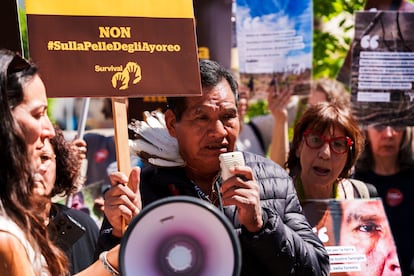
Rome received an unprecedented visit this week that has triggered an unexpected butterfly effect across the Atlantic. Two Ayoreo Indigenous leaders traveled from the Gran Chaco — their forest, and the second‑largest in South America — to denounce before the Italian government, Parliament, and the Vatican that it is being illegally cleared with bulldozers. And that their people, who live inside this Paraguayan forest, are being displaced. All for a reason they find utterly absurd: producing leather for luxury car brands.
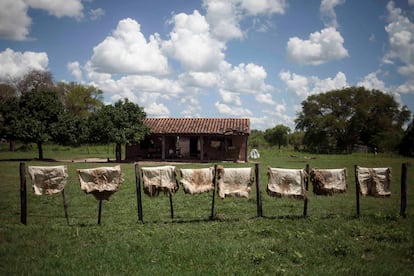
For years, cattle ranchers have been destroying their ancient, untouched forest — the home of their relatives living in voluntary isolation — to produce leather. That leather has then been exported mostly to Italian companies, which in turn have transformed it into the belts, steering wheels, and seats of luxury cars made by BMW, Porsche, and Land Rover, the Ayoreo say, presenting documented evidence pinpointing the exact locations where the illegal clearing is taking place.
As the Indigenous leaders Porai Picanerai and Rosalino Darajidi Picanerai met with Vatican officials, representatives of Italy’s Ministry of Foreign Affairs, and the Human Rights Committee of the Chamber of Deputies, the unexpected impact of their trip was already erupting back in Paraguay.
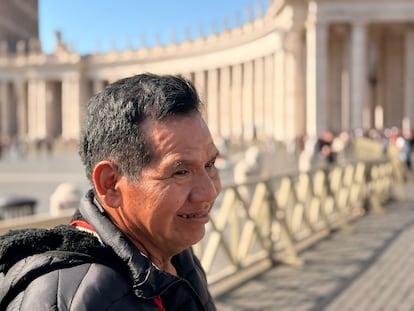
“We came to defend our people who are in the community, in the territory. We need help from any country willing to support us in defending our right to have land,” the leaders said upon arriving in Italy, where they stayed from Monday, April 20, to Friday, April 24. A photo of the two of them in St. Peter’s Square made it into the main Paraguayan news sites alongside their account of what is happening. A small butterfly’s wingbeat that unleashed a major backlash from the Paraguayan government.
Porai Picanerai once lived in the forest with his family, where they wove their own clothes and shaped their own clay pots. They hunted wild boar, roasted turtles, and planted squash. They walked hundreds of miles each month. Sometimes, in search of salt or a freshwater lagoon, they crossed the border between Paraguay and Bolivia without even realizing it. But in 1986, Catholic and evangelical missionaries entered the forest and forcibly removed him and his entire family. The abduction was so violent that four people died in the struggle. After that, the forest began to be cleared.
As a community leader, Porai has been denouncing the situation and attending meetings with the government, Congress, and other institutions for three decades, but this is the first time he has done so in a foreign country. It was a major journey for him — one that might have gone unnoticed were it not for the fierce response that followed.
First, the Paraguayan embassy in Rome refused to receive them; second, the Paraguayan Leather Chamber contacted major local media outlets to attack the Indigenous leaders and the organizations providing them with technical and legal support — denying everything and disparaging their Indigenous compatriots, whom they accused of lying.
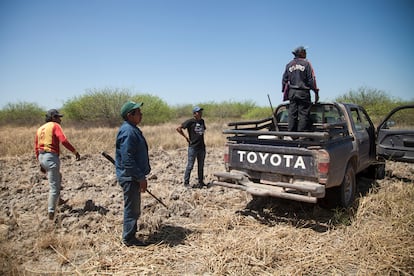
Third, even though the clearing of Ayoreo Totobiegosode territory violates the law and a precautionary measure issued by the Inter-American Commission on Human Rights, the government devoted its time to defending the companies, overlooking the negligence of the Ministry of the Environment and Paraguay’s Forestry Institute, which has granted permits on Ayoreo land, as documented by Paraguayan organizations such as the Amotocodie Initiative.
The political and legal struggle of this Indigenous people — around 7,000 individuals between Paraguay and Bolivia — has succeeded in preserving hundreds of thousands of hectares of forest in recent decades. But their leaders, lawyers, and dozens of national and international organizations say that the illegal invasion by cattle ranchers continues with impunity due to the rampant corruption of local authorities.
Where does the leather in luxury cars come from?
The link between the leather used in the automotive industry and the illegal destruction of Ayoreo forest was established in 2021 in an investigation by the NGO Earthsight and later submitted as a formal complaint to the OECD by the U.K.‑based organization Survival. In two reports, Grand Theft Chaco I and Grand Theft Chaco II, Earthsight revealed that nearly two‑thirds of the hides exported from Paraguay end up in Italian companies, chiefly the Italian tannery Pasubio, whose annual revenue of €313 million ($365 million) depends 90% on the automotive sector.
Following the complaints, in 2023, Pasubio — one of the leading companies in its field — announced that it would refrain from purchasing leather from suppliers “unable to provide appropriate guarantees regarding the absence of any relationship, direct or indirect, with the cattle ranches located within the [Ayoreo territory].”
The Picanerai brothers’ visit to Italy also comes at a particularly sensitive moment. Before the end of April, the European Commission will review the EU Deforestation Regulation (EUDR), a rule that requires thorough monitoring of raw materials linked to deforestation risk throughout the entire supply chain. In this context, the Italian leather industry has intensified its efforts to have leather removed from the list of products subject to these requirements.
“It’s a shame what’s happening; it’s a total distortion of the reality we live here in Paraguay. These NGOs spend their time writing articles as if they know the Paraguayan Chaco, the way things are done in Paraguay,” said Marco Riquelme, Paraguay’s minister of industry and commerce, on a local radio station.
The Paraguayan government and the Paraguayan Leather Chamber argue that a traceability system does exist, though they acknowledge it is relatively new. The cattle‑ranching lobby says they have recently launched the RETSA system, a socio‑environmental traceability network through which ranches will be able to link their operations in the future.
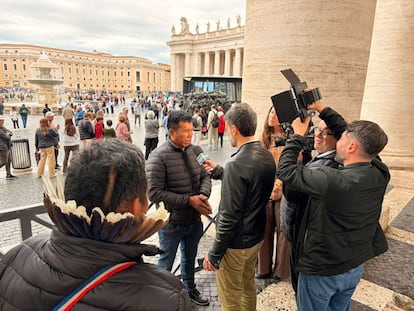
“What we are asking of Italy is that they ensure the leather they buy from Paraguay is not linked to the deforestation of Ayoreo territory,” Teresa Mayo, a researcher with the NGO Survival International, told EL PAÍS. “Currently, there is no reliable system in the country for tracking cattle by geolocation, from their origin to the slaughterhouse, nor then to their export destinations. This means that buyers of local leather and beef cannot be sure whether their leather is free from deforestation and the suffering of the Ayoreo people.”
According to Mayo, her organization’s demand “is not against leather, it is against the blatant deforestation of the Chaco, of Indigenous territories, of their Indigenous forest, on which they and their relatives in isolation depend to survive.”
Approximately 2.5% of Paraguay’s population owns 85% of the country’s arable land, and in the Chaco region, this inequality is even more pronounced. Most of these large landowners in Paraguay are officials and military personnel from South America’s longest-running dictatorship, that of Alfredo Stroessner (1954-1989), who during that period seized and divided up between 8 and 22 million hectares (three times the size of Panama) that belonged to Indigenous peoples, peasant cooperatives, and political opponents.
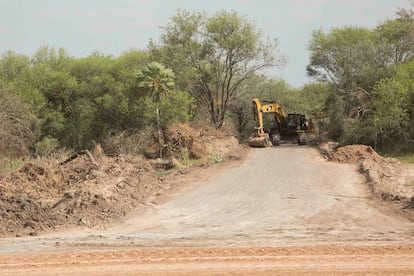
Between 2022 and 2025, six companies have been recorded deforesting in Ayoreo territory in Paraguay, according to monitoring by the Paraguayan organization Amotocodie Initiative. A total of 4,948 hectares — the size of cities like Cambridge or Bilbao.
All of these areas were invaded and deforested within the Ayoreo Totobiegosode Natural and Cultural Heritage, one of the last green lungs remaining in Paraguay.
Sign up for our weekly newsletter to get more English-language news coverage from EL PAÍS USA Edition









































