
Colombians stranded in Congo after being expelled from the US: ‘I never thought I would get to know Africa under these circumstances’
A group of 15 Latin Americans has arrived in the Central African nation, which for the first time is receiving migrants from third countries sent by the Trump Administration
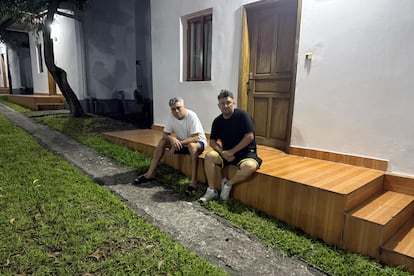

Jorge Cubillos, a 42-year-old Colombian, could not believe what the Immigration and Customs Enforcement (ICE) agents were telling him. After being detained for more than three months by U.S. immigration authorities on a deportation order, the agents had just told him what the outcome would be: a flight to the Democratic Republic of Congo (DRC), a Central African nation that has made a deal with the Trump Administration to temporarily receive migrants from third countries expelled by Washington. “Those months of confinement teach you to be strong, but at that moment I broke down. I thought about my children and started to pray. We were being taken in chains to a country we don’t know, on the other side of the world. I never thought I would get to know Africa under these circumstances,” Cubillos says by phone from Kinshasa, the Congolese capital, which, since Friday, has become his makeshift home.
Cubillos is one of 15 Latin Americans deported to the DRC, in the first group of migrants expelled by Trump to this country of more than 115 million inhabitants. Kinshasa announced on April 5 that it would begin receiving groups of deportees this month and would host them temporarily, in a campaign fully funded by Washington. It is the latest African country to reach similar agreements with the White House, following Ghana, Cameroon, Equatorial Guinea, South Sudan and Eswatini. The U.S. Congress estimated a few months ago that the Administration had spent up to $40 million on these agreements, an average of more than $130,000 per deportee.
These costly agreements with third countries have been the Trump Administration’s immediate solution for deporting migrants who, for their own protection, cannot return to their places of origin. This was the case of Cubillos, who is from Bogotá. This truck driver worked for many years on Colombia’s southern border and received threats from armed groups operating in the area. When he arrived in the U.S. in 2018, he tried to apply for asylum. Due to the expiration of the legal time limits, the judge granted him a suspension of deportation. This guarantee only prevented his return to Colombia, but not his deportation to another nation willing to receive him.

“I was arrested in Orlando, Florida, and held in a federal jail. Twenty days later, they took me to Jacksonville, to an ICE detention center. They didn’t explain why I was being detained, only that I had a deportation order. The agents started pressuring me to go to a third country like Mexico, but the situation there is also complicated with drug trafficking. That’s why I filed a writ of habeas corpus,” Cubillos says. This legal instrument allows detained migrants to challenge their detention before a judge. In theory, they cannot be deported until the case is resolved.
The Colombian man maintains that his application was still within the deadline, but that didn’t stop ICE’s plans. “From Jacksonville they took me to Louisiana. There they told me they were going to give me the yellow fever vaccine because they were going to send me to Angola, but I assumed it was just pressure and a mind game. Until the 13th [of April] they took me out and put me in some cells at the Alexandria airport, and that’s when I found out they were going to send me to the Congo.”
Carlos Rodelo, a 43-year-old from Barranquilla, suffered a similar fate. He fled Colombia after being extorted on several occasions. He entered the U.S. through the border with Mexico and requested asylum. A judge eventually granted him CAT protection (under the UN Convention Against Torture), which only allows relocation to a safe third country in the event of deportation. Rodelo was detained last August and he also filed a writ of habeas corpus. “They held me for several hours in a cell at the Alexandria airport in a small room. I was shackled and hadn’t eaten anything. At one point, 10 ICE agents came in and told me, ‘Go.’ I explained that I couldn’t return to Colombia, and they replied that I was going to Congo and that I shouldn’t waste their time.”

He boarded the plane that would take him to the DRC. It would first stop in Dakar (Senegal) and Accra (Ghana). “I couldn’t believe what was happening. My head was still spinning, and I prayed to God for strength. I felt so helpless because we were tied up. They gave us a small bag with a sandwich and water. We couldn’t lift our heads. They treated us like slaves. It’s something I wouldn’t wish on anyone,” Rodelo recounts. Traveling with him and Cubillos were other Colombian, Peruvian, and Ecuadorian citizens.
Colombian President Gustavo Petro reacted to the news on Saturday. “This is what you call ostracism… The Foreign Minister has orders to bring these Colombians back from Congo immediately and without chains,” he stated in a message on X. The deportees are hopeful that their respective governments will be able to repatriate them. Although both Cubillos and Rodelo maintain that returning to the country they fled under threat was not part of their original plan, they believe it is now their best option given the circumstances. “They can help us there. What happened to me was eight years ago, so I hope to feel safer in Colombia and be able to start over. In the United States, nobody cares about what happens to us. Not a single official has come forward to defend us.”
The deported South Americans have been staying at a hotel in Kinshasa since Friday and have received support from the International Organization for Migration (IOM), a UN agency, including food and medical care. The Colombians interviewed for this story said that a Congolese official told them the government would process temporary visas for them and that they might even issue longer permits if any of them planned to stay. Both of them—and they believe the others as well—want to return to their home countries as soon as possible.
Sign up for our weekly newsletter to get more English-language news coverage from EL PAÍS USA Edition









































