
Markwayne Mullin’s first steps as Secretary of Homeland Security: Improving public image, but maintaining deportations
Stephen Miller’s continued presence in the White House suggests that the change in leadership at the DHS will not bring about significant changes in the campaign against immigration
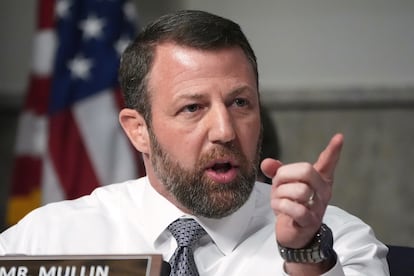

On March 23, Republican Senator Markwayne Mullin of Oklahoma was confirmed as the new Secretary of the Department of Homeland Security (DHS). He inherited the difficult task of improving the public image of a department whose reputation has plummeted due to the tactics it has employed to implement Donald Trump’s anti-immigration crusade.
From the outset, Mullin sought to distance himself from the practices of his predecessor, Kristi Noem, a champion of the hardline stance against immigrants who was prone to making controversial statements — such as defending the federal agents who fatally shot U.S. citizens Renee Good and Alex Pretti — which sparked outrage even among colleagues in her own party. “My goal in six months is that we‘re not in the lead story every single day,” Mullin said during his confirmation hearing. “My goal is for people to understand we’re out there. We’re protecting them, and we’re working with them.”
The image change started with his own attire. Since taking office, Mullin has stuck to a suit and tie instead of the bulletproof vest emblazoned with the ICE emblem that his predecessor favored. It remains to be seen whether the change is merely a matter of image or if, under his leadership, the changes at DHS will result in a more humane immigration policy than the one implemented since Trump returned to the White House.
“The reality is that this administration’s agenda remains unchanged: to deport millions of people and to frighten millions more into hiding and ultimately leaving the country they call home; they have not backed down on that agenda,” says Naureen Shah, director of government affairs at the American Civil Liberties Union (ACLU).
In his first days at the helm of DHS, Mullin reversed some of the policies implemented by Noem that contributed to her discrediting. The former senator has halted the purchase of warehouses to convert them into Immigration and Customs Enforcement (ICE) detention centers, declared that federal agents will need a court order to enter homes — not just an administrative warrant as Noem decreed — and eliminated the requirement to authorize every minor decision made within the department. The essential objective, however — to carry out the largest deportation in history — remains unchanged.
“He is expected to carry out the administration’s hardline border and immigration agenda in a more discreet, less ostentatious, and less controversial manner,” noted Adam Isacson, the Washington Office on Latin America (WOLA)’s director of defense oversight, in a recent article. Evidence that the ultimate goal hasn’t changed is that Trump has retained the two architects of his immigration agenda, Stephen Miller and Tom Homan. “With Mullin adopting a lower profile and a more managerial role, Miller and Homan — both hardliners on immigration — are in more firm control than before,” Isacson predicts.
Miller, White House deputy chief of staff and national security advisor, continues to chair regular meetings with Homeland Security and Immigration officials. He is considered one of the most influential presidential advisors in recent history and openly advocates for the deportation of all undocumented immigrants, despite Trump’s rhetoric — contradicted by reality — that the focus is on criminals.
“Regardless of who holds the position of DHS secretary, Miller is, in reality, the one who determines what happens at ICE and the Border Patrol, and his agenda remains unchanged. He aims to deport as many people as possible and, in the process, instill fear in the rest; and that is precisely why we continue to see these reports of brutality,” Shah maintains.
Arrests continue
Although ICE raids on the streets have decreased, cases of illegal detentions and excessive use of force continue to make headlines. Carlos Iván Mendoza Hernández, a 36-year-old Salvadoran man, is hospitalized after being shot by ICE agents on April 7 in Patterson, California. Authorities claim he is a member of a criminal gang, but his family has denied this. Brian Morales, a U.S. citizen born in Denver, was detained in Texas on his way to work and deported to Mexico, even though he informed the agents of his nationality. From Mexico, Morales told Univisión that Border Patrol agents threatened him if he did not sign his self-deportation. And in less than 10 days, the government has had to return two DACA recipients — the program that protects those who entered the country illegally as children from deportation — to the United States after they were illegally expelled by ICE agents.
Nor have arrests at immigration courts ceased. On April 6, Nelson Ramón Espinoza Sierra was detained along with his wife and two young children as he attended his routine asylum hearing in Charlotte, North Carolina, as they have done for the past four years. Within hours, they were deported without being given the opportunity to contact a lawyer or have their case reviewed by a judge.
However, despite doubts about their purpose or duration, some of Mullin’s measures have been well received, such as blocking DHS acquisitions of warehouses to convert into ICE detention centers. With the goal of doubling available beds, the agency has a budget of $38.3 billion, allocated in Trump’s tax reform passed last summer. ICE has already spent nearly $1 billion purchasing 11 warehouses nationwide, but has had to abandon other acquisitions due to opposition, often based on moral grounds.
The conditions at the detention centers — where detainees report inhumane treatment, including spoiled food, inadequate facilities, and lack of access to medical care — have turned public opinion against them. With the death of 49-year-old Mexican citizen Alejandro Cabrera Clemente at the Winn Correctional Center in Winnfield, Louisiana, on April 11, the number of people who have died in ICE custody since Trump launched his anti-immigration campaign has reached 47. Furthermore, several local leaders, both Democrats and Republicans, have opposed the establishment of ICE centers in their communities, arguing that the infrastructure is insufficient and will drain public resources to the detriment of residents.
Another policy implemented by Noem that Mullin has eliminated is the requirement that all projects exceeding $100,000 required her authorization. Under the former secretary’s administration, this requirement was blamed for creating a bottleneck in the allocation of funds during several natural disasters last year. With the new regulations, only contracts exceeding $25 million will require the secretary’s approval.
Noem’s management of DHS also generated discontent within the department itself. According to The New York Times, several officials interviewed believe that Mullin will grant agency heads, such as those at ICE and Customs and Border Protection (CBP), greater autonomy in making key decisions. This would represent a dramatic shift from the Noem era, when officials in her inner circle — most notably Corey Lewandowski — wielded considerable influence. It would also put an end to the internal problems stemming from the power given to Gregory Bovino, a mid-level official who, tasked with leading mass operations against migrants in Los Angeles, Chicago, Charlotte, New Orleans, and Minneapolis, reported directly to Noem, bypassing his immediate superiors. Bovino, a proponent of the most aggressive tactics in arrests, was removed from his post following the protests that erupted after the deaths of Good and Pretti in January.
If implemented, the requirement to obtain a warrant to enter homes and arrest people will eliminate another of Noem’s most controversial measures, but skepticism remains. “We’re not getting our hopes up. And I don’t think people should let their guard down,” Shah says. “Unfortunately, I don’t think we can think, ‘Okay, the worst is over, and now, under Secretary Mullin, things are going to get better.’”
Sign up for our weekly newsletter to get more English-language news coverage from EL PAÍS USA Edition









































