
Department of Homeland Security reconsiders plans to convert warehouses into ICE detention centers
The government has paused the purchase of new facilities, while Democratic senators investigate alleged corruption
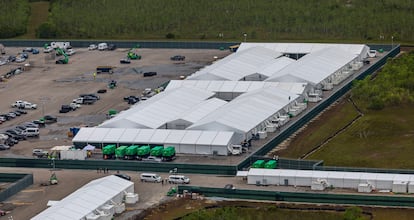

The Department of Homeland Security (DHS) has recently paused the purchase of warehouses intended to be converted into detention centers for Immigration and Customs Enforcement (ICE), according to senior officials who spoke to U.S. media on condition of anonymity. The acquisition plan had been designed while the department was led by former DHS secretary Kristi Noem, and its goal was to double the number of beds available for detainees as part of the Trump administration’s deportation campaign.
In January 2025, when Trump took office, there were roughly 40,000 migrants in detention. Now, the figure exceeds 70,000 — an all‑time record. The plan to continue increasing arrests is unworkable without additional space to hold people. The halt to the acquisitions is one of the department’s first measures since Markwayne Mullin took over from Noem. “As with any transition, we are reviewing agency policies and proposals,” the department said.
In addition to pausing the planned purchases — first reported by NBC — some of the acquisitions already completed will also be reviewed, according to department sources. After a judge halted construction of a facility in Williamsport, Maryland, the Department of Homeland Security will reconsider the project and is expected to carry out an environmental impact study before continuing the work, as reported by the local outlet The Baltimore Banner. Federal district judge Brendan Hurson suspended the project last month at the request of the state of Maryland and has set an April 17 deadline for both sides to present their arguments.
Mullin inherited a $38.3 billion budget earmarked for increasing detention capacity to 92,000 beds through the acquisition of eight large-scale detention centers — each capable of holding between 7,000 and 10,000 detainees — and 16 smaller regional processing centers. To date, the government has purchased 11 warehouses in Arizona, Georgia, Maryland, Michigan, New Jersey, Pennsylvania, Texas, and Utah, with a combined federal expenditure of $1 billion.
Opposition
The plan to convert warehouses into detention centers was highly controversial from the outset. In addition to some owners refusing to sell their facilities to ICE, the plans have faced opposition from local communities and authorities, forcing the administration to reassess the projects. At least eight purchases have been thwarted by social and political backlash. In some cases, the objections are moral: citizens oppose the inhumane conditions in which migrants are held — crowded into small spaces, fed spoiled food, and denied adequate medical care. Concerns grow even stronger when one considers that the warehouses slated for redesign were built to store goods, not to house people.
In other cases, the concern is that the facilities would be inadequate to house detainees and would drain local resources to the detriment of residents, who have pushed back against the administration’s plans. That was the case in the town of Social Circle, Georgia. Even though residents there voted overwhelmingly for Trump, the plan to convert a warehouse into an ICE facility has met strong opposition. The mayor, Eric Taylor, even cut off the warehouse’s water supply to block the project. The Social Circle site is one of the megacenters that was expected to hold up to 10,000 detainees.
DHS is also reassessing the capacity of some centers. That has been the case in Surprise, Arizona, where a warehouse was slated to be converted into a 1,500‑bed processing center. Mayor Kevin Sartor announced last week that DHS now plans to scale it down to 542 beds.
A lucrative business
The mass‑detention campaign pushed by the Trump Administration has created a lucrative business for the companies that run ICE facilities, chiefly CoreCivic and the GEO Group. Several Democratic senators have launched an investigation to determine whether government contractors, real‑estate agents, and property owners are profiting through corruption in the process of converting warehouses into migrant detention centers.
Maryland Representative Jamie Raskin, the ranking member of the House Judiciary Committee, and Massachusetts Senator Elizabeth Warren — backed by 52 members of Congress — sent a letter to six companies urging them to explain how much they expect to earn from these new detention warehouses and what steps they have taken to secure these lucrative government contracts, among other details.
“These warehouses were built to hold products, not people […] Given the public’s grave concerns about this warehouse system, we request prompt answers to questions about your involvement in the system,” the lawmakers wrote.
Lawmakers say ICE is using a Navy contracting program — diverting Defense Department resources — to bypass the competitive bidding process and avoid disclosing contractual details that would normally be made public. As an example, they note that ICE paid $129 million for the Social Circle warehouse, a sum nearly five times the property’s appraised value just a year earlier. Details of some of these transactions have been kept secret, including through the use of nondisclosure agreements.
They also point to the close ties some senior Trump Administration officials maintain with contractors. One example is David Venturella, who currently heads the ICE division responsible for overseeing detention contracts — a position he assumed after leaving the GEO Group, one of the main operators of detention centers. The lawmakers also cite former attorney general Pam Bondi’s past work as a lobbyist for GEO, as well as reports suggesting that Tom Homan, the border czar, and Corey Lewandowski, a former adviser to Donald Trump and DHS, allegedly helped secure contracts for personal financial gain.
The legislators asked contractors and real‑estate firms to provide, no later than April 13, clear information on the following: their involvement in the warehouse expansion, the profit margins they expect to obtain from the project, whether they have made donations to Trump’s campaign or to members of his cabinet, and whether they commit to ensuring that their work is not used to facilitate inhumane conditions in these detention centers.
In an emailed statement to EL PAÍS, Ryan Gustin, director of public relations at CoreCivic, one of the companies to which the letter was sent, said that “CoreCivic is not involved in any of the efforts mentioned in the letter.”
Sign up for our weekly newsletter to get more English-language news coverage from EL PAÍS USA Edition









































