
Trump’s ‘historic’ deportation campaign spreads fear on the streets, but the president wants more
Abuses in detention, contentious executive orders, and court disputes have marked the immigration policy of the Republican’s second administration


Donald Trump is not satisfied with the results of the immigration crackdown he launched as soon as he moved into the White House after winning the election a year ago. The raids by Immigration and Customs Enforcement (ICE) “haven’t gone far enough,” he said in a recent interview on CBS’s 60 Minutes, where he defended ICE agents’ aggressive tactics, which have sparked protests across the country. The Trump administration claims to have deported more than 400,000 people since taking office — a high number, but still short of the one million deportations the Republican had promised, and harder to achieve than he expected.
Trump had already made it clear on the campaign trail: if he won, he would carry out the largest deportation effort in history. In his first 100 days, the Republican approved 175 immigration-related measures. Most of those actions were aimed at increasing deportations, but they also shut down borders and weakened asylum and refugee programs. The government has turned documented residents into undocumented ones, expelled workers who had committed no crime, separated families, and even detained U.S. citizens.
“He has been far more aggressive than anyone expected, more brutal,” says Matt Barreto, a professor of political science at the University of California, Los Angeles (UCLA). “He has acted with virtually no regard for the law, violating people’s rights and receiving almost weekly warnings from the courts, including from judges he himself appointed, that his actions are illegal.”
Many of his actions are being challenged in the courts, and after his first 10 months in office, it is almost impossible to keep track of all the rulings issued by district judges and appellate courts. Some of those cases have reached the Supreme Court, which — with its conservative majority — has upheld several of Trump’s initiatives, such as allowing the use of racial profiling (whether based on appearance or place of work) to justify an arrest.
The president’s determination to achieve deportations on a historic scale has led him to allocate an enormous sum — $170 billion — for immigration enforcement as part of his “big, beautiful” tax reform, approved in July. The funds will go toward expanding the raids that have multiplied across the country, as well as increasing detention capacity through the construction of new immigration centers.
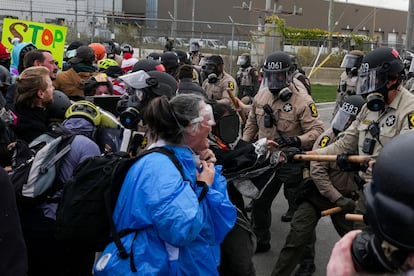
“One of the biggest changes under the Trump administration has been the shift of immigration enforcement into the interior of the United States,” notes Kathleen Bush-Joseph, an analyst at the Migration Policy Institute (MPI). ”Under the previous administration, the primary goal was to reduce the number of arrivals at the border.”
As early as January, Trump shut down entry points, and Customs and Border Patrol (CBP) recorded just 279 daily apprehensions in September — a 95% drop compared to the daily average during Joe Biden’s presidency, according to official data. By deploying immigration agents inland, Trump has effectively opened the door to a full-scale hunt for migrants.
During the previous administration, the priority was detaining undocumented immigrants who had committed crimes. Trump also vowed to focus on deporting criminals — “the worst of the worst” — but in practice, being undocumented has become synonymous with being a criminal. Only 35% of those detained by ICE have criminal records, compared to 65% in October 2024.
The numbers may not satisfy the president, but they are at record highs. When Trump returned to the White House in January 2025, there were 39,000 detainees in ICE custody. By the end of August, that number had risen to 61,000 and could reach 107,000 by January 2026, according to MPI data. The September average — the most recent month available — stood at 1,178 arrests per day, still below the 3,000 daily target set by Stephen Miller, the White House architect of immigration policy.
The surge in ICE raids has spread fear throughout migrant communities, which have seen once-sensitive locations — churches, schools, and hospitals — lose their protected status. Videos showing agents arresting parents as they drop their children off at school have gone viral, sparking panic among students.
One of the most heavily targeted places is immigration courts. Officials take advantage of migrants’ scheduled check-ins — meant to comply with government requirements — to detain them, turning what should be a routine appointment into a trap.
Targeting Democratic cities
Cities governed by Democrats have been the target of the largest anti-immigration operations. Trump has sent National Guard troops to reinforce what he claims is a crime crisis caused by undocumented immigrants in Los Angeles, Washington, D.C., and Memphis.
In Chicago, citizens staged a mass protests against Operation Midway Blitz, an aggressive ICE operation in which Blackhawk helicopters were used for arrests. Federal agents fired pepper bullets and tear gas at demonstrators who had gathered outside the Broadview detention center, in a predominantly Black and Latino suburb, to protest the treatment of detainees.
In detention centers like Broadview, children, pregnant women, abuse victims, and migrants with no criminal record are crammed together. Detainees and the organizations that defend them denounce unsanitary conditions, malnutrition, and the lack of access to medicine and medical care. Many sleep on the floor, with barely any warm clothing, under bright lights that remain on through the night, making rest impossible. They are also denied communication with their lawyers or families, according to the complaints.
The poor conditions in which detainees are held have been cited as a possible reason why, during fiscal year 2025, 23 people have died in ICE custody — the highest number in 20 years. Several family members reported that the deceased had no known illnesses at the time of their arrest.
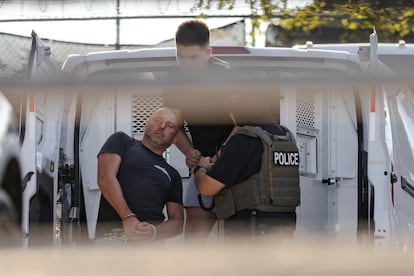
ICE detention centers can no longer keep up with the number of detainees, leading to the reopening of closed prisons and the construction of new ones — such as the controversial Alligator Alcatraz facility in Florida, which faces lawsuits for holding inmates in inhumane conditions and for having been built without environmental studies in a protected wetland area. Despite the criticism, the administration plans to create more such centers, allocating $45 billion for the effort.
The lack of space to handle the surge in arrests has led the government to turn to the two largest private prison companies, CoreCivic and GEO Group — both major donors to Trump’s presidential campaign — to manage facilities for housing detainees.
Detention is now the standard prelude to deportation. Once detained, migrants are increasingly unlikely to be released. The percentage of people freed on bail, parole, or supervision fell from 26% in October 2024 to just 3% in September 2025, according to MPI data. In fact, 90% of those detained by ICE in September 2025 were deported directly from detention centers, compared with 63% a year earlier.
No protection from deportation
Migrant rights organizations denounce that expulsions are being carried out without granting detainees due process. Back in March, Trump invoked the Alien Enemies Act of 1889 to deport more than 200 migrants to El Salvador without trial, accusing them of belonging to the Latin American criminal gangs Tren de Aragua and MS-13.
No evidence was ever presented, and many of those deported — who were imprisoned in the notorious Terrorist Confinement Center (CECOT) — had no criminal record. Some, such as the now well-known Kilmar Abrego García, a Salvadoran who is fighting a legal battle against the government and has become a symbol of unjust deportations, even had court orders protecting them from removal.
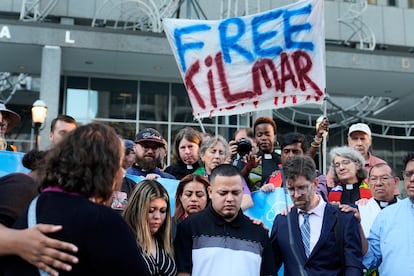
“This has become a matter of democracy. [Trump] is using his immigration policies to undermine democracy in the United States, defying court orders and ignoring laws passed by Congress,” argues Barreto.
What’s more, to broaden the spectrum of those who can be deported, the government has eliminated legislation granting legal permanent resident status and work permits to millions of people. Among other actions, it has canceled programs like humanitarian parole and Temporary Protected Status (TPS), which were created to shelter citizens fleeing their countries due to armed conflicts, natural disasters, poverty, and political crises. Hundreds of thousands of Nicaraguans, Haitians, Cubans, and Venezuelans have suddenly lost protection from deportation.
For those who cannot be returned to their home countries because the latter refuse to accept them, the administration — with the Supreme Court’s approval — is sending them to third countries such as Rwanda, South Sudan, and Eswatini, where human rights are not respected and governments offer no guarantees about the fate of deportees.
The aggressiveness of the immigration policy that has marked Trump’s first 10 months in office has completely transformed the lives of millions of migrants, as well as those of U.S. citizens. “The Trump administration’s immigration enforcement policy is affecting the rights of Americans, as we’ve seen with the detentions, but it has also changed their way of life: now they carry identification documents for fear of being arrested or detained,” says Bush-Joseph. “That wasn’t what people expected.”
Sign up for our weekly newsletter to get more English-language news coverage from EL PAÍS USA Edition









































