
The Florida of Alligator Alcatraz: The state with the most deaths in ICE custody so far this year
In the past six months, 11 people have died in facilities operated by the federal agency, with five of those deaths occurring in the region — where a new prison has opened in the Everglades
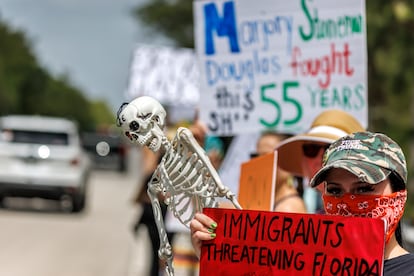

So far this year, 11 immigrants have died in detention centers managed by the U.S. Immigration and Customs Enforcement (ICE). Nearly half of those deaths — five — have occurred in Florida, where this Tuesday a new immigrant detention facility began operating in the middle of the Everglades wetlands.
U.S. President Donald Trump attended the opening of the new center, nicknamed “Alligator Alcatraz,” which he described as “beautiful.” The comment comes amid growing criticism over conditions inside ICE facilities, particularly those in Florida.
The most recent victim in Florida was Isidro Pérez, who died on June 26 following three weeks of detention at the Krome facility in Miami. Pérez was Cuban, 75 years old, and had arrived in the United States at age 16. “The cause of death is still under investigation,” the agency stated Sunday in a press release. According to ICE, Pérez was admitted to Krome’s Medical Care Unit on June 6, where he was diagnosed with “several medical issues,” and on Thursday the 26th at 7:00 p.m. he informed staff he was experiencing chest pains, was transferred to a hospital, where he died at 8:42 p.m.
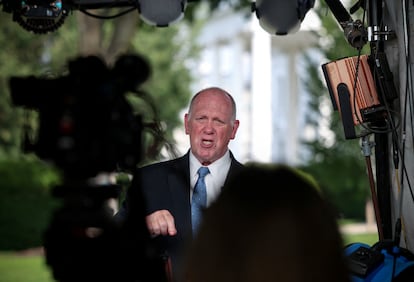
“People die in ICE custody, people die in county jail, people die in state prisons,” border czar Tom Homan responded when questioned by reporters Monday about Pérez’s death.
Homan — who at the time said he was unaware of the details surrounding the Cuban immigrant’s case — boasted about the detention conditions and health services detainees receive nationwide, which, according to him, exceed those of any federal or state detention facility: “We have the highest detention standards in the industry at a very expensive cost to the taxpayers.”
Three days before Pérez’s death, on June 23, Canadian Johnny Noviello was found dead in a federal prison in downtown Miami, which has been used as a migrant detention center since February. Noviello was 49 years old, had lived in Daytona Beach since he was 10, and had been a legal resident since 1991. In 2023, Noviello was convicted of selling opioids and was on probation when he was detained by ICE on May 15 of this year after voluntarily reporting to the Florida Department of Corrections in Daytona Beach.
Since then, he had been undergoing deportation proceedings. According to his family, Noviello had epilepsy and was receiving seizure medication. Like Pérez, the cause of his death has not yet been determined, and neither case has been included in the death records for the year published by ICE on its website, which to date, only listed deaths reported through early May.
Between January and April, three other people died in migrant detention centers in Florida. Marie Angie Blaise, a 44-year-old Haitian woman, died on April 25 at the Broward facility after reporting chest pains and receiving medication for hypertension. And at Krome, two immigrants died of “natural causes,” according to forensic reports.
Migrant advocacy organizations have denounced worsening detention conditions at ICE centers since the start of Trump’s second term and report that some of these facilities have exceeded capacity by as much as 17%. In Florida, these reports have been disputed by Republican legislator Carlos Giménez, who visited Krome last month and said he saw no overcrowding or deplorable sanitary conditions.
Giménez also gave a vote of confidence to future operations at Alligator Alcatraz, the new detention center built by Governor Ron DeSantis in the Everglades. “It will not be inhumane in any way,” he told Fox News. “It is in the middle of the Everglades, but it’s not the Everglades. It is an improved section of the Everglades that had a purpose a long time ago to be a runway […] I’m sure that the facilities will be just fine."
The Everglades cover about 4,000 square miles of wetlands, stretching from west Miami to the center of the Florida peninsula. There, on what was formerly the Dade-Collier Airport, this center will operate with a capacity of 5,000 beds, costing about $245 per day.
Before his visit to the Alligator Alcatraz, Trump joked about the skills immigrants will need to develop to escape the center without getting caught by an alligator. “We’re going to teach them how to run away from an alligator if they escape.” “Don’t run in a straight line. Run like this,” he said, making a zigzag gesture with his hand.
Sign up for our weekly newsletter to get more English-language news coverage from EL PAÍS USA Edition









































