
‘Alligator Alcatraz’: Florida builds immigration detention center in the Everglades
According to the State Attorney General, the facility will become operational in the first week of July and will accommodate up to 5,000 beds
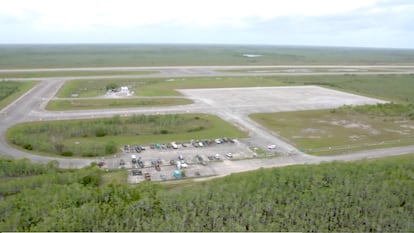
The Florida government has begun construction on a temporary immigrant detention center in the heart of the Everglades — the sprawling 39-square-mile wetland system west of Miami. Florida Attorney General James Uthmeier has dubbed the facility “Alligator Alcatraz.” The name may be an attempt to win the approval of U.S. President Donald Trump, who has previously expressed interest in reopening the notorious prison island and, during his first term, even suggested building a moat filled with alligators along the U.S.–Mexico border.
Florida’s Republican Governor Ron DeSantis and his attorney general have placed themselves at the forefront of President Trump’s national crackdown on immigrants. So far this year, hundreds of immigrant arrests have been made at workplaces, highways, and immigration courts in Florida, and the state has reached agreements with more than 200 local law enforcement agencies to collaborate with federal immigration agencies on complex operations.
Reports of overcrowding have drawn scrutiny to other, less colorfully named immigrant detention facilities in the region, such as the Broward Transitional Center in Broward County and the Krome Processing Center on Krome Avenue in southwest Miami-Dade, which have been accused of inhumane conditions.
“Alligator Alcatraz and other Florida facilities” will support President Trump’s mission “to fix our illegal immigration problem once and for all,” Uthmeier said in a statement.
The attorney general surprised many with last Thursday’s announcement of the new detention center via a video posted to his social media. Uthmeier said the governor had tasked him with identifying locations to build temporary detention centers for immigrants, and he had found the perfect one: an “old, virtually abandoned airport facility,” he says in the video while touring the site. “If people get out, there’s not much waiting for them other than alligators and pythons.”
The site in question is an old airport in the center of the peninsula, surrounded by Big Cypress National Preserve — an environmentally sensitive protected area sacred to local Indigenous peoples, particularly the Miccosukee and Seminole tribes.
The Dade-Collier Training and Transition Airport, located just north of the Tamiami Trail highway that runs east-west across the state, began construction in the late 1960s as part of a massive project ultimately scrapped after fierce opposition from local environmentalists. It is now used primarily for commercial pilot training and military exercises and is owned by Miami-Dade County, although county officials did not receive formal notice of the state’s plans until Saturday.
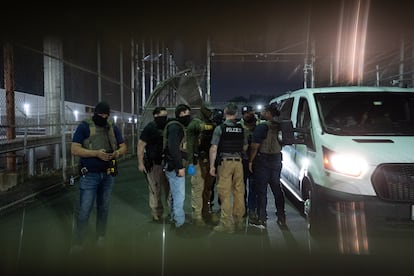
The notice reached the county in the form of an offer from Kevin Guthrie, director of Florida’s Division of Emergency Management, to purchase the property for $20 million, according to the communications director for Miami-Dade Mayor Daniella Levine Cava, a Democrat, speaking to EL PAÍS. The offer called for resolving what it described as an “emergency” in a “quick and efficient” manner.
Levine Cava responded on Monday requesting more information, raising concerns about the potential environmental impact — particularly to the drinking water supply — as well as the proposed price, which the county estimates at around $190 million, based on the most recent appraisal. “There hasn’t been enough time to fully discuss these matters,” the mayor wrote, questioning the “accelerated pace of the state’s efforts.”
It’s unclear how much negotiating power Levine Cava ultimately has, since construction has already begun. State agents from the Florida Fish and Wildlife Conservation Commission blocked access to the site this week to prevent entry to the media. Trucks carrying what appeared to be portable generators and toilets arrived at the location, according to the Miami Herald. Uthmeier’s spokesperson, Jeremy Redfern, confirmed on social media: “Florida is building Alligator Alcatraz.”
In a letter to the county on Monday night, the state indicated that “while the negotiations to purchase the property are underway,” it would begin “immediate utilization” of the facility, citing Governor DeSantis’s executive powers. “We must act swiftly,” the letter reads, to continue “statewide operations to assist the federal government with immigration enforcement.”
The total cost of the facility will be approximately $245 per bed per day, for a total of 5,000 beds — about $450 million per year, a Department of Homeland Security spokesperson told EL PAÍS. The expense will be covered by the state of Florida, which plans to file for reimbursement from the Federal Emergency Management Agency (FEMA) and DHS.
The facility is set to become operational within days, with between 500 and 1,000 beds, and plans to expand capacity to 5,000 by early July. Initially, the facilities will consist of temporary canvas structures, though there is a possibility permanent buildings could be constructed later.
Hundreds of people protested on Monday in defense of the Everglades, gathering at the site’s entrance and along the fence surrounding Dade-Collier Airport, holding signs that read: “Hands off our Everglades,” “No to Alligator Alcatraz,” and “Preserve Nature, No More Building.” One person held a sign reading “Stop the Deportations.” Environmental activists warn that the facility’s operation will affect the endangered Florida panther population and other local wildlife, as well as the broader ecosystem, due to the lack of proper sewage and potable water systems.
The Everglades are considered a masterpiece of nature’s engineering. The so-called “River of Grass” carries water from Lake Okeechobee in the northern part of the peninsula through marshes, mangroves, and swamps down to Florida Bay. In addition to hosting a rich biodiversity, the Everglades are vital to the region’s water supply. Much of the ecosystem has already been altered by urban development and agriculture, and restoration efforts have been ongoing for decades.
The ecosystem surrounding Dade-Collier Airport has been at the center of numerous disputes between authorities and environmental protection groups since its construction. The airport’s long 3,200-meter runway — comparable in size to those at Miami International Airport — has been a key draw for Uthmeier. “Big planes can land; we’ll process there, the National Guard will be on site,” he explained Monday in an interview with a Tampa podcaster, where he announced that the federal government had approved the plan for the facility.
Uthmeier confirmed that the facility would be ready to begin operations during the first week of July, rather than in one or two months as previously indicated, since a “light infrastructure” — such as “heavy-duty tent facilities” — would be sufficient to house detainees, with the inhospitable Everglades ecosystem itself serving in part as a natural barrier against escapes.
“We believe in the swamp down here in Florida. We’re swamp creatures,” said Uthmeier, who said the facility will house migrants detained “around the country and in Florida.” “We’ll prioritize criminal aliens,” he added. “There are 600,000 or so criminal aliens in this country that have already been convicted of other crimes, so there’s a lot of low-hanging fruit [...] but then we’ve got to enforce the rule of law across the board. If you are not legally in this country, you should not be here.”
Sign up for our weekly newsletter to get more English-language news coverage from EL PAÍS USA Edition









































