
Goya's last mystery is called Rosario Weiss
Sergio del Molino has published an acclaimed novel about the young artist raised and mentored by the Spanish genius. He walks EL PAÍS through Madrid’s Prado Museum as he recounts the story of her erased life
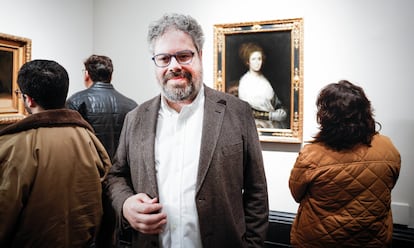

Goya’s monsters not only provoke unique sensations, national reflection, and inner turmoil in those who contemplate them, but they also inspire new and immensely valuable works about his life, his painting, his thought, and his legacy — works that continue to enrich Spain’s cultural heritage.
The Spanish genius did more than create masterpieces and portray both his own era and ours; he inspired a torrent of creations in film, painting, and literature. That wave now includes a new essential addition to the bookshelf: La hija (The Daughter), the latest book by EL PAÍS writer and columnist Sergio del Molino, who takes us through Madrid’s El Prado Museum in search of the seed, the spark, the origin of his obsession.
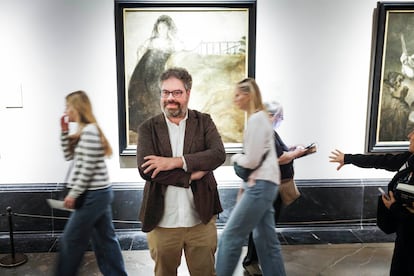
When asked how it all began, the author responds: “My earliest fascination starts here, with the Black Paintings. [...] For me, they are the center and the heart of the museum. These paintings were my way into Goya, and they were also my way into Spain.”
Del Molino stops in front of what is perhaps the most luminous portrait in this dark collection that survived the deterioration of Goya’s last house in Madrid, the Quinta del Sordo. It is a portrait of Leocadia Zorrilla, his last companion, who lived with him in that Madrid house and accompanied him into exile in Bordeaux. “Leocadia was a woman with a very unorthodox mindset for her time, but very easy to understand through today’s lens. Her relationship with freedom and with Goya is visible to anyone. I’ve only filled in a few gaps.” In the Prado’s wall text, she is still listed as his housekeeper.
But the focus of Del Molino’s book is not exactly Leocadia, the divorced woman whose husband ruined her financially, but rather one of her three children: Rosario Weiss. She grew up with Francisco de Goya, who acted not only as a father figure but also as her teacher. Unlike Goya’s surviving son, Javier, and his grandson, Mariano — who squandered the inheritance and even forged works — Rosario learned to paint and fought against being erased from history. Over time, she became an artist sought after by museums and collectors, though still not widely recognized by the general public.
Del Molino’s new book is grounded in historical truth, but from that foundation he builds, with imagination and the tools of fiction, a powerful biography of an artist who was both extraordinary and silenced by Goya’s family and the cultural establishment of the time. Along the way, he paints a portrait of 19th‑century Spain — its violence, reactionary forces, struggles for progress, and the birth of modern politics. He respects the limited historical record on Weiss, while adding bold narrative engineering to illuminate the girl who inherited Goya’s artistic sensibility but little else. Worse still, she was erased.
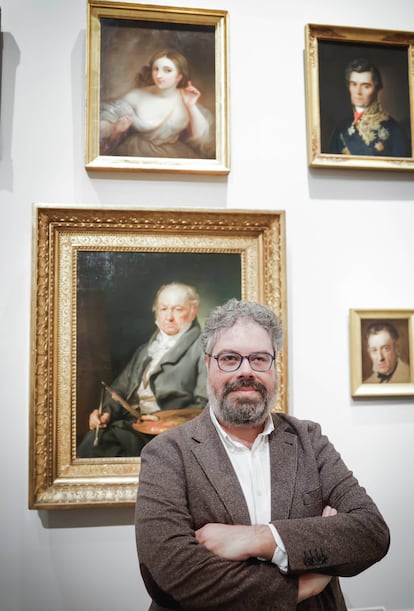
We walk toward the self‑portrait known as The Attention (1841), one of the few surviving works by Weiss, placed directly above the portrait of Goya painted by Vicente López in 1826. The two works encapsulate Weiss’s life: below is her father and teacher as he was when she was a child; above is her own image as a grown woman. This canvas by Weiss, charged with sensuality and eroticism, strikes Del Molino as entirely consistent with an artist who, in adulthood, was accused of being a whore, rumored to have syphilis, and said to have used her body to get ahead. “This is the portrait of a woman who cared very little about such accusations. She looks defiant, and I love that.”
Nearby hangs The Milkmaid of Bordeaux (1827), one of the paintings Goya created in Bordeaux during his final years, a year before his death there, and very likely executed in collaboration with the young apprentice. In fact — and to the misfortune of Leocadia Zorrilla and her daughter — it was practically the only inheritance they received.
“There’s an overwhelming amount written about Goya, but I only ever found Rosario Weiss mentioned as a footnote, and I’m sure she must have had a significant influence on him,” says Del Molino. “Whether she was his daughter or not, I tried to trace her presence and found that she remains a black hole in the mystery of Goya’s final years.”
His conviction is that — beyond what he taught her — she also taught him, influenced him, and mattered, and that “part of what unsettles and disturbs us about Goya’s later work are better illuminated by Rosario’s presence.”
“There has been much study of Beethoven and other artists who become darker at the end of their lives, where before they were clear and lucid. Goya has a tendency toward darkness, but in this period he recovers; there is a luminous moment, and I think it has to do with the fact that he is closely involved in Rosario’s apprenticeship, and that contributes greatly to his work.”
The image of those years obsessed Del Molino to such an extent that he shut himself away to read everything he could, trying to document himself and breathe the air of that period.
When asked if his book is a tribute to Goya or Rosario Weiss, Del Molino replies: “It’s out of love for both of them, because I see something very powerful in the conjunction between the old Goya and the young artist.”
But the burgeoning artist was erased in an instant when Goya’s grandson and daughter‑in‑law arrived in Bordeaux just days before the master’s death, took control of everything, and left Leocadia Zorrilla and her daughter practically out on the street, with no inheritance other than The Milkmaid of Bordeaux, the painting now hanging in the Prado.
Was Goya unfair to them? “I try to redeem him in the book. I think he wasn’t aware that he was abandoning them. I want to believe he died thinking he had settled things, but that wasn’t the case.”
Both women were left out in the cold, in exile, and cut of from Madrid’s artistic circles. “Then, on top of that, they sabotaged her. Goya’s son used all the power of Madrid’s patronage networks to sideline her, and it was going to be very difficult for her to reach the public.”
Weiss succeeded. She became a copyist at the Prado, worked at the Academy of San Fernando — where she was named an Academician of Merit in 1840 — and served as drawing teacher to Queen Isabella II, a final post cut short by her early death from cholera in 1843, at just 28 years old. But almost all of her oil paintings, some 20 or 30 works, have disappeared. “There is still a great deal of Rosario Weiss to recover; perhaps much of her work has been attributed to other artists,” says Del Molino.
Her drawings are held at the Lázaro Galdiano Museum, and a couple of major exhibitions have been devoted to her. “She is beginning to gain recognition, but her acclaim remains limited to a very small circle. The world’s great museums, including the Metropolitan Museum of Art in New York, feel their collections are incomplete without a Weiss piece, but she lacks widespread public recognition,” says Del Molino.
The great unresolved mystery, Del Molino believes, is still the question of Goya’s paternity. But, frankly, what would we be without that silence—without the mysteries that nourish literature and art?
The great unsolved mystery of Goya’s paternity remains, according to Sergio del Molino. But frankly, what would become of us without that silence, without the mysteries that fuel literature and art?
Is he concerned about how his book will be received by Goya scholars, the experts wary of laypeople entering the painter’s world? “I suppose they’ll read it with some skepticism, but I’d be delighted to debate it; there’s nothing I enjoy more than a good conversation,” says Del Molino. After all, “there’s a Goya for everyone. Each person can create their own portrait of him because we have enough gaps in our knowledge to be able to appropriate and interpret ambiguous things.”
Del Molino ends the tour of the Prado with a more positive reflection on Spain: he believes it is no more fratricidal or violent than neighboring countries, but no one else had the fortune of having Goya to “project our tragic sense of history onto his work.” Beyond that, he is fascinated by the era in which modern politics and political parties were born, replacing the court‑bound cliques that had defined power until the 19th century. “In that period we witness the birth of factional politics, but polarization and intransigence haven’t changed at all.” So says Sergio del Molino.
Sign up for our weekly newsletter to get more English-language news coverage from EL PAÍS USA Edition









































