
Everyone on the floor: The attempted assassination of Trump from inside the Correspondents’ Dinner
The attack happened just as the first course was being served. It was the president’s debut appearance at Washington’s marquee media gala
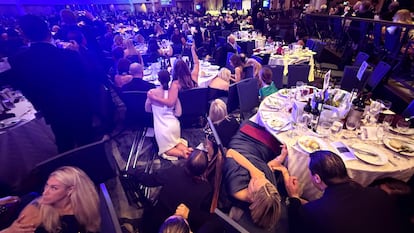

The roughly 2,500 guests at the White House Correspondents’ Dinner at the Washington Hilton had barely begun the first course — a burrata and fresh‑pea salad — when five dull, heavy thuds rang out. “I thought it was a tray going down many times,” President Donald Trump would later say.
The noise was from gunshots — it was a third assassination attempt on Trump. A 31‑year‑old man, the suspected shooter, was arrested, 45 years after John Hinckley tried to assassinate then‑president Ronald Reagan at this same hotel.
The White House Correspondents’ Dinner is traditionally Washington journalism’s marquee event — a gala that brings together the reporters who cover the presidency and the rest of official Washington, from politics and media to the broader machinery of power, with a scattering of celebrities. The sitting U.S. president is typically the guest of honor. But Trump, whose relationship with the press has long oscillated between hostility and dependence, had declined to attend every year. Until now.
Trump’s decision to show up this year — and to deliver a speech — had injected an extra dose of anticipation and intrigue into the evening. In the hours leading up to it, and at the many parties orbiting the dinner, journalists joked about which insults the president might lob at his hosts from the podium. No one imagined the story would turn out to be something else entirely.
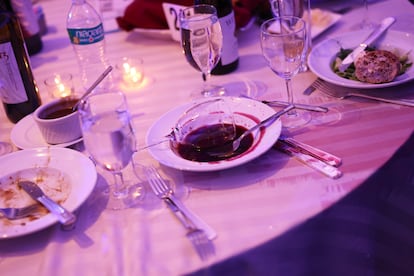
Everything had begun exactly as planned. The impeccably dressed guests had taken their seats in the Hilton’s grand ballroom, which hosts the event each year because it is the largest in Washington — at least until the one Trump is building in the East Wing of the White House is finished. A military band had been playing. The U.S. national anthem had been performed, with everyone standing. The entrance of President Trump and his wife, Melania, had been announced. The president of the White House Correspondents’ Association, CBS journalist Weijia Jiang, had offered a brief introduction. The diners had started on the first course of a menu that was to continue with filet mignon, lobster, and assorted desserts.
At that moment, five heavy thumps were heard, seeming to come from one of the doors. They were not, as Trump and a few journalists initially thought, trays hitting the floor. They were gunshots — the shots fired at a security checkpoint in the lobby when a 31‑year‑old California teacher, identified as Cole Allen, approached carrying knives and firearms. Everyone hit the floor. Everyone except several journalists, who lunged for their phones (in vain: the ballroom is in a basement, and there was no signal to be had).
As the shots rang out, Secret Service agents rushed en masse, rifles in hand, toward the presidential table on the stage to shield the president and get him out of the hotel. “We’re leaving — now,” one of them shouted as he ran toward Trump.
“Quite an evening in D.C. Secret Service and Law Enforcement did a fantastic job. They acted quickly and bravely. The shooter has been apprehended, and I have recommended that we “LET THE SHOW GO ON” but, will entirely be guided by Law Enforcement. They will make a decision shortly," Trump posted almost immediately on Truth Social, his social‑media platform. “Regardless of that decision, the evening will be much different than planned, and we’ll just, plain, have to do it again.”
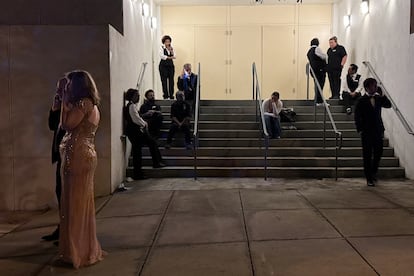
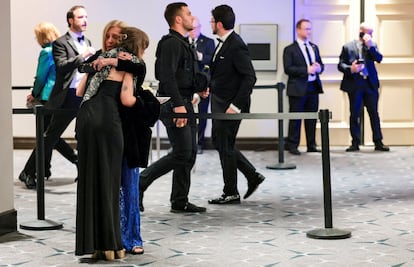
Confusion reigned in the first moments after the gunfire. Some insisted the shooter had been killed. Others offered the correct version: he had been taken into custody. Many of the guests — from White House press secretary Karoline Leavitt to FBI director Kash Patel, Treasury Secretary Scott Bessent, and dozens of senators and members of Congress — tried to comfort one another. Some were shaking; others wiped away tears. From one of the tables near the president’s, a voice shouted, “Long live the United States!”
About 20 minutes after the incident, the president of the White House Correspondents’ Association, Weijia Jiang, announced that the party would resume “as soon as possible.” It didn’t. By then, many guests had already left, either on their own or at the urging of their security details. Some departed in great haste: at the exit police had designated, a single gold‑sequined stiletto — the abandoned shoe of an anonymous Washington Cinderella — lay on its own.
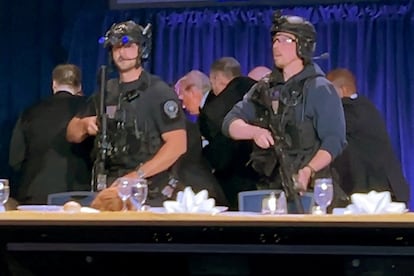
There was neither the mood nor the quorum to celebrate. But in his post‑event press conference, speaking from the White House and still wearing the tuxedo from the dinner, Trump said the event would be held on another day. “We’re not going to let anybody take over our society. We’re not going to cancel things out, because we can’t do that,” he said.
Trump had been scheduled to deliver remarks to the journalists gathered under the WHCA, the association that represents reporters covering the White House and with which he has long had a complicated relationship. He often lashes out at its members when they ask questions he considers uncomfortable, and his comments sometimes veer into the personal. At the start of this term, the White House stripped the association of responsibilities it had traditionally held in organizing presidential coverage, shifting them to Trump’s press office.
At the same time, the president boasts of being the most accessible in U.S. history and takes reporters’ questions almost daily. Since the start of the war in Iran, he has made a habit of answering calls from various journalists on his cellphone to grant brief interviews.
The Hilton hotel is no stranger to tragedy. On March 30, 1981, it was the scene of an attack on then‑president Ronald Reagan, who had just delivered a speech there. One of the bullets fired by John Hinckley Jr. ricocheted and struck Reagan in a lung, causing severe internal bleeding. His press secretary, James Brady, a Secret Service agent, and a police officer were also wounded.
Sign up for our weekly newsletter to get more English-language news coverage from EL PAÍS USA Edition









































