
Cubans deported by Trump to Mexico face an uncertain fate with no guarantees
The United States is systematically expelling migrants south of the border, as the island refuses to accept them. There’s little certainty about the number of Cubans deported, nor about their status in the country
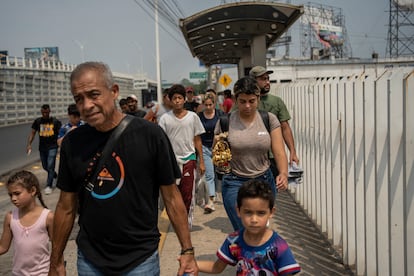

Laudel Camacho Ricardo had been sleeping on the streets of Tapachula, a city in southern Mexico, for three days. That’s when he decided to sell his gold chain and a watch for $20 (just over 350 Mexican pesos). He would never have pawned his possessions for such a low price, if not for the hunger that gripped his stomach.
“These have been very hard days. Sometimes, I’ve felt like I would have preferred to die,” he confesses. “Finding myself in a foreign country, not knowing anyone, without resources — and hungry — is a pain that I’ll remember for the rest of my life.”
He was no longer the Cuban immigrant and Texas warehouse worker that he had so recently been. Within a week, he was suddenly a deportee in the Mexican state of Chiapas, without money, a phone, or identification documents. This was how the U.S. Immigration and Customs Enforcement (ICE) officers left him on the other side of the border.
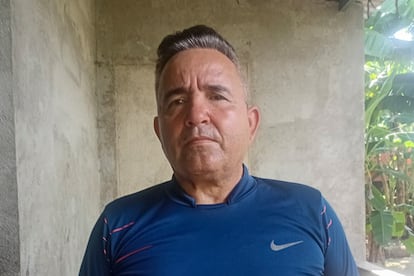
Laudel is 55-years-old, with graying hair. In the middle of his chest, he has a tattoo of the Statue of Liberty — a silhouette made with the unmistakable blue-green ink that’s used in prisons. He spent a total of 22 years locked up in Cuban jail cells for his political activism, his work as an independent journalist and his protests against the Castro regime. His tattoos have been the only thing they haven’t been able to strip him of: neither the Cuban government each time it locked him up, nor the U.S. government when, on September 16, 2025, it notified him of an immigration appointment. Instead, the American authorities placed him in one of the detention centers that, today, are the catacombs of its immigration policy.
Without even returning his passport, the agents left him in the hands of the Mexican authorities. On September 23, after about a week in detention — a fleeting period of time when compared to the months that some spend in ICE custody — Laudel was deported by bus to Mexico. This is what happens to the majority of Cubans who are deported from the United States. The government in Havana isn’t receiving them.
In negotiations with Barack Obama — as part of the reestablishment of diplomatic relations 10 years ago — Raúl Castro began admitting deportees. However, the island’s government retains the right to choose who it takes back and who it doesn’t. To this day, the reasons why one Cuban migrant lands in Havana, another in Tabasco, Mexico, and another sent to faraway Eswatini (formerly Swaziland) remain incomprehensible.
One of the theories circulating is that the Cuban government is mostly accepting citizens from more recent migration exoduses who don’t have serious criminal records. But this cannot be proven. Some deportees have ended up in Mexico, or even African countries, indiscriminately.
Laudel, for his part, had no criminal charges in the United States. He braved the danger of the sea on a rustic raft from Cojímar, Havana, arriving in the U.S. just over 20 months ago, where he lived under I-220 B status, or deportation order. This is the same status that some 42,000 Cubans remain under.
Even so, many are grateful to be deported to Mexico and not to Cuba, which has collapsed due to its worst-ever economic crisis. They also prefer it to ending up in Africa. Alexander Rodríguez — a 52-year-old Cuban who spent about 10 years in prison in the United States (and now rarely leaves his home for fear of arrest) — says that, in the event of expulsion, the best thing would be to return to his home country, where he has cousins and uncles. However, he says that Miguel Díaz-Canel’s government won’t accept him. “It’s better to be there than in Africa. If they send me to Mexico, that’s fine, too. But if they send me to Africa, what am I going to do at this age in one of those countries?”
Mexican President Claudia Sheinbaum has ruled out any kind of negotiation that would turn Mexico into a “safe third country” for deportees. And Havana has received about 1,000 Cubans back since January. But the rest, for the most part, have ended up expelled from the U.S. to Mexican territory. The Economist reported that “at least 731 Cuban nationals had been deported to third countries” as of August 2025 — the highest number publicly recorded. According to data available from the Deportation Data Project — which compiles and publishes anonymized U.S. government data sets obtained through the Freedom of Information Act (FOIA) or from proactively-released records — approximately 640 Cubans were deported to Mexico between January 20 to the end of July. That same month, Sheinbaum stated that her country had received approximately 6,525 foreigners, without specifying their nationalities.
Numerous organizations have denounced the dangers that these migrants face. “These practices leave many people in legal limbo, without documentation or access to basic services. They’re exposed to extortion, violence and human-trafficking, especially in southern Mexico, where the risks for migrants are high,” says María José Espinosa, a foreign policy expert and executive director of the Center for Engagement and Advocacy in the Americas (CEDA). “The human cost is devastating and, in many cases, irreversible. These policies tear families apart.”
The path to legalization in Mexico
This is the first time that the Cuban community has faced a harsh U.S. immigration policy, after decades living under the protection of the 1966 Cuban Adjustment Act. In Florida — where the majority supported Trump’s return to the White House — the terror of deportations took the form of “Alligator Alcatraz,” the nickname given to the South Florida Detention Facility. Now, nearly a year into Trump’s second term, the streets of cities like Miami have become the main danger for undocumented immigrants.
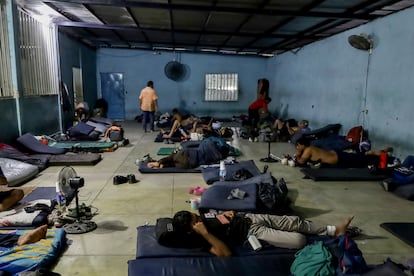
Thomas Kennedy — an immigration activist and policy analyst for the Florida Immigrant Coalition — argues that the types of raids taking place in the state are less dramatic than in Chicago or California. “But what happens here is what I call a constant raid,” he notes. Florida Governor Ron DeSantis’ administration — through the 287(g) program, which grants federal immigration powers to local and state police — has empowered the Florida Highway Patrol to arrest many people. However, in a state where Cubans are the largest foreign group, they’re not the most-affected by ICE detentions. Rather, Guatemalans and Mexicans are the principal victims.
Even so, the last 10 months of Republican rule have been devastating for many Cubans, whose naturalized relatives didn’t hesitate to vote for Trump. During this time period — according to Espinosa — U.S. immigration policy “has gone from protection to punishment.”
“The humanitarian parole program was eliminated, work permits were revoked, and deportations were expanded to countries such as Mexico and even Africa. Hundreds of thousands of Cubans who entered the country regularly are now at risk of detention or expulsion, while others live in fear of losing everything. And still others wait on the island to be reunited with their families in the United States,” says Espinosa. “What we are seeing is a historic setback: after decades in which Cubans were welcomed into this country, many now live in limbo, without protection or a clear path forward.”
This is how Laudel survives in Mexico. After several days on the streets, it was other Cubans in the city of Tapachula who helped him get through his first days as a deportee. “I ended up asking some Cubans I saw passing by for food or money. I hadn’t showered and was sleeping wherever I could find shelter at night,” he says. Later, those same Cubans offered him a place to stay until he could find a job, which is far from straight-forward. “I don’t have any documents, and that makes my situation worse. There is work, but without documentation it is impossible for a migrant,” he says.
Irene Pascual, an immigration lawyer in Mexico, tells EL PAÍS that the first thing a deportee must do is report to Mexican immigration authorities within 30 days. The lawyer also explains that Mexican law establishes three forms of regularization: family ties, humanitarian reasons, or expired documents, which apply to people with a prior immigration record.
“Most people have no family [in Mexico], nor do they have [an immigration] record, so they must apply for refugee status with the Mexican Commission for Refugee Assistance (COMAR),” explains Pascual. “Many Cubans meet the criteria of persecution and fear for their lives or of being imprisoned if they return, but each case is different. Likewise, applying for asylum is a human and constitutional right. It is the authority — COMAR — that determines during the process whether the person will be recognized as a refugee and granted the corresponding benefits.”
Many migrants in Tapachula report long wait times or delays by COMAR, as well as denials of procedures and corruption. Some say that they’ve had to pay up to more than $1,000 to receive their legal documents.
Laudel has already appeared before COMAR. He’s been told he will have to wait four to five months for a response to his case. He doesn’t plan on returning to Cuba, where the authorities have threatened his family, saying that they’ll send him back to prison. There’s also no possibility of returning to the United States. His uncertain fate now lies in Mexico.
Sign up for our weekly newsletter to get more English-language news coverage from EL PAÍS USA Edition









































