
Arrested by ICE and deported in a vegetative state: A Costa Rican man’s family seeks answers after his death
Randall Gamboa migrated to the United States in December in perfect health and returned to Costa Rica in September bedridden, unable to speak or eat. He died last weekend
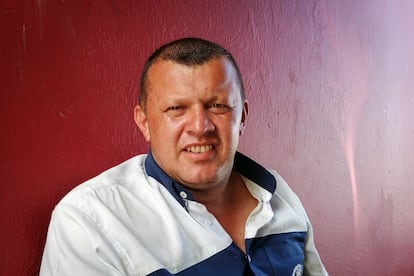

When Greidy Mata said goodbye to her brother Randall before he emigrated from Costa Rica to the United States in search of work, she hugged a man who was “big, tall, and full of remarkable vitality.” Ten months later, when Randall was deported back to the Central American country, the person Greidy received at the airport was unrecognizable.
“It was a shocking sight,” she recounts over the phone. “He couldn’t speak or move, the wounds on his body were neglected and open, he was filthy, smelled bad, and his mouth was full of dried blood.”
Randall Gamboa, 52, was deported by U.S. authorities and arrived in Costa Rica in a vegetative state, suffering from encephalopathy and rhabdomyolysis. He could no longer walk or eat on his own. Less than two months later, Gamboa died in a hospital in Pérez Zeledón, his hometown in the south of the country.
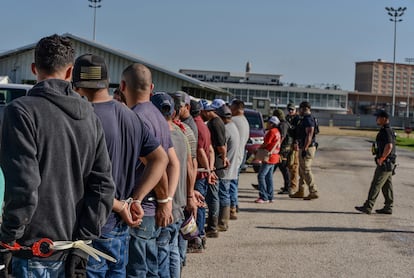
Greidy, her mother, and the rest of the family want answers and say they are willing to take Randall’s case to the Inter-American Court of Human Rights (IACHR). The family went through a “calvary” that began in February, when Randall was arrested by the U.S. Immigration and Customs Enforcement (ICE) in Texas, after crossing the border from Tijuana, Mexico.
Randall was first held at the Webb County Detention Center, and later transferred to Port Isabel, both in Texas. During his time in those centers, he called his family every day, but on June 12, he disappeared. “He wasn’t answering our calls, and we were very worried. Finally, someone at the detention center said he had a health issue and that’s why he wasn’t answering us. But they didn’t give us any more information,” says Greidy.
Randall’s family turned to two lawyers who ended up scamming them, until they finally found a third attorney who managed to locate him in a Texas hospital at the beginning of August. By then, Randall was bedridden, in a vegetative state, and the lawyer began the process to have him returned to Costa Rica.
“We were suffering because he was missing, but when we realized his condition, we consulted doctors and understood that it was a very serious situation and that we could lose him,” says Greidy.
Despite their fear and worry, Greidy and her family were “determined to bring him back to his homeland, to the warmth of his people.”
Randall was finally flown back to Costa Rica on an air ambulance on September 3, in a trip paid for by ICE. He was immediately hospitalized in the emergency room of a medical center in San José, the capital of Costa Rica, and a few days later was transferred to the hospital in Pérez Zeledón. After nearly two months in the hospital, he died on October 26.
Costa Rica seeks clarification from the US
Randall’s family has called on the Costa Rican government to demand answers from the United States. In early October, when Randall was still alive, Costa Rican Foreign Minister Arnoldo André said they would “raise this issue with the U.S. government.”
“I have personally taken charge of this, reviewed the consular file, and I am escalating communication with the State Department through a diplomatic note. This needs to be clarified,” André said during a congressional hearing.
A day after Randall’s death, the Ministry of Foreign Affairs issued a statement indicating that authorities “will continue to make every effort to clarify the circumstances” and that the ministry has “maintained communication with the Costa Rican’s family to provide them with guidance and support.” However, Costa Rica has not yet received an official response from the United States.
Greidy says that with this statement, the government is doing “the bare minimum,” but they are still waiting for President Rodrigo Chaves to speak out. “They don’t want to get involved in this because they are friends of the United States,” she says.
One person who did speak out forcefully was Óscar Arias, two-time president of Costa Rica (1986-1990 and 2006-2010) and Nobel Peace Prize laureate (1987). In a post on his social media, Arias described the reaction of the United States government as “complicit silence.” “Almost two months have passed since Randall returned to the country, and our government has been unable to obtain an explanation from the authorities in Washington. Randall’s family deserves to know the truth and what happened to him while he was in the custody of U.S. immigration authorities,” the former president wrote.
Arias added that “the immigration policy promoted by President Donald Trump embodies the worst anti-values that any American policy has ever professed: it is racist, xenophobic, and normalizes inhumane treatment of migrants.”

Limited alternatives
Following Randall’s death, the family announced that it would “begin recovering data, organizing the information, seeking out lawyers who are experts in international law, and proceeding with an official complaint before the Inter-American Court.”
Juan Ignacio Rodríguez, legal adviser for the International Institute for Social Responsibility and Human Rights, a Costa Rica-based NGO dedicated to promoting compliance with international human rights standards, explained by telephone that “there is no similar precedent” to the case of Randall Gamboa in international law. “This case is complicated because the United States has the peculiarity of not having ratified many international human rights treaties,” the expert notes.
“The United States has not accepted the jurisdiction of the IACHR, nor has it accepted several United Nations treaties, so it is virtually impossible to denounce the United States before international human rights bodies or tribunals,” explains Rodríguez. According to the lawyer, one of the few options available are the IACHR mechanisms known as “thematic hearings.” These, however, are not contentious and do not take place before a court; rather, their purpose is to “raise awareness of the issue.”
Another alternative, he added, would be to bring a case against Costa Rica, if the family believes that the Costa Rican consulate in the United States was aware of what was happening to Randall and “did not act diligently in this regard.” In its official statement, the Ministry of Foreign Affairs noted that “during the time Mr. Gamboa remained in the custody of Customs and Immigration, the Consulate General of Costa Rica in Houston followed up on his case, taking all possible actions within the framework of international law and applicable local regulations.”
Randall’s sister says she understands that taking on the United States “sparks fear” since it is “a great power,” but that the family is convinced they must continue with the case out of their “deep love” for Randall. “We are going to act with both our strength and our hearts and explore every avenue,” she says.
Sign up for our weekly newsletter to get more English-language news coverage from EL PAÍS USA Edition









































