
Laurence Joseph, psychoanalyst: ‘Being silent sometimes means learning to listen, and that’s quite rare in today’s society’
The French author has published a book in which she reflects on secrets, violence and the code of silence
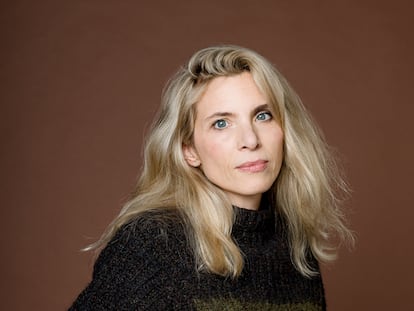

Just as there are many kinds of noise, there are also different kinds of silence. Some silences protect victims, while others shield perpetrators. Some silences can fester and harden when they hide a shameful secret. They may be complicit, or resemble a sinister code of silence.
In today’s hyperconnected and noisy world, silence can even become a luxury — soundproof windows, noise‑canceling headphones, meditation retreats. Yet silence can also feel like exposure, a vast and unprotected space for someone who has no one to talk to. These themes are explored by Laurence Joseph in her book Nos silences: Apprendre à les écouter (or, Our Silences: Learning to Listen to Them).
Joseph works with silence. She is a clinical psychologist and psychoanalyst, and, as she explains in her book, only in the face of the other person’s silence can a person begin to tell their story. It’s called silent listening. Learning to be silent for the benefit of the other, so they can explore and develop their own discourse. “Being silent sometimes means learning to listen, and that’s quite rare in today’s society,” the French author explains in a video call from her home in Paris. She wrote the book based on her more than 20 years of experience in therapy. But it’s not simply a collection of clinical cases. Joseph draws on mythology, literature, and philosophy to map our individual and collective silences.
The author begins by explaining the most difficult and uncomfortable silences she has experienced in her practice. “I’ve had many patients, especially children, who are victims of incest or sexual violence, so it’s clear that there’s an aspect of silence surrounding children, adolescents, and women that stems from the inability to listen to them,” she reflects. But she believes something is changing. As evidence, she cites several recent literary successes, especially Consent: A Memoir, in which editor Vanessa Springora recounts her relationship at age 14 with a 50-year-old writer, Gabriel Matzneff, and the silence and even social complicity surrounding a pedophile, who was celebrated in the literary world until very recently.
“I firmly believe in the power of example to empower people to speak out; the narrative of shame makes change possible,” she says. “The fact that public figures are speaking out demonstrates that these testimonies are being heard. And this has a ripple effect. Through these media stories, we discover our potential to share our secrets, so that our relationship with shame can change. In this sense, the story of the #MeToo movement is fascinating.”
It was the French philosopher Roland Barthes who explained that silence is neutral. People then manipulate it in their own way to give it meaning, and sometimes to turn it into something political, the author explains. “In this way, silence is not a simple absence of sound, not a passive pause, but an act laden with meaning.” Joseph believes that society has lived through years — decades — of political silence, and that testimonies like Springora’s have begun to break it.
Processes aimed at repairing harm done to victims and holding perpetrators accountable — such as the investigation into abuse within the Catholic Church in Spain — are another example of a long-standing silence that has finally been broken. There is an undeniable political dimension to all of this. There is a social muteness that shelters many individual secrets. By bursting the bubble of this silence, stories begin to surface one by one.
The book doesn’t just explore the silence that surrounds trauma; it also examines the need for silence in an increasingly noisy world. Social media plays a major role in this dynamic. Today we can have an opinion about everything, and whenever something happens, we are encouraged to comment, argue, and react. That impulse has spread into all areas of life, so people never stop talking or expressing opinions.
This constant noise has also seeped into the workplace, where there are too many meetings, and into leisure time, where there are millions TV channels and streaming platforms. The result is an overload of information and stimulation that our brains are not equipped to handle.
Joseph traces a generational arc, noting that silence takes on different meanings depending on one’s stage of life. For a mother, silence can feel like a blessing — a moment of peace and rest, something she knows well as the parent of two teenagers. For a grandmother, however, silence is often tied to loneliness. “I thought a lot about my own grandmother, and about older people in general, while writing the book,” she explains. “I imagined what her day was like; she was over 90 and lived alone at home. If I didn’t call her, she didn’t speak to anyone all day. And I tried to imagine what a whole day without noise would be like. In the absolute silence of solitude.”
Joseph talks a lot about children, grandmothers, and parents. Silence, she explains, is inherent to family. There are secrets that are meant to protect, and are shared only within the inner circle. “And that’s what’s interesting,” she explains. “Secrecy can be the ethical core of a group. The ability to keep secrets about death, illness, origins, or sexuality.”
Sexuality also plays an important role in the book. “Among the secret names, there is one that always prevails,” the author explains, “the name of the beloved.” Homosexuality, extramarital affairs, caste, age differences… “Some names become unspeakable for a time, or forever. What happens to a love affair without witnesses? Does it become more intense, or on the contrary, does it quickly become an illusion? Does secrecy fuel the words whispered in private?”
Here too, she draws on literature to explain her thesis. The protagonist of Annie Ernaux’s Simple Passion accepts the silence, the secrecy that governs her relationship with a married, foreign, younger man. A man with whom she can never converse, given that they lack common language: she doesn’t speak his language, nor he hers; their bodies are their only dictionary.
“All of humanity’s problems stem from man’s inability to sit quietly in a room alone.” The mathematician and philosopher Blaise Pascal said this, and Joseph includes it in her book. It’s a good one. “Yes, but Pascal’s problem is that he forgets the importance of others,” says Joseph. “This idea of silence in a room reminds me of Virginia Woolf, of A Room of One’s Own. In fact, what’s interesting is that Pascal, here, leans toward prayer, faith, meditation; he has a more masculine perspective. Virginia Woolf starts from a different place; she sees moments of solitude as a blessing, perhaps because women have access to it later in life.”
Sign up for our weekly newsletter to get more English-language news coverage from EL PAÍS USA Edition









































