
Trucks, trains and pipelines: Gulf countries desperately seek new routes to sell their oil
Aside from short-term fixes, several countries in the region are reviving old projects to overcome the Hormuz blockade
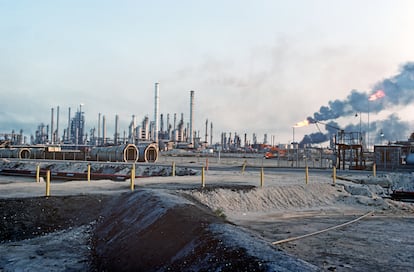
The countries of the Middle East had not faced such a critical economic situation in decades. Some of them, never. The double blockade of the Strait of Hormuz has plunged their oil and gas exports to multi-year lows, slashing their revenues, forcing them to seek external aid—from the same country, the United States, which, along with Israel, has once again turned the region into a tinderbox—and to desperately search for alternatives to sell their fossil fuel production. Without these exports, they can barely hold out for many more weeks without the financial damage worsening.
Each country is following a different strategy. Iran, which faces a drought in exports compounded by enormous military costs and the repair of damage caused by bombs, is trying to take advantage of a rail corridor that has been operational since 2025 to ship its crude oil to China. This route, according to The Wall Street Journal, even shortens the delivery time compared to the traditional route by ship through the Strait of Hormuz, but would only allow the shipment of a small fraction of what the Islamic Republic currently pumps.
Saudi Arabia, the other major regional power, is another one of the states with a partial alternative to the Strait of Hormuz. It has a large pipeline, although without the capacity offered by the maritime route through Hormuz, the artery through which Riyadh normally exports the bulk of its production. The East-West pipeline—also known as Petroline—was built in the 1980s during the Iran-Iraq War, and carries crude oil from Abqaiq in the Persian Gulf to Yanbu in the Red Sea. It had a capacity of five million barrels per day, later expanded to seven million in 2019, according to the U.S. Energy Information Administration (EIA). In the first three weeks of March, Saudi Arabia shipped around four million barrels per day via this alternative route, less than half of its pre-war production, which exceeded 10 billion barrels.
The United Arab Emirates, which in recent years has attempted to diversify its production by adding oil and gas derivatives to its offerings, is now trying to ship its fertilizers—currently in short supply (along with kerosene), especially in Asia and Europe, jeopardizing the upcoming agricultural season—by road to Emirati ports in the Gulf of Oman, beyond the Strait of Hormuz. This week, Iraq also began transporting some of the crude oil it previously exported by ship to Syria by truck.
The UAE also has an oil pipeline that terminates at the port of Fujairah on the Gulf of Oman. However, its terminals have been attacked repeatedly during the war, most recently on Monday and Tuesday. On Monday, the Iranian Revolutionary Guard published a map that included Fujairah within the area under its control at the entrance to the Strait of Hormuz.
These solutions are, in any case, “temporary patches,” in the words of Gonzalo Escribano, director of the Energy and Climate Program at the Elcano Royal Institute. The Gulf Cooperation Council, he recalls, also had a plan to interconnect member states by rail by 2030, an infrastructure that could be used to export oil. “But in both the case of rail and truck, the volumes that can be exported are much smaller. And it is significantly more expensive than transporting crude oil by pipeline or ship,” he states by telephone.
These supposed alternatives, agrees Nikolay Kozhanov, an energy expert and associate professor at the Gulf Studies Institute of Qatar University, based in Qatar, “are not realistic.” This type of transportation is “designed for other types of goods,” not for oil or many of its derivatives.
Bahrain and Kuwait are the most precarious of the Gulf countries. Neither one has an oil pipeline across the Strait of Hormuz, so their fossil fuel exports—the bulk of their trade balance—have virtually plummeted to zero in April in Kuwait’s case. Furthermore, Bahrain has a high level of public debt, which hinders any future solutions requiring significant investment.
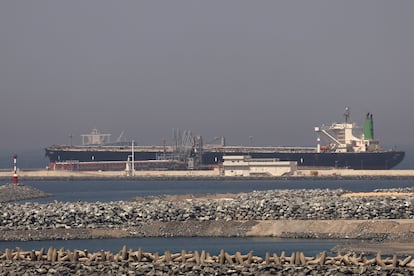
The case of Iraq is somewhat more complex. Although significantly poorer than Bahrain, Kuwait, Saudi Arabia, and especially the United Arab Emirates, it does have an oil pipeline that allows it to export some 250,000 barrels of crude oil per day. It’s a tiny fraction of the total, in any case: in February, the last full month before the strait was closed, it delivered more than 3.5 million barrels daily to the once overflowing, now thirsty international market through the terminals south of Basra. Lacking storage capacity, Iraq has had to reduce its production to between 1.5 and 2 million barrels per day: the volume its refineries can absorb for domestic consumption.
Given that 90% of Iraq’s budget depends on oil exports, time is increasingly of the essence in the Arab country. Iraqi authorities have just announced the start of construction on a new pipeline—between the towns of Basra and Haditha, stretching just over 700 kilometers—to transport their oil to Syria and Turkey. The project, for which an initial allocation of $1.5 billion (€1.3 billion) has already been announced, and which will have the capacity to transport 2.5 million barrels per day, will take at least two years to become operational. It will therefore not resolve the current crisis.
Nor does it seem feasible to revive a pre-war project to reactivate an old oil pipeline running between Kirkuk, Iraq and Baniyas, Syria, one section of which has been inactive since the 2003 U.S. invasion. Repairing this pipeline poses a huge and costly technical challenge, especially since, in addition to its long period of inactivity, successive conflicts in Iraq and Syria have destroyed most of the pumping stations along its original route, as Syrian Deputy Minister of Petroleum Affairs Ghiath Diab told the newspaper Al Arabi Al Jadid last November.
“It’s logical that they’re seriously considering building new pipelines or expanding the capacity of existing ones,” Escribano reflects. “The UAE is looking to double the capacity of its current pipeline, something that makes even more sense after its departure from OPEC [the Organization of the Petroleum Exporting Countries], because they will no longer be subject to production quotas. And Saudi Arabia, in addition to trying to increase its exports through the existing pipeline, is considering moving some of its operations to the Red Sea,” he notes. This last option, however, has an added problem: from the risk of Iran closing the Strait of Hormuz, they now face the risk of the Bab el-Mandeb Strait being closed by the Houthis of Yemen, allies of the Islamic Republic.
“These alternative solutions,” adds Nikolay Kozhanov, “do not cover” the losses caused by the Hormuz blockade. With notable differences, the expert warns, citing the case of Saudi Arabia. Because it can continue exporting a smaller but significant portion of its production, “the rise in crude oil prices,” now above $100 a barrel, “partially compensates for the losses.”
Sign up for our weekly newsletter to get more English-language news coverage from EL PAÍS USA Edition









































