
The desert kingdom is cutting off the tap: Saudi Arabia’s new plans for its petrodollars
The new strategy of the national sovereign wealth fund, one of the largest in the world, reviews the viability of its megaprojects, concentrates more investment within the country and calls for greater involvement from the private sector
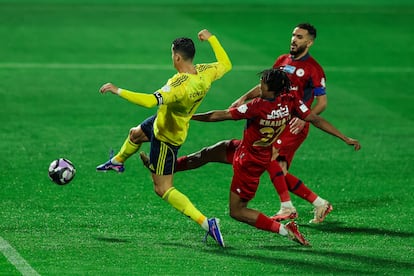

In recent years, Saudi Arabia has established itself as one of the world’s most active and ambitious investors. From financing the futuristic city of Neom on coast of the Red Sea to signing Cristiano Ronaldo for Al-Nassr and hosting a Formula 1 Grand Prix in Jeddah, not forgetting its investments in Western companies like SoftBank, Uber and Telefónica, Riyadh’s financial resources have left virtually no sector unexplored.
Leading this strategy is the Public Investment Fund (PIF), one of the world’s largest sovereign wealth funds, thanks primarily to the revenue generated by the kingdom’s oil. Over the past five years, it has invested more than $199 billion (approximately €170 billion) in new projects in Saudi Arabia, thus becoming one of its main economic drivers. In the last decade, the fund has also increased its asset portfolio sixfold to more than $900 billion (approximately €767 billion).
Now, however, the PIF has decided to slow down and adjust its course. The board of directors of the entity, chaired by the Crown Prince and leader of the country, Mohammed bin Salman, approved its five-year strategy for 2026-2030 on April 15. This strategy includes reviewing the viability of its domestic megaprojects, concentrating more investment within the country, and demanding greater involvement from the private sector. The era of easy Saudi money appears to be over.
“The fund will focus, through its strategy, on improving the efficiency of its spending and disbursements, along with a sustainable evaluation of the performance of its businesses, to achieve a balance and ensure the sustainability of its financial resources,” declared PIF Governor Yasir Al-Rumayyan at a press conference following the announcement of his new plan.
The fund’s new five-year roadmap has been unveiled amid the crisis gripping Saudi Arabia due to the US-Israeli war against Iran and Iranian retaliatory attacks on Gulf Arab states, which are undermining its image as an oasis of peace and stability for business and tourism. The shift, however, is more of a response to the limitations Riyadh faces in sustaining its policy of unlimited expansion with oil prices that, until a few weeks ago, remained stuck below $90.
The Saudi sovereign wealth fund will now divide its investments into three portfolios. The Strategic Portfolio, comprised of large domestic companies with the capacity to expand into the international market, the Financial Portfolio, focused on investments in global markets seeking profitability, and the Vision Portfolio, its cornerstone, with which it will invest in six domestic sectors, including tourism and entertainment, urban development, industrial technology, clean energy, and Neom.
One of the main casualties of this change of course will be its megaprojects with uncertain profitability. Since the beginning of the year, the kingdom’s authorities have already indicated that colossal projects such as The Line, a 170-kilometer linear city clad in glass mirrors; Mukaab, a cubic skyscraper capable of housing 20 Empire State Buildings; and Trojena, a ski resort with artificial snow, are no longer priorities.
Conversely, the PIF has committed to completing other colossal projects that it considers critical, especially given the country’s international commitments, such as the infrastructure for the 2030 World Expo and the 2034 FIFA World Cup. Other tourism initiatives, such as the development of the historic area of Diriyah, on the outskirts of Riyadh, and the city of Qiddiya, about three times the size of Paris and designed around leisure, are also on track.
In addition to its urban megaprojects, Saudi Arabia’s recent extravagance in the sports sector also appears to be nearing its end. The day after presenting its new roadmap, the Saudi Investment Fund (PIF) sold 70% of the Al-Hilal football club, which has featured stars like Neymar and Karim Benzema, in line with its strategy of “maximizing profitability.” The sovereign wealth fund is also considering withdrawing its funding from the Saudi golf league, LIV Golf, and in January, it was announced that the 2029 Winter Olympics, originally scheduled to be held in Trojena, are relocating to Kazakhstan.
Delayed developments
“Projects with limited potential returns, but which strongly projected Saudi Arabia’s soft image and global presence, and which were seen as a vehicle for changing Western perceptions of Saudi Arabia, have been sidelined or outright abandoned,” notes Umer Karim, a Saudi policy expert at the King Faisal Center for Research and Islamic Studies. “This makes sense,” he continues, “because the state is now more focused on ensuring its political, financial, and defensive security.”
Another significant shift will be the allocation of its investments. In an interview with the Saudi network Al Arabiya following the announcement of the new plan, Rumayyan stated that the PIF will allocate more funds to the domestic economy and aims to reduce its international investments to around 20%, down from a previous peak of 30%. While the absolute amount of capital dedicated to foreign investments will continue to grow, this adjustment reflects a clear reevaluation of priorities. Furthermore, the institution plans to create an investment fund of approximately €15 billion in partnership with the private sector, demonstrating a willingness to begin sharing risks.
On the political front, the recalibration of the PIF aligns with the shift in stance of Mohammed bin Salman, who has made the fund his primary vehicle for driving the kingdom’s economic and social transformation and projecting a new image. In recent years, the Saudi leader has softened the aggressive approach he displayed when he assumed power a decade ago and has moved toward more pragmatic positions, although the lack of transparency surrounding the fund’s strategy review has now drawn renewed criticism.
Sign up for our weekly newsletter to get more English-language news coverage from EL PAÍS USA Edition









































