
Somali pirates resurface in the shadow of crises in Persian Gulf and Red Sea
In recent days there have been several attacks against vessels sailing off the coast of the African country, including four kidnappings
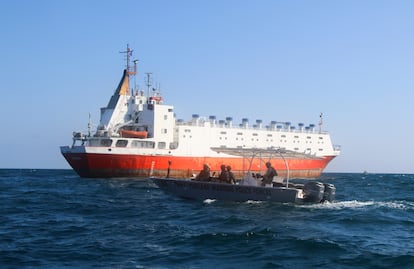

Last Sunday, about six nautical miles off the Somali coastal city of Garacad, a group of armed individuals stormed and seized control of the cargo ship MV Sward, which was sailing under the flag of St. Kitts and Nevis, according to the UK Maritime Maritime Trade and Operations Organisation (UKMTO). Just five days earlier, another armed group had hijacked the oil tanker Honour 25 while it was sailing off the coast of the Somali town of Durdura under the flag of Palau, according to the same agency.
This rapid succession of ship hijackings off the coast of Somalia, following a period of relative calm, has reignited concerns about a potential resurgence of piracy in the region. The upswing in activity also comes at a delicate time for maritime transportation, which is grappling with the repercussions of the closure of the nearby Strait of Hormuz in the Persian Gulf by the United States and Iran, while still recovering from the disruption in the Red Sea caused by the threat of attacks from Houthi rebels in Yemen.
Following the incidents of recent days, the European Union’s naval mission coordination center against piracy in the region (MSCIO) has recommended that vessels sailing in its waters maintain a high level of vigilance, while the UKMTO has called for caution and the reporting of any suspicious activity. Despite these guidelines, the recent hijackings and other attacks are once again bringing to the forefront the security gaps created by naval resources stretched to their limits throughout the region.
In addition to the two previous hijackings, several other incidents occurred last week. On Saturday, a group of pirates seized control of a traditional fishing vessel 10 nautical miles off the coast of Somalia, which may have been used the following day to attack the MV Sward, according to the MSCIO. On Thursday, two other small fishing boats with armed individuals on board attempted to attack another vessel but withdrew after some warning shots were fired, according to the UKMTO. And on Monday, a group of pirates hijacked another fishing boat, which they are believed to have later used to seize the Honour 25, according to the MSCIO.
In late March, another traditional fishing vessel flying the Iranian flag was hijacked by pirates 400 nautical miles east of Somalia’s capital, Mogadishu, the MSCIO reported. The MSCIO again considered it highly likely that the group intended to use the vessel to venture further out to sea and attempt to attack a larger ship. On that occasion, however, the pirates eventually abandoned the vessel in early April.
Houthi attacks
The current surge in attacks by armed groups in the region also follows a slight resurgence of piracy in early 2024, after Houthi attacks in Yemen on ships sailing through the strategic Red Sea disrupted maritime traffic in that waterway, prompting many shipping companies to circumnavigate Africa. At the time, experts and monitoring groups indicated that there were likely between two and four active pirate groups in the area, based in the Somali federal state of Puntland.
Although concerns about a resurgence in activity have increased following recent hijackings, warning signs first appeared at least as early as last November, when an armed group of pirates boarded a Maltese-flagged merchant ship with 24 crew members about 700 nautical miles off Mogadishu. On that occasion, forces from Operation Atalanta, the EU naval mission, freed the vessel the following day.
However, Somali piracy is currently far from posing a threat comparable to that of more than a decade ago. In 2011, at the height of its activity, these groups were contained thanks to a large deployment of international maritime forces, as well as increased security on board ships and the pursuit of the attackers, for whom this activity ceased to be profitable and who then focused on other, more lucrative practices.
Beyond the opportunistic component derived from the current disruption of maritime traffic, the Puntland region, at the tip of the Horn of Africa and from which many of these pirate groups have operated in the past, has a long fishing tradition that has been hampered for years by overfishing by foreign companies and the Somali civil war.
Sign up for our weekly newsletter to get more English-language news coverage from EL PAÍS USA Edition









































