
From Somalia to Spain’s Balearic Islands: A journey along one of the most dangerous migration routes in the world
There are very few Somali refugees in Spain. However, some have been arriving to the islands of Formentera and Mallorca by way of Algeria
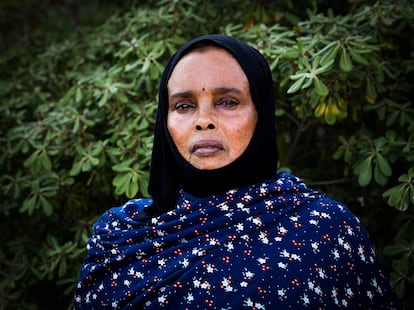

Sahra and Samia’s story begins on a farm in Somalia that no longer exists. Things were going well for them: Sahra, a 55-year-old mother, successfully ran a small livestock and crop business. That is, until her brother — the only adult man in the family — devastated everything.
They say that he used drugs, stole from them and tried to force his 15-year-old niece — Samia — to marry an unknown man. He burned down the house while they were sleeping. He tore off one of his siblings’ legs with a chainsaw. He shot Sahra. He was a powerful man: the police treated his behavior as a domestic problem, so no one arrested him.
The mother and daughter fled, but he eventually found them.
“Everyone loves their country; there’s always a very strong reason to leave it,” Sahra begins, four months after arriving in Mallorca, Spain, on a small boat. Mother and daughter now live in a shelter, the only one on the Balearic Islands. It’s a pleasant place, surrounded by pine trees. From midday onwards, hundreds of tourists fill their bellies with beer.
On a Monday in early-July, cicadas are chirping in the shade. It’s 98.6°F. The mother speaks and her daughter translates, while adjusting her black-framed glasses.
Sahra — with bullet shrapnel still embedded in her right leg — left the rest of her children with a friend. She planned to retrieve them later, after fleeing to a safe country. But Samia made the life-changing decision to go with her. “I couldn’t leave [my mother] alone.” She only speaks Somali: no Arabic, no English. How could she get there? And so began the journey of a mother and daughter across four countries — almost 3,700 miles — during which they survived kidnappings, mafias, prisons, exiles… and the sea.
The two women are part of an unexpected influx. Since last year, hundreds of Somalis have been arriving in Spain via a previously untraveled route: the one connecting Algeria with the Balearic Islands. Compared to the 22 people who ended up (likely by mistake) on the islands in 2016, in 2024, there were almost 6,000 new arrivals. This year — in just over six months — there are already more than 3,300 migrants. The majority are Somalis, who have displaced Algerians as the main nationality making this journey.
Like others arriving from Mali, Burkina Faso, or Sudan, the Somalis have a clear refugee profile. Their country has been at war for more than three decades, plagued by fighting between armed clans, the advance of the terrorist group Al-Shabab, climate disasters, a collapsed state and, today, even less international aid.
It took Sahra and Samia more than a year-and-a-half to board the boat that took them from Algeria to Europe. Before that, they traveled through Uganda, Sudan, Libya and Tunisia. “We suffered a lot; we spent an entire winter sleeping on the streets,” says the mother. “Before all this, we were middle-class, but we had to beg to get here,” her daughter explains.
With their skin color and headscarves, they were seen as a source of income for all the middlemen and criminals they encountered. At the border between Sudan and Libya, they were kidnapped. They were taken to Kufra, an illegal Libyan prison. It’s run by human traffickers, who torture migrants while trying to extort money from their families. The kidnappers demanded $6,000 in exchange for their freedom.
“They extorted us, but we didn’t have the money,” her daughter explains. Their fate could have been the same as that of the 28 bodies found in a mass grave near the detention center last February. But they managed to get away. “The militia was attacked and we managed to escape.”
The U.N. refugee agency UNHCR has focused its attention on the Balearic Islands. And interviews conducted by the UNHCR reveal a pattern: the women — all victims of female genital mutilation — fled Somalia due to widespread violence, persecution by armed groups and sexual abuse.
“Some mentioned sexual violence, detention, forced labor and other abuses en route to Spain,” said Paula Barrachina, a spokesperson for the agency. The men — aged between 18 and 45 — cited conflict, persecution and ethnic discrimination as the reasons for their escape. “Their journeys lasted between five months and a year, crossing high-risk countries for migrants, such as Libya and Algeria,” said the spokesperson.
Spain grants asylum to 97% of Somalis who apply. It recognizes the danger they face if they return. But the country isn’t prepared to receive them. Refugee care requires specific measures, but Somalis — like Malians, who previously reached the Canary Islands — quickly come up against an immigration system that lacks interpreters, information, or sufficient appointments to apply for asylum.
In the Balearic Islands, many have slept on the streets while waiting to board a ferry to Spain, with no food or water other than what local residents give them. The only space to house them is where Sahra and Samia now live… and the shelter only has 44 beds, reserved for the most vulnerable migrants. The majority are mothers and daughters, who must wait months on end for a DNA test, so that the authorities can confirm they are related.
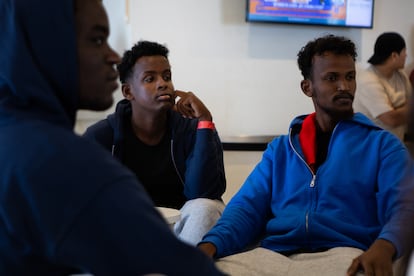
Ibrahim, 29, owned two small supermarkets in Beledweyne, located about 200 miles from the Somali capital of Mogadishu. The city is a strategic location in the war against Al-Shabaab terrorists, who have been carrying out attacks on its streets for years.
On the ferry from Mallorca to Barcelona, he says that, back in 2000, his father was killed in an attack perpetrated by terrorists. And, in 2021 they came after him. Threatening Ibrahim with death, they began demanding payment if he wanted to keep his businesses open. He refused to be extorted.
“They burned all the shops in the village that didn’t want to pay,” he recalls. Subsequently, he fled. “I was clear that I wanted to get to Europe. I wanted peace. I have a mother, I’m the eldest of the siblings, I have a responsibility…” He speaks with EL PAÍS after having crossed Ethiopia, Kenya, Uganda, Benin, Niger and Algeria.
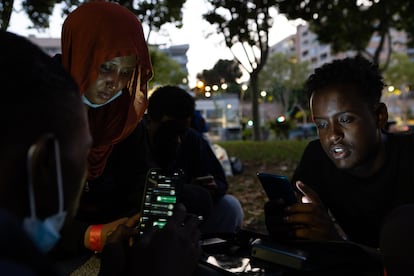
The Somalis survive in groups. Faced with the brutal violence in Libya, Tunisia and Algeria, they try to protect each other. “The Somalis are the ones who protected us,” says Samia. In Algeria, the final stage of the journey, many women — and men, too — spend months in hiding to avoid being arrested by the police and deported to the desert.
“We saw too much in Algeria. Tunisia is a paradise compared to how Black people are treated in Algeria. As soon as [the authorities] see you, they grab you and expel you to the desert. You can’t go out to buy groceries, you can’t make a life for yourself. Everyone tries to get money from you. We spent 10 days in jail,” Samia recalls.
Many migrants say that they lived in train tunnels, taking turns risking their lives in order to find food. They shared the remittances sent by their relatives. “We didn’t see the light of day for five months,” Aisha notes. She fled Somalia, leaving her two children with her ex-husband. She did so while knowing that perhaps she would never see them again.
There’s no easy route. And, if they finally reach a reception center, many of the after-effects that these people suffer from are the result of the time they spent in Libyan prisons, or during their stay in Algeria. Many are expelled from the North African countries again and again, until they take to the sea.
Representatives of the Spanish Commission for Refugee Assistance (CEAR) — which welcomes many of these Somali citizens to its centers — detail two of the most common routes. The first — which is more expensive, costing around €5,000 ($5,800) per person — includes a flight from Ethiopia to Benin, followed by a bus to Nigeria, or directly to Niger and Algeria.
The second — more dangerous — costs half the price and makes stops in Ethiopia, Sudan, Libya and Algeria. “The entire journey from Somalia can take between one and three years. The final leg, at sea, takes about 14 hours. By then, the refugees are severely physically weak and in poor health,” CEAR representatives explain.
Sahra and Samia spent five months in Algeria, locked in a house with 40 other Somalis. “One after another, everyone left… but we still didn’t have enough money to pay for the trip,” the teenager explains. Until, one day, she says, they were allowed to board. It was a 16-hour journey. And, for once — aboard a precarious boat in a sea that claims hundreds of lives each year — they felt safe. “It was sunny and the sea was calm,” she remembers.
Translated by Avik Jain Chatlani.
Sign up for our weekly newsletter to get more English-language news coverage from EL PAÍS USA Edition









































