
UAE’s exit deals a death blow to OPEC
Saudi Arabia, at odds with the United Arab Emirates, remains the undisputed leader of a much‑weakened oil cartel with little sway over the market

For over six decades, the world has regarded the beautiful and peaceful city of Vienna with a certain apprehension. Austria, a country far removed from the fossil fuel imagery, is nonetheless the seat of power in the world’s largest commodities market. There, a stone’s throw from its imposing neo-Gothic City Hall, the energy ministers of the Organization of the Petroleum Exporting Countries (OPEC) meet month after month to decide how much production to withhold from the market in order to keep prices high, effectively steering a marketplace that resembles a modern bazaar more than a free market.
All of that may be coming to an end. The surprise announcement on Tuesday that the United Arab Emirates is leaving OPEC deals a potentially fatal blow to the oil cartel. The group is losing not only the member with the second‑largest spare production capacity — a crucial measure of power among oil‑producing nations — but also a key counterweight to its de facto leader, Saudi Arabia, with whom Abu Dhabi had clashed repeatedly.
Without Abu Dhabi, which has already announced its intention to pump as if there were no tomorrow, OPEC’s influence shrinks dramatically. It will control less than a third of global oil supply — only once in its history, in the mid-1980s, has it had less market power. To keep prices elevated in the medium and long term, OPEC would have to forgo selling enormous volumes of crude. Most members, however, are in urgent need of revenue and know that time is running out.
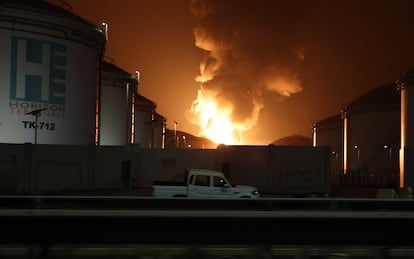
The timing of the UAE’s decision to jump ship could not have been more paradoxical. The double blockade of the Strait of Hormuz, by Iran — also an OPEC member — and by the United States, has taken almost a fifth of global production offline and threatens to trigger what the International Energy Agency calls “the biggest energy crisis in history.”
But that waterway connecting the Persian Gulf to the Indian Ocean will reopen sooner or later — no one can afford otherwise — and the world will go from unprecedented scarcity to an equally unprecedented glut. Supply will skyrocket, demand is already showing signs of slowing — with electric cars playing a key role — and prices will plummet. This prospect was acknowledged on Wednesday by Anton Siluanov, the finance minister of Russia, the world’s second-largest exporter. And it opens a new chapter in the story of global energy.
That OPEC is losing one of its members — it currently has a dozen, mostly African and Gulf countries — is not in itself extraordinary. Indonesia left for the second time in 2016, Qatar — a heavyweight in the gas market but a lightweight in the oil market — followed suit in 2018, Ecuador defected in 2020, and Angola did the same in 2024. But the UAE’s exit is different: it strikes at the heart of the organization and plunges it into its deepest crisis since its creation in 1960.
After years of substantial investment, Abu Dhabi’s production capacity hovers around 12% of OPEC’s total. That’s nearly five million barrels per day, although today, with the Strait of Hormuz closed, it’s only able to sell less than two million. If its expansion plans materialize, the UAE’s capacity will exceed six million barrels per day in the coming years. That would still be below Saudi Arabia — the world’s largest exporter — but increasingly close, sharpening a rivalry that extends beyond OPEC into conflicts and influence battles in Yemen, Sudan and the Horn of Africa.
“The move may signal a more urgent need for revenue by the UAE — reflecting reconstruction, rearmament, and the loss of revenues from oil, tourism, and nomadic wealth," said Paul Donovan, chief economist at the Swiss investment bank UBS, in the UBS podcast.
The UAE’s departure also opens a dangerous breach in a ship — OPEC — that was already listing under the weight of surging production outside the group. The biggest pressure comes from the Americas: the United States, Canada, Brazil, Argentina, and even tiny Guyana, which is on the verge of reaching one million barrels per day despite its small size.
Hamad Hussain, from the analysis firm Capital Economics, predicts that it could “embolden other members to follow the UAE’s lead by leaving OPEC” or, at the very least, undermine group cohesion. “For what it’s worth, Iraq and Kazakhstan also have a recent history of not sticking to output quotas,” he added.
A decade ago, in a bid to keep control of the oil market, OPEC created a larger umbrella group known as OPEC+, bringing in countries such as Russia, Kazakhstan, Mexico and Oman. Even with this expanded alliance, the bloc never managed to regain even half of the global market share — and with the UAE now preparing to walk out as soon as Friday, its influence will shrink further. That is welcome news for major importers in Asia and Europe, who are paying a steep price for the closure of the Strait of Hormuz, but far less so for the petrostates that have grown rich on oil for nearly a century.
With talks underway between Abu Dhabi and Washington to secure a financial lifeline to weather the Strait of Hormuz crisis, its withdrawal from OPEC is also seen as a nod to U.S. President Donald Trump, who faces midterm elections with low approval ratings and a stalled war against Iran. “It will bring the Emirates even closer to the U.S. and is a victory for the White House, which had been pressuring the region’s producers to leave the group and increase oil production,” argue Gregory Brew, Firas Maksad, and Henning Gloystein, from the geopolitical consultancy Eurasia, in a brief report. Late Wednesday, Trump hailed Abu Dhabi’s “great” decision.
The UAE’s exit from OPEC is also a forward‑escape — a recognition that the oil era is finite. Even the most pro‑oil governments acknowledge that crude has a limited future. The world’s main use of oil today — moving goods and people — is heading toward rapid electrification. The long‑feared “peak supply” never arrived; instead, the real turning point is peak demand, and it is not far off.
What we are seeing now is only the beginning. Sooner or later, oil will be confined to sectors that are hardest to electrify — aviation, perhaps — and to the vast petrochemical industry, which uses crude to produce plastics and other materials. Producers can see the threat coming, and the UAE has chosen to accelerate output — selling as much oil as possible while it still has value. Its goal is simple: to leave as little of its reserves stranded underground as possible. For Abu Dhabi, it’s their final chance to cash in.
Sign up for our weekly newsletter to get more English-language news coverage from EL PAÍS USA Edition









































