
Ceasefire? What ceasefire?
Neither the United States nor Iran has yet entered into a compromise following the announcement. For now, the negotiations are not aimed at bridging differences, but rather at imposing them
We are asked to call the agreement announced on April 8 between the United States and Iran a ceasefire. But a ceasefire is not merely a pause in attacks between two actors. It also requires a minimum of shared understanding, a willingness to exercise restraint, and some recognizable political horizon. None of that is guaranteed today. What exists, at best, is a precarious two-week pause.
Just look at how the two sides are presenting it. Washington does not frame it as a first step toward de‑escalation, but as the consequence of its military superiority. Tehran, for its part, does not speak in terms of concession either, but of resistance and of its adversaries’ miscalculation. When both sides describe the ceasefire as the result of the other’s failure, we are not looking at a basis for understanding but at two incompatible narratives of victory. This makes it difficult to build a serious negotiation.
The unwillingness to negotiate is also evident in the content. The U.S. plan requires Iran to end uranium enrichment, dismantle its missile program, and scale back support for its regional allies. Iran, by contrast, insists on maintaining its right to enrichment and links any progress to security guarantees and new rules governing passage through the Strait of Hormuz. These are not minor differences. They are maximalist positions that show that neither side has yet entered a logic of compromise. For now, the negotiation is not aimed at bridging differences but at imposing them.
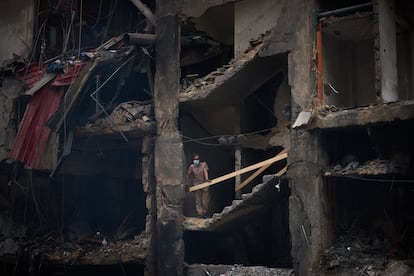
And then there is Israel, which has exposed the fragility — or outright fiction — of the supposed ceasefire. After the announcement, it launched one of its most intense offensives on Beirut and other parts of Lebanon, arguing that the ceasefire did not cover Hezbollah. In other words, one of the main fronts connected to the war continues to burn, while one of Washington’s key partners behaves as if nothing essential had changed.
The problem is not only that Israel continues to carry out airstrikes. The problem is that there is not even a minimal consensus on what exactly the ceasefire covers. Iran and Pakistan have insisted that Lebanon must be included. France has argued that any credible ceasefire must also encompass that front. But the United States and Israel maintain the opposite. A ceasefire whose territorial and political boundaries are disputed from day one is not a stabilizing mechanism. It is simply another arena for conflict.
Nor is there any real de‑escalation visible on the ground. Washington maintains the threat of resuming operations if diplomacy fails. Iran remains on high alert and continues to use the Strait of Hormuz as a tool of pressure. It is difficult to speak of a ceasefire when the material architecture of the war — armed deterrence, economic coercion, reciprocal threats, and the immediate capacity to resume hostilities — remains intact. What we are seeing is not the dismantling of the conflict, but rather its provisional management.
From Europe, there is a tendency to read any ceasefire as good news. But confusing temporary relief with a peace process is both an analytical and political mistake. This ceasefire was not born of mutual recognition, nor of a clear framework, nor of a genuine willingness to negotiate. It emerged from exhaustion, from the risk of a larger escalation, and from the tactical need to regroup without abandoning core objectives.
That is why the right question is not whether the ceasefire will hold for two weeks. The question is whether a ceasefire truly exists at all. And the answer today is uncomfortable but obvious: not entirely. What we have is not peace, nor even an effective regional ceasefire, but an armed pause between actors who continue to interpret the situation through the lens of their own victory, the other side’s defeat, and their freedom of military action. Calling it a ceasefire may be helpful for headlines. But it does not honestly describe what is happening.
Sign up for our weekly newsletter to get more English-language news coverage from EL PAÍS USA Edition









































