
Tech magnate Peter Thiel strengthens ties with Milei in Buenos Aires
The founder of Palantir, the data processing company, arrives in Argentina after his visit to Rome to talk about the Antichrist
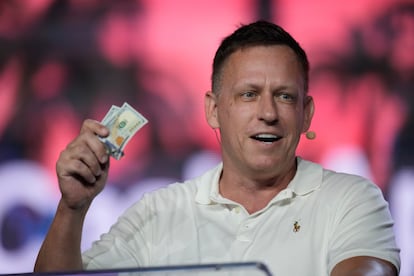

Buenos Aires has become the latest destination for Peter Thiel, the tech oligarch who owns Palantir and PayPal and brings his anti-woke and warmongering crusade to every place he visits. After his trip to Rome to speak about the arrival of the Antichrist, this advocate of far-right ideas — who is very close to U.S. President Donald Trump — is currently keeping a private schedule in the Argentine capital that includes high-level political meetings, among them one with President Javier Milei, whom he met in 2024.
Thiel, one of the world’s richest men — with an estimated fortune of over $23 billion — has been in Buenos Aires with his family for at least a week. According to local media, they are staying in a luxurious home in Barrio Parque, an area of embassies and French and English-style mansions. In recent days, it has been reported that Thiel had lunch with Santiago Caputo, Milei’s powerful star adviser, dined at the home of the Minister of Deregulation and State Transformation Federico Sturzenegger, and on Sunday attended the great Argentine soccer derby at the Monumental Stadium: River Plate versus Boca Juniors, which the visiting team won by a single goal.
The meeting with Milei is scheduled for Thursday at 2:00 p.m., sources at the Casa Rosada, the seat of government, confirmed to EL PAÍS. It will be one of the Argentine president’s first activities after returning from his official trip to Israel and the fourth meeting he has held with Thiel in two years. They met in January 2024 at the Casa Rosada; again in May of that year in Los Angeles, during the Milken Institute forum; and once more in Buenos Aires. “Argentina has all the conditions to be the new mecca of the West,” Milei said at the time.
Thiel arrives at his new meeting with Milei with the same low profile as always, but this time surrounded by controversy after the publication of a post on Palantir’s account summarizing the core ideas of his book The Technological Republic. The text denounces “the limits of soft power” and urges the development of artificial‑intelligence weapons on the premise that enemies will not pause the technological race “to indulge in theatrical debates about the merits of developing technologies with critical military and national security applications.” It also argues that “the atomic age is ending, and a new era of deterrence built on A.I. is set to begin.”
Among Thiel’s long list of enemies is Leo XIV, whom he considers a “woke Pope” because he warns of the dangers of artificial intelligence — which, for the billionaire, represents the future. He sees himself as a kind of prophet: the world is approaching apocalypse, and only he and his followers can save it.
Thiel also argues that freedom is incompatible with democracy and believes that the West is under threat from various forces, including immigration. Palantir, which specializes in large‑scale data processing, has found a lucrative niche in this arena: its work has been central to tracking and monitoring individuals suspected of being undocumented immigrants in the United States, facilitating operations by Immigration and Customs Enforcement (ICE). In 2025, more than 440,000 people were deported.
In Argentina, some researchers believe it is no coincidence that Thiel has returned at the moment of Milei’s lowest approval ratings since taking office in December 2023, amid a difficult economic situation and corruption scandals plaguing his inner circle. “What Palantir provides is a surveillance and control tool that could be of use to the Argentine government,” says Valeria di Croce, author of El arca de Milei: ¿cómo y con quién construyó su poder? (Milei’s Power Base: How and With Whom Did He Build It?)
Thiel, for his part, is interested in the same things as the U.S. administration: cheap energy, raw materials, and vast tracts of land. “Argentina is not being invited into technological development,” di Croce adds, “it is being invited, as [Foreign Minister Pablo] Quirno signed in the United States, ‘to guarantee U.S. national security as a supplier of raw materials.’”
Thiel and his business partner, Alex Karp, drew inspiration from The Lord of the Rings when choosing the name of their company. The palantíri were the “seeing stones” that Sauron used to dominate minds across Tolkien’s Middle‑earth. That all‑seeing eye is now fixed on Argentina.
Sign up for our weekly newsletter to get more English-language news coverage from EL PAÍS USA Edition









































