
New attacks in Middle East lay bare the fragility of US-Iran ceasefire
Israel is complying with the truce brokered by Trump, but has intensified its airstrikes on Lebanon. Tehran has struck infrastructure in Gulf countries and remains ambiguous about the reopening of the Strait of Hormuz
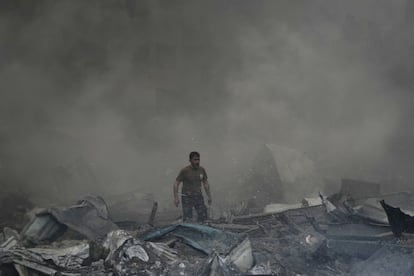
The fragile two-week ceasefire reached early Wednesday morning between the United States and Iran remains in effect, albeit precariously. Amid deep mutual mistrust, each side is proclaiming an absolute victory and attributing a crushing defeat to the other. The cessation of hostilities has eased tension in the global economy as oil prices eased, having skyrocketed by 50% over more than five weeks of conflict. But the truce is faltering amid new attacks in the Middle East. Israel, which is abiding by the agreement reached by the U.S. president, launched the largest wave of airstrikes on Lebanon this Wednesday in over a month of parallel fighting with the pro-Iranian Hezbollah militia. Tehran has also struck again at the energy infrastructure of the Gulf countries allied with Washington.
U.S. Secretary of Defense Pete Hegseth has proclaimed an “overwhelming victory,” while the Ayatollahs’ regime, for its part, triumphantly announces “the era of Iran.” But the precise terms of the truce that both sides have agreed to through Pakistan’s mediation remain unclear. With conflicting accounts: in his initial announcement, Donald Trump appeared to have based the negotiations on Iran’s 10-point proposal, which maintains uranium enrichment in its nuclear program. On Wednesday, the U.S. president once again emphasized the 15-point U.S. plan, which calls for the country’s denuclearization to prevent it from acquiring nuclear weapons.
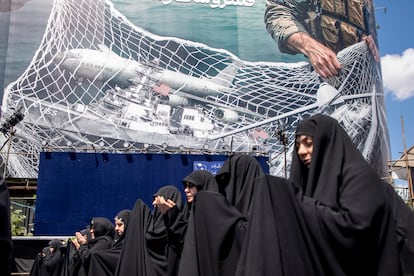
The first major test of the ceasefire’s durability will come this Friday, when delegations from the two countries begin the first round of negotiations in Islamabad, the Pakistani capital, to work out an agreement that will definitively end the war within two weeks.
Meanwhile, all eyes are on developments in the Strait of Hormuz, a key component of the agreement. Iran has pledged to reopen it to shipping during the cessation of hostilities, under a safe-transit protocol supervised and regulated by Tehran, which intends for this to involve the payment of a fee.
Several merchant ships have reported receiving messages stating that the strait remains closed, and they claim the directive comes from Iranian authorities. The Pentagon, for its part, maintains that the strategic chokepoint is clear.
“What we know is that Iran is going to say a lot of things. A lot of people are going to say a lot of things, claim a lot of things. What has been agreed to, what’s been stated, is the strait is open,” Defense Secretary Hegseth stated at a press conference on Wednesday to analyze the military situation following the truce’s entry into effect.
The Pentagon chief avoided answering questions about possible military escorts for oil tankers and other merchant ships attempting to pass through the Strait of Hormuz. He also noted that the U.S. military deployment in the area will remain in place to ensure that Iran complies with the ceasefire, keeps the strait open, and respects the terms agreed upon during the negotiations.
Hegseth also referred to one of the major issues still to be resolved in the negotiations: Iran’s nuclear program. Like Trump, he has demanded that Iran hand over its stockpile of more than 450 kilograms of highly enriched uranium, which could eventually be used to develop nuclear bombs.
According to the Pentagon chief, Trump could still order a raid on Iranian territory to seize that material, which is buried many meters underground and access to which is blocked by debris left over from the U.S. attack last June. Experts believe that such a mission would be excessively risky, due to its technical complexity and the time required to complete it, which would expose participants to Iranian retaliation.
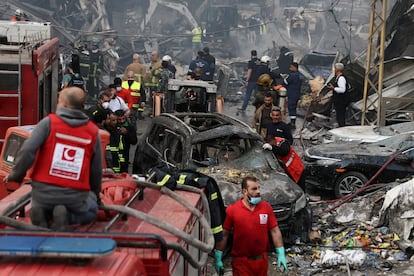
160 bombs in 10 minutes
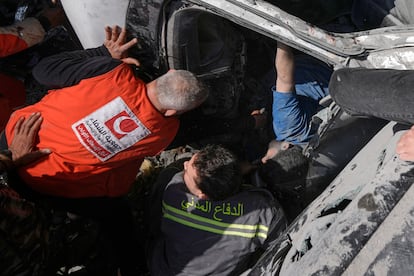
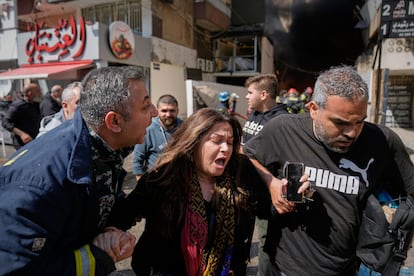
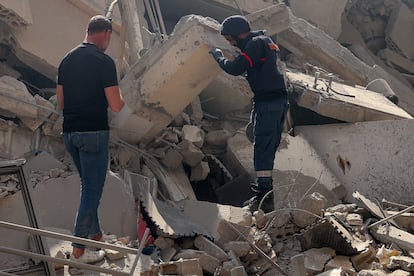
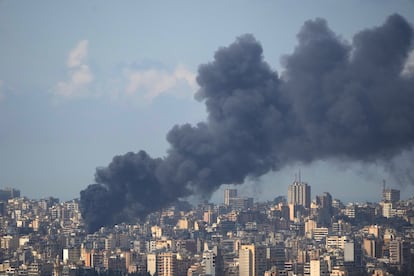
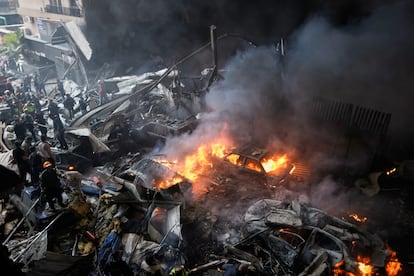
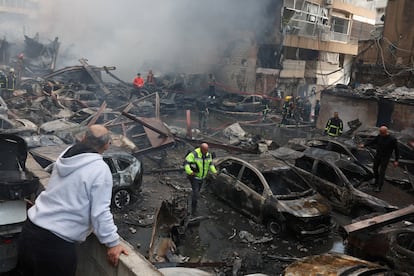
The ceasefire has not brought peace. On Wednesday, Israel launched the largest attack of its campaign against Lebanon, dropping 160 bombs in just 10 minutes on some 100 Hezbollah positions. This could mark the start of a large-scale offensive or the final wave following more than a month of airstrikes on the neighboring country. The international community is calling on the Israeli government to extend the ceasefire to Lebanese territory, but Trump has merely responded on social media that Lebanon is not part of the agreement.
The head of the Israeli Army, General Eyal Zamir, has warned that his forces will continue to strike Hezbollah “with determination” in Lebanon. According to Lebanese authorities, the bombings have caused “dozens of deaths and hundreds of injuries.”
Although the ceasefire with Iran also applies to Lebanon, according to the Pakistani mediator, Israeli Defense Minister Israel Katz insisted on Wednesday on the “separation of spheres of action between Iran and Lebanon.”
Tehran has hailed the truce as a victory that underscores Washington’s “historic impotence.” Kuwait and the United Arab Emirates, for their part, have reported new missile and drone attacks on critical energy infrastructure.
Saudi Arabia also claims to have intercepted and destroyed nine drones on its territory. The East-West pipeline, the only route for exporting Saudi oil outside the Strait of Hormuz, was hit in an Iranian attack, an industry source told Reuters, adding that other oil infrastructure facilities were also attacked.
Sign up for our weekly newsletter to get more English-language news coverage from EL PAÍS USA Edition









































