
Trump’s threats against Iran spark fears over potential war crimes
Attacks on civilian infrastructure and power plants in Iran violate international law, according to experts. Tehran has also targeted the energy sector in the Gulf


U.S. President Donald Trump gave Iran 48 hours on Sunday to meet his demands and open the Strait of Hormuz, declaring: “Tuesday will be Power Plant Day, and Bridge Day, all wrapped up in one, in Iran.” The following day, he escalated his threats, saying “the entire country could be taken out in one night, and that night might be tomorrow night.” And on Tuesday, Trump warned “a whole civilization will die” if Tehran does not comply with his demands.
Each of these recent statements from Trump has raised fears that the United States is openly willing to commit war crimes. Attacking infrastructure essential to the survival of the civilian population — such as power plants, oil wells, bridges, and roads — can be considered a violation of international law, according to experts who spoke with EL PAÍS. Trump said he was “not at all worried” about committing possible war crimes.
“The only legal basis for directing attacks against objects or structures in a war is that they are effectively contributing to the military action,” explains Tom Dannenbaum, a law professor at Stanford University, via email. This type of threat “suggests attacking facilities based on their contribution to the functioning of a modern society. It is a threat of committing war crimes,” argues the author of The Crime of Aggression, Humanity, and the Soldier.
In Iran, infrastructure guarantees the survival of its 93 million residents. Timothy Snyder, a renowned U.S. historian specializing in the Holocaust, has suggested that Trump’s threat to wipe out an entire civilization could be punishable under the U.N. Genocide Convention.
“A whole civilization will die tonight, never to be brought back again.” -Trump
— Timothy Snyder (@TimothyDSnyder) April 7, 2026
Article III
The following acts shall be punishable:
(a) Genocide;
(b) Conspiracy to commit genocide;
(c) Direct and public incitement to commit genocide;
(d) Attempt to commit genocide;
(e) Complicity…
Even when energy resources are used to move military vehicles and weapons systems, these infrastructures cannot be attacked “if doing so puts the survival of the civilian population at risk,” explains Mary Ellen O’Connell, professor of International Peace Studies at the University of Notre Dame and author of The Art of Law in the International Community, via email.
“The most important principle of International Humanitarian Law is that civilians should never be intentionally attacked, and civilian objects are also protected,” O’Connell adds. This is set out in the Geneva Convention (four conventions) signed in 1949, after World War II, to establish how different parties to a conflict, including civilians, must be treated.
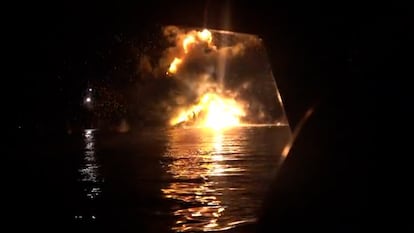
Meanwhile, the threats are already beginning to materialize. Israel, the United States’ ally in the war against Iran, struck on Monday the petrochemical complex linked to the massive South Pars gas field — the largest in the world, shared by Iran and Qatar. It is the second attack on this facility, a key piece of infrastructure for Iran’s natural‑gas supply and for much of its economy.
Iran also accuses the United States and Israel of attacking another petrochemical complex in Marvdasht. On Tuesday, Iranian authorities reported a new bombing on Kharg Island, key to its oil industry, as well as strikes on the country’s railway lines.
Professor Adil Haque, a specialist in the law of war at Rutgers University and author of the book Law and Morality in War, noted on the social network X that the Israeli attack against Iranian civilian infrastructure “may be intended to trigger an Iranian response (probably also illegal) that will derail whatever negotiations are ongoing.”
Iran has also carried out similar actions against energy and water infrastructure in Gulf countries. Following the initial U.S. and Israeli attacks on February 28, the Islamic Republic responded with offensives against neighboring countries. Some of these attacks targeted military installations near ports, refineries, and storage facilities, though they did not affect energy production.
“There are serious reasons to believe that both sides in the conflict have violated international law in their conduct of the war. Neither side can invoke the other’s violations to justify its own,” Dannenbaum notes.
Iran’s response
The escalation intensified when Israeli warplanes launched the first large-scale attack on the South Pars gas field on March 18. Iran’s response was swift. Tehran attacked refineries in Saudi Arabia, Kuwait, and Bahrain. It also struck a gas field in the United Arab Emirates and the country’s main oil storage facilities, which connect to a pipeline that bypasses the Strait of Hormuz. Iran also targeted in Qatar an installation central to the liquefaction and export of liquefied natural gas.
Tehran has also sought to raise the economic cost of the conflict. It has blocked and restricted maritime traffic through the Strait of Hormuz, a route through which roughly 20% of the world’s oil supply passes.
Trump went so far as to declare last week that, without a deal, the United States would “conclude our lovely ‘stay’ in Iran by blowing up and completely obliterating all of their Electric Generating Plants, Oil Wells and Kharg Island (and possibly all desalinization plants!).” Desalination plants are crucial for the supply of drinking water in the Gulf.
In an article, legal expert Tadesse Kebebew from the Geneva Water Hub argues that attacking hydroelectric plants could lead to the “weaponization of water,” and result in devastating humanitarian consequences for millions of civilians. Similarly, the destruction of hydroelectric plants could affect tens of millions of people, depriving them of basic services such as access to clean water, medical care, and food, according to Amnesty International.
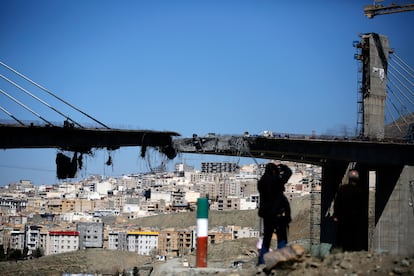
The International Committee of the Red Cross said that its “teams are seeing the destruction of infrastructure essential for civilian life. Power plants, water systems, hospitals, roads, bridges, homes, schools and universities have come under fire.” The statement adds that the most “alarming” threat is to nuclear facilities, because a miscalculation could cause “irreversible consequences.”
The precedent in Ukraine
This is not the first time civilian infrastructure has been targeted in a recent armed conflict. In 2024, the International Criminal Court issued arrest warrants for then-Russian defense minister Sergei Shoigu and a Russian general for attacks on energy infrastructure in Ukraine that caused excessive harm to civilians. During the four years of the full-scale invasion of Ukraine, the Russian military has struck and damaged much of Ukraine’s energy sector facilities and its capacity to generate electricity, which has had a devastating effect on civilian lives, especially during the most recent winter of the war.
Kyiv has responded, with particular intensity in recent months, by striking Russia’s oil industry in an effort to undermine Moscow’s revenue‑raising capacity. Some of these attacks have also hit parts of Russia’s power grid.
The president of the European Council, António Costa, stated in an article in X that targeting civilian infrastructure, including energy infrastructure, is “illegal and unacceptable.” “This applies to Russia’s war in Ukraine, and it applies everywhere,” he said.
Dannenbaum believes that “there have always been illegal attacks, but in Ukraine, Gaza, and now in this war, there is a tendency toward blatant violation; that is, a violation without even a rhetorical adherence to the notion of legal restraint.” He warns: “That is deeply damaging to the rule of law.”
In a letter published in Just Security magazine, 100 U.S. experts argue that they are concerned about the “dangerous rhetoric” of Trump and the Pentagon. They cite as an example the words of Defense Secretary Pete Hegseth, who went so far as to claim that the United States does not fight according to the “stupid rules of engagement.”
These rules require that, in war, the warring parties act with distinction, proportionality, and caution, explains Carlos Espósito, professor of public international law at the Autonomous University of Madrid. This means seeking a balance between concrete military advantage and humanitarian considerations (protecting civilians in times of war). Espósito notes, however, that there is an institutional problem: the mechanisms for enforcing these norms are limited when the violator is a major power.
According to Espósito, this situation is observed in conflicts such as the war in Ukraine, where “the documentation of possible war crimes coexists with the paralysis of the [U.N.] Security Council due to the Russian veto power.”
The result is a legal order that offers incomplete protection and ultimately depends on the will of the very states it purports to regulate. Even so, he warns, abandoning these norms is not an option: international law often survives wars, and when wars end, it is precisely these rules — imperfect but in force — “that help to shape peace.”
Sign up for our weekly newsletter to get more English-language news coverage from EL PAÍS USA Edition









































