
Iran’s attacks strain its relations with the Arab Gulf states
Tehran claims its targets are US military interests, but countries in the region reject its justification and fear being drawn into a conflict they have tried to avoid
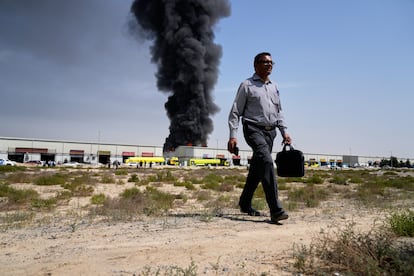

Just hours after Israel and the United States launched a large-scale joint attack against Iran on Saturday morning, Tehran responded with a barrage of hundreds of missiles and drones aimed at Israeli soil but also at most of the Arab Gulf states. Amid calls from senior Iranian officials to bury any remaining red lines, the Islamic Republic opted to immediately expand the conflict zone to include states in the region hosting U.S. military bases with an Israeli troop presence, such as southern Syria.
These airstrikes against the Persian Gulf countries resumed again on Sunday morning in retaliation for the death of Iran’s Supreme Leader, Ali Khamenei, and hundreds of civilians. For the second day in a row, the loud roar of explosions echoed east of Riyadh, the capital of Saudi Arabia, and plumes of smoke once again clouded the skies over Dubai, in the United Arab Emirates. Air defenses were also activated overnight in Manama, the capital of Bahrain, and Doha, the capital of Qatar, was shaken again from the early hours of the morning.
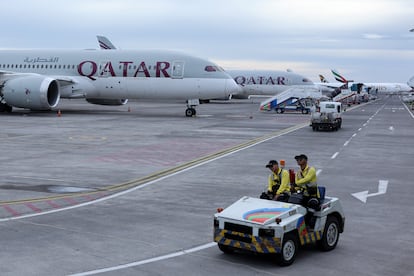
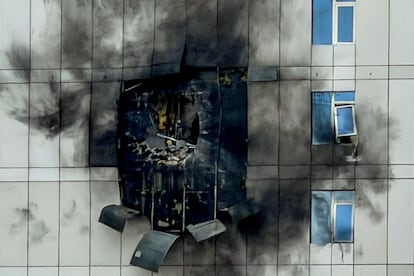
Although Tehran’s stated target has been U.S. military interests, its attacks on Gulf Arab states have left a trail of serious civilian damage. In the Emirates, at least three people have been killed and around 60 wounded in attacks that set fire to Dubai’s main commercial port and a luxury hotel. In Manama, several residential buildings, including another luxury hotel, have been hit, and in Doha, some intercepts are taking place over densely populated civilian areas. International airports in Kuwait, Abu Dhabi, and Dubai have also been affected, amid widespread disruption to air traffic in the region.
This aggressive response from Iran has placed the Gulf Arab states in a precarious position, as they are being drawn into a conflict they have tried to avoid by actors with far superior military capabilities and power projection than themselves. In an attempt to recover from this setback, the region’s capitals are rushing to formulate a common response in defense of their national security and sovereignty. But a prolonged war could reduce their room for maneuver and push them toward more direct involvement.
Some experts believe Iran’s attacks in the region are intended to deter Gulf Arab states from allowing the United States to use their territories in the military operation and, at the same time, compel them to increase pressure on Washington to halt the war. However, they also warn that this strategy could backfire, drawing Gulf states closer to the United States and granting it greater freedom of movement.
Iranian Foreign Minister Abbas Araghchi reiterated on Sunday in an interview with Qatari broadcaster Al Jazeera that he has been in contact with all his counterparts in the region to convey that it is not they who are being attacked, but rather American targets. He also acknowledged that Iran’s neighbors “are not happy” and that “some are even angry,” but asserted that “they should be angry with Israel and the United States” for imposing this war on them.
Despite these justifications, Saudi Arabia, the United Arab Emirates, Qatar, Kuwait, and Bahrain have strongly condemned the attacks in their countries. In official statements reflecting a similar stance, they have criticized the attacks as a violation of their sovereignty, pointed to Tehran as solely responsible for this escalation, and affirmed their right to defend themselves and respond. Speaking at a U.N. Security Council meeting in New York on Saturday, Bahrain’s ambassador, Jamal Alrowaiei, representing the Gulf states, Jordan, and Syria, declared that they hold the Iranian government “fully responsible” for the attacks and reject “any justification or explanation” to excuse its actions.
Along the same lines, the diplomatic adviser to Emirati President Anwar Gargash declared on Saturday in an interview with Sky News Arabia — the first by a high-ranking Gulf official — that Tehran’s attacks on these countries in response to the U.S. and Israeli offensive, are increasing the regime’s “isolation” and predicted they will damage their relationship “beyond war.” Gargash also rejected the notion that Iran is compartmentalizing its sovereignty to justify the attacks, accused the Iranian government of targeting more than just military bases, and reiterated that Iran needs them to stop the conflict.
Escalation of war
One factor that could precipitate greater involvement of the Gulf Arab states in the conflict is whether Iran openly attacks targets in the region that are not linked to the United States. Some, in fact, already seem to suggest this. On Saturday, Saudi Arabia reported that it had thwarted attacks in the east of the country, where its oil infrastructure is concentrated and where no U.S. military assets are known to exist. And on Sunday, Oman, the only Gulf country that did not suffer attacks on Saturday and one of the main mediators between Washington and Tehran, also claimed that two drones had attacked a commercial port in the country. At least three ships were also attacked on Sunday in the strategic Strait of Hormuz.
One of the strongest rebukes of these attacks came from the Secretary General of the Gulf Cooperation Council (GCC), Jassem Albudaiwi, who on Sunday condemned the Iranian actions as “brutal” and “treacherous,” and deemed them an “unacceptable escalation.” He also noted that the GCC countries had assured Tehran that they would not allow the use of their territories or airspace for any operation against Iran.
Since the beginning of the year, several countries in the region, along with Egypt and Turkey, had been mediating to prevent an open conflict between the United States and Iran, but Saturday’s offensive and Tehran’s response appear to have buried this diplomatic effort. On Sunday morning, the Sultan of Oman, Haitham bin Tariq, spoke with Egyptian President Abdel Fattah al-Sisi and King Abdullah II of Jordan, and they agreed to continue coordinating their efforts to resume dialogue. But no concrete initiative has yet emerged.
Sign up for our weekly newsletter to get more English-language news coverage from EL PAÍS USA Edition









































