
Yomif Kejelcha, the athlete who made history but whom nobody will remember
The Ethiopian athlete broke the symbolic barrier of the 42.195-kilometer race, but only Sebastian Sawe, the winner in London, will go down in the annals of sport
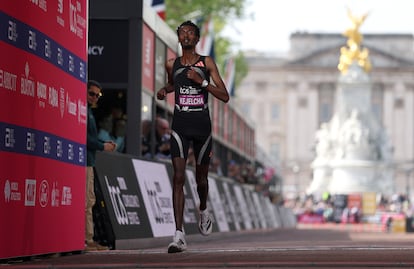

Neil Armstrong took a small step to set foot on the Moon and plant a flag, and everyone is still talking about him; he’s a children’s hero. Just seconds later, Buzz Aldrin also stepped off Apollo 11, but he received less attention. There is also a certain silence surrounding the slender figure (1.86m, 59 kilos) of Yomif Kejelcha, who was right by Sebastian Sawe on Sunday in the final mile of the London Marathon and, like the Kenyan who etched 1:59.30 on his white running shoes, reached the finish line just 11 seconds later.
“It’s my destiny,” Kejelcha might have declared, being as he is the perennial runner-up in almost every competition, a kind of Poulidor of athletics, who adds to his four silver medals in all kinds of World Championships — cross country, outdoor track, and road — the unusual misfortune of breaking the two-hour barrier in his debut marathon and still not winning it. Only he can say with absolute certainty that he has never run a marathon in over two hours.
Perhaps his mindset, his modesty, a lack of ambition, which doesn’t match his spectacular class and style, has something to do with the stubbornness with which he piles up good results and few victories (two world titles in the 3,000m indoors are all) an athlete who has achieved great marks in all distances: in the mile (he was the world record holder for the distance indoors, 3m 47.01s), in the 3,000m (7m 23.64s), in the 5,000m (12m 38.95s), the 10,000m (26m 31.01s) and the half marathon (57m 30s, the second best mark in history, as in the marathon, his destiny). Haile Gebrselassie and Kenenisa Bekele, his elders and a reference point in Ethiopian athletics, achieved Olympic and world titles, and records, but their marks pale next to those of the humble Kejelcha, who was defeated by an opportunistic Frenchman in the final straight of the last 10,000m World Championship in Tokyo.
That same nonchalance was also evident in his statements before and after the 26.5-mile (42.195 km) race to London’s Big Ben and beyond. Before the race, the 28-year-old Kejelcha said it would be “impossible” for him to break two hours in his first marathon, although he would try to keep pace with the pacemakers who would guide his Adidas teammate Sawe to the 30-kilometer mark. After his 1:59:41, he was on cloud nine, despite not winning, as is almost always the case. “It’s crazy, I feel great, I’m speechless,” he said after the race. “My coaches told me I was ready... I didn’t expect to break two hours, but London is also my dream marathon. I come to London and this happens in London, and I’m so happy...”
Kejelcha’s track pedigree, which delights fans, sets him apart from Sawe, a 31-year-old Kenyan athlete from the stable of Italian manager Gianni Demadonna, a 71-year-old marathon runner, and coached by Claudio Berardelli, an Italian from Brescia (the same coach as Olympic 800m champion Emmanuel Wanyonyi), who has only ever run on asphalt. Kejelcha has run four marathons and won all four (Valencia, Berlin, and London twice), and in his last victory, he improved his personal best by 2 minutes and 35 seconds, the time he achieved in his debut at the distance in Valencia.
Kejelcha’s story also includes a turbulent period: his years in Oregon, coached by Alberto Salazar, a former marathon runner suspended for doping, who managed Nike’s long-distance running projects.
Shortly afterward, Kejelcha — Adidas’s Plan B in London — left Nike, the first brand to announce the two-hour marathon project. It was achieved in a somewhat theatrical way in 2019 with Eliud Kipchoge, but viewed from a distance, that accelerated run through Vienna’s Prater is something like the Soviet Sputnik compared to NASA’s Apollo XI. In athletics, the equivalent would be 97-gram, single-use shoes costing $500 online, with a carbon plate enclosing airy foam — worn by Sawe, Kejelcha, and Ethiopia’s Tigst Assefa.
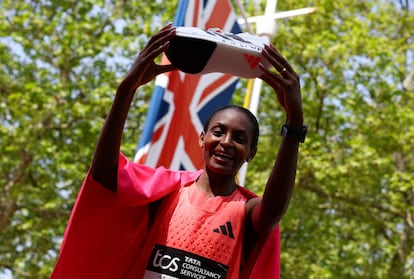
Assefa also broke a world record (in the women-only marathon, without male pacemakers) when she won on the Mall in London with a time of 2:15:41, defeating Kenyan Hellen Obiri, who wore laceless, sock-like On shoes, custom-made with a 3D printer to fit her feet. The number of records set in a single morning along the Thames shows how much technology has contributed.
Sign up for our weekly newsletter to get more English-language news coverage from EL PAÍS USA Edition









































