
From the lab to the trail: The scientific truth about training barefoot
From an evolutionary anthropological perspective, human beings have adapted to be able to run and work out without shoes, and biomechanics show the practice can be beneficial if adopted gradually
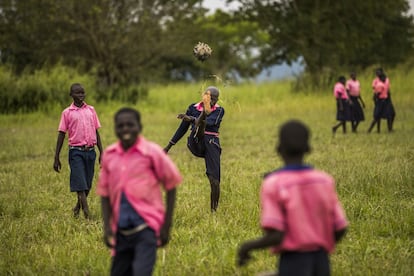

The world became fascinated with the athlete Abebe Bikila at the height of his career, when he won the gold medal in the marathon at the 1960 Olympic Games in Rome. He ran the race barefoot when the sneakers he’d been given proved to be a poor fit and were giving him blisters. He preferred to compete the same way he had trained: with no shoes at all.
Another notable example from outside the world of sports is that of the Tanzanian Hadza tribe. Due to their nomadic lifestyle, which is based on hunting and gathering practices, they run barefoot across varying terrain, allowing for a wide range of movement. Another community that has been studied by biologists, doctors and anthropologists is that of the Rarámuri, who call themselves “runners on foot” and “people of the fleet feet.” They are also known as the Tarahumara, and live in a mountainous region of northern Mexico. The tribe is famous for the way that racing forms part of its culture. Members run barefoot or with sandals made of recycled tires or leather. In his book Born to Run, writer Christopher McDougall explores their ability to run long distances, giving rise to notable Rarámuri athletes like María Lorena Ramírez, who won the Ultra Trail Cerro race in 2017 wearing traditional clothing and huarache sandals.
Nowadays, exercising barefoot or with minimal footwear has become trendy, and is seen as a way to come into close contact with nature. In Australia, it’s typical to see people walking around stores, service stations and campgrounds with no shoes. But modern technological advancements in the athletic shoe industry have allowed for improvements in the quality and comfort of our stride, even helping us to avoid injuries while working out. It’s important to keep in mind that since prehistoric times, humans have been wearing shoes, beginning in the Paleolithic era, when we started to craft sandals and moccasins out of animal skin. The first athletic sneakers appeared in the 1970s.
When we see a person training or merely walking around barefoot or while wearing minimal footwear, some questions come to mind. Are there any risks associated with leaving behind shoes? Is it efficient, facilitating movement? And, is it really natural?
Scientific evidence allows us to shed some light on these queries. From an evolutionary anthropological and biological perspective, human beings have evolved to run barefoot. Natural selection favored adaptations that optimized shoeless locomotion — functional plantar arches, elastic tendons and an upright posture — and that increased sensory feedback in their rejection of excessive cushioning. In that sense, running barefoot or in minimal footwear could improve running economy, due to reduction in footwear weight and technique modification, although such benefits may only be observed after gradual periods of adaptation to the practice.
Studies have not indicated that running shoeless or in minimal footwear leads to a direct reduction in injuries, which are most influenced by technique and weight than what one has on their feet. Here’s one tell: in the summer, a shift to walking barefoot or in sandals for long periods of time increases the load carried by plantar muscles, and when the shift to shoeless is abrupt, it can result in plantar fasciitis. Such risks point to the importance of an adequate transition period, one that is gradual enough to include adequate strengthening of the muscles in our feet and lower body.
But if done correctly, walking barefoot or with light footwear can increase the strength in our foot muscles, primarily by stabilizing the plantar arch and building support for the rest of body. Working with objects that seek to shorten the sole of the foot through toe grips, rolling objects across the sole of the foot, and walking on uneven or unstable surfaces like sand or grass allow the muscles to be activated, key to increasing strength, preventing injury and improving overall performance in dynamic activities.
This chart sums up the characteristics, benefits and potential risks of different kinds of training:
| Modality | Characteristics | Benefits | Risks |
|---|---|---|---|
| Barefoot | Lacks protection and leads to maximum contact with the ground. | Increases proprioception and muscle activation, and results in a more natural running style. | Can produce injuries from cuts, impact of hard surfaces, or due to a lack of gradual adaptation |
| Minimalist footwear | Very flexible footwear with no support for the foot’s arch. | Simulates barefoot movement and strengthens the foot’s musculature. | Includes risk of overuse, if transition to the footwear takes place rapidly |
| Sports shoe | Protects, cushions, supports the plantar arch and allows control of pronation. | Useful for hard surfaces and for beginners. Reduces initial weight on the foot. | Can reduce muscular activation, altering the natural mechanics of one’s movement |
Other questions concern the where and how of working out in minimal or no footwear. The practice is best employed during functional training, when it can help to activate key muscles in the foot, and in so doing, improve balance and proprioception. Walkers may opt to replace traditional athletic sneakers with minimalist footwear, in addition to amateur runners with good technique, during certain functional training activities.
The most important thing to keep in mind is that transition to such practices must be done safely, gradually and in a way that avoids injuries. Here are some recommendations to do just that, according to scientific studies:
- Increase barefoot or minimal footwear training by 10 to 20% per week, wearing athletic shoes the rest of the time.
- Include exercises that strengthen the plantar arch, like heel lifts, walking slowly with a towel wrapped around the foot, picking up objects with one’s toes, and heel-toe exercises on unstable surfaces.
- Promote forefoot striking with a stride rate of between 170 and 180 steps per minute, avoiding long strides that increase impact on the foot
- Start on surfaces such as grass, soft earth or smooth indoor floors, avoiding asphalt, sidewalks or uneven rocky surfaces. Introduce other types of surfaces gradually.
Scientific evidence shows that training barefoot or in minimal footwear can be a valuable tool when carried out progressively and gradually. Bikila, the Hadza and the Rarámuri remind us that human locomotion originally took place without shoes, and that going back to our natural state can offer benefits when done sensibly. Getting back, even partially, to direct contact with the ground beneath our feet does not mean renouncing technology, but rather, integrating our past and present in order to optimize health and movement.
Sign up for our weekly newsletter to get more English-language news coverage from EL PAÍS USA Edition









































