
‘Super López,’ the 81-year-old who ran a marathon in 3 hours and 39 minutes
Juan López started running at 66. Now in his eighties, he continues to amaze physiologists with his record-breaking feats

Running is a form of escape. You put on your sneakers, leave the house and put distance between yourself and your ordinary everyday life, a feeling that Juan López discovered at the age of 66, a year after he retired. He got hooked and now, at 81, he is still running at a pace that has amazed the scientific community. Juan runs for pleasure, for responsibility, and for love: his disabled wife needs his care and the fitter he is, the more able he is to help her.
“It’s funny, because you don’t realize what it is until you try it. We all have problems at home, and when you start running you have the same problems, but they don’t look so bad. I liked that. It keeps me fit enough to help my wife, and that is why I’ll continue with it,” he explained to the team of Spanish physiologists from the University of Castilla-La Mancha, the University of Alcalá, and the University of Pavia in Italy. The researchers, who are aiming to analyze the influence of age on physical fitness, have published their results in the journal Frontiers of Physiology.
It’s more than a sport for Juan. He runs fast. He is known as Super López or the Toledo Kenyan. Just a year ago, he won gold in the European Marathon with the incredible time of three hours, 39 minutes. That day, he ran on average a kilometer every five minutes and 11 seconds. In 2025, he achieved the world record in the 50-kilometers race with a time of four hours, 47 minutes and 35 seconds — times unattainable for most runners in their thirties. For decades, he worked as a freelance mechanic who worked all hours fixing vehicles to make ends meet and put a little by for a rainy day. Sport was a luxury that he could not afford. The year of his retirement he started walking and completed 800 kilometers (just shy of 500 miles) of the Camino de Santiago in 20 days. One of his daughters told him to go for a run.
“I started slowly. Then I met a group of long-distance runners from Toledo and that’s when one of my friends, Ricardo Ortega — who has always been my doctor and is now my coach — told me that the pace I went at was among the top four or five in Spain for my age. That surprised me a little, because I saw myself as a rookie, but if Ricardo, who has athletics in his blood, told me, it had to be right. From that moment on, I joined a federation and took it seriously. At the age of 70, I completed my first cross country championship in Mérida and became champion of Spain. That was the beginning, and since then it has been non-stop,” he says.
But his real feat as an athlete came in 2019, at the age of 75, at the World Championships in Torun (Poland). He was apprehensive that he would be up against stiff competition but returned with so many medals for his over-75 category that he couldn’t fit them all into his suitcase: in the first race, a 3,000m indoor track, he became world champion. The next day, he won gold in cross-country. After a day’s rest, he ran 10 kilometers on a road race and became world champion with the Spanish record (42 minutes, 32 seconds). Two days later, he won the half marathon. “The four golds gave me confidence to do anything: indoor track, road, and even marathon,” he says.
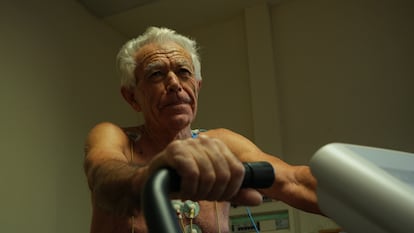
The question the scientists are asking is how is it possible that Juan is not only continuing to break records, but is improving with age? Where does his secret lie? Pedro Valenzuela, physiologist and Ramón y Cajal researcher at the University of Alcalá and founder of Fissac, has been studying Juan’s case and places the potential of this octogenarian athlete in context: “His body composition — 1.57 meters with a weight of 59 kg — is very good, and his percentage of muscle mass is 77%,” says Valenzuela. “This figure is similar to what most U.S. Marines are expected to have between the ages of 20 and 30. But it’s not this that makes him exceptional, it is his maximum oxygen consumption (VO2 max), which reflects his body’s ability to use oxygen in his muscles.
“VO2 max has been shown to be not only a great determinant of sports performance, but also a great predictor of health. Juan achieved a value of 52.8 ml/kg/min in the stress test, the highest VO2 max ever recorded for a person over 80 years of age. In fact, a study that included more than 20,000 stress tests showed that 80-year-olds have, on average, a VO2 max of 17.6 ml/kg/min, three times less than Juan. But it’s not just high compared to people his age. Juan has values similar to an 80th percentile of 30-year-olds, which means that his aerobic capacity is higher than that of 80% of men who are 50 years younger than him.”
Right now, Juan has to prioritize as the deterioration of his wife Mari has accelerated. “Sometimes I get angry with myself, but I realize that it has to be that way,” he says. “I’ve had a good run but I don’t know if I will attempt the over-85 record.”
Logically, at Juan’s age, he has few rivals. In fact, he is competing with himself. “Sometimes I compete alone,” he says. “There used to be subsidies from the town council if 10 of you were racing against each other, but it is impossible to bring so many together; we’re lucky if three of us get together. So, since I’m competing against no one, I’m just going for the records,” he explains. As a mechanic, he knows that engines work better if they are used.
The physiologists who have worked with Juan López recognize that he has special genes. But this does not explain everything: he runs between 65 and 120 kilometers a week spread over six days. This means 3,500 kilometers per year. His incredible aging process may have a non-esoteric explanation: “Training can be the key to record-breaking aging,” says Valenzuela. Juan López has his own theory: “I perform well now because I didn’t wear out the engine when I was young.”
Sign up for our weekly newsletter to get more English-language news coverage from EL PAÍS USA Edition









































