
Ali Khamenei, the Ayatollah who ruled Iran with an iron fist for nearly four decades
The country’s highest authority was considered by a large part of the population to be a dictator who never doubted in giving the order to shoot whenever they took to the streets demanding greater freedoms
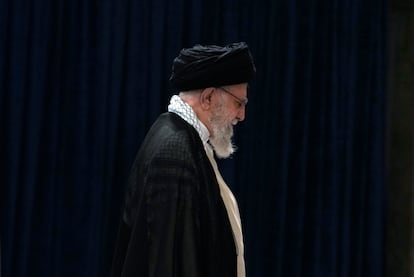

Ayatollah Ali Khamenei, Iran’s supreme leader since 1989, has been killed in a bombing raid by his arch-enemy Israel, according to U.S. president Donald Trump and Israeli sources. He was 86 years old. His followers will mourn the passing of the man who kept alive the flame of the revolution that in 1979 brought down the monarchy and transformed the country into an Islamic Republic. For most Iranians, a dictator has disappeared — one who did not hesitate to give the order to fire whenever people took to the streets demanding greater freedoms or denouncing economic hardship and whose nuclear ambitions they blame for the country’s international isolation and the bombings by the United States and Israel. Whoever succeeds him will never wield the same power, given the weight the Revolutionary Guard has acquired during his tenure and the loss of legitimacy suffered by the Islamist regime.
The old anti-monarchy slogan “marg bar diktator” (death to the dictator), which Iranians revived in 2009 (when they protested alleged electoral fraud) and have repeated at every demonstration since, reflects not only the country’s polarization but also the supreme leader’s failure to build bridges. From that point on, the idea of the supreme leader as an arbiter among the factions that had competed for control of the state since the birth of the Islamic Republic faded away. Khamenei aligned himself with the most conservative sectors out of concern that allowing reformists greater influence would jeopardize a system whose apparently democratic structure (elections, parliament) was always constrained by the supremacy of unelected institutions such as that of the leader himself. The growing repression during his 37 years in power — he was the longest-serving autocrat in the Middle East — has left the opposition decimated and with little immediate chance of presenting a viable alternative.
Shortly after those protests, framed quotations from “Imam Khamenei” appeared at the Directorate General of Foreign Press. It was not just another propaganda exercise. The use of the honorific title imam (literally, “one who preaches the faith”) sought to bolster Khamenei’s legitimacy, which had been questioned by other ayatollahs since he took office. In this way, Iran’s most powerful man revealed his weak spot.
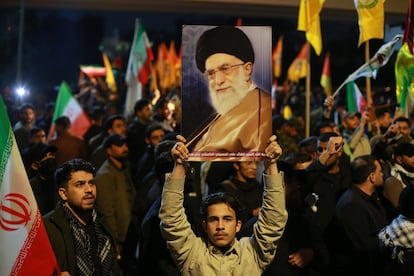
Anyone would have found it difficult to succeed the founder of the Islamic Republic, Ayatollah Ruhollah Khomeini, who also devised the doctrinal framework of velayat-e faqih (guardianship of the jurist), on which Iran’s theocracy is based and which grants the supreme leader ultimate authority over all matters of state, including the military. Moreover, Khamenei was not the intended successor. A few months before his death, Khomeini had sidelined his heir apparent, Grand Ayatollah Hossein Ali Montazeri. Unlike Montazeri, Khamenei held only the lower rank of hojatoleslam, yet he secured the backing of two-thirds of the 86 clerics who then made up the Assembly of Experts. The ruling elite closed ranks around the new leader, and all official media began referring to him as ayatollah.
Aware that he lacked the charisma and religious credentials of his predecessor, Khamenei from the outset focused on building networks of loyalty both within the Revolutionary Guard (the ideological army and backbone of the regime) and among the clerics who administer the country’s main foundations and seminaries. It was above all members of the Guard, also known as the pasdaran, who helped him consolidate his authority within Iran and expand the regime’s influence across the Middle East. He turned to them to silence every outbreak of dissent without flinching at the thousands of victims of his repression. In return, he rewarded them with growing economic and political power.
His other instrument of power was the hedge fund known as Setad, which initially grouped together properties confiscated during the revolution but later expanded through its own investments. The organization, which Reuters valued at $95 billion in 2013, includes vast real estate holdings and dozens of companies across sectors ranging from oil and industry to finance and telecommunications. This wealth enabled the regime to reward loyalists, while most of the population grew poorer as a result of inflation fuelled by economic mismanagement and international sanctions over its controversial nuclear program.
As champion of the Islamic Republic, Khamenei made hostility toward the United States and Israel the cornerstone of his foreign policy. This underpinned his support for the network of armed groups he funded in the Middle East (the now diminished “Axis of Resistance”) and his determination to master the nuclear fuel cycle as a deterrent. Only reluctantly did he accept the 2015 nuclear agreement (in part because the Revolutionary Guard, responsible for the project, expected economic and technological benefits). The withdrawal from the deal by the first Trump administration three years later confirmed his distrust of the “Great Satan,” as the regime calls the United States. The Israeli bombing in June 2025, just as Iran was once again negotiating on the issue, exposed the limits of his strategy. Many Iranians blamed him for provoking such hostility through these policies.
Ali Hosseini Khamenei, born in the holy city of Mashhad in 1939, was the second of eight children of Ayatollah Javad Hosseini Khamenei, a cleric of Azerbaijani origin (an ethnic minority that speaks a Turkic language). As is customary in Shiite clerical families, he began his religious studies even before completing primary school. Later he attended the classes of several prominent ayatollahs, including Khomeini himself, and over time became one of his confidants. From an early age he engaged in Islamist activities, which led to his first arrest in 1963.
From then on, although he returned to his studies in Mashhad, Khamenei devoted himself more to politics than to scholarship. According to his official website, the shah’s secret police arrested him several more times before the revolution. He joined the uprising against the monarch from the outset, and Khomeini appointed him to the Islamic Revolutionary Council shortly before returning from exile in Paris. Once the Islamic Republic was proclaimed, he held various positions until being elected president in October 1981. Four months earlier, he had been the target of a terrorist attack by the Mujahedin-e Khalq that left his right arm permanently paralyzed.
In addition to Persian and some Turkish (his father’s mother tongue), he was fluent in Arabic, an essential language for any scholar of Islam, which enabled him to translate the Egyptian thinker Sayyid Qutb, one of the key theorists of modern Islamist movements and undoubtedly an influence on the conservatism of his thought. Little is known about his private life, beyond his passion for horses. On one occasion he admitted that in his youth he had smoked and enjoyed traditional music — two habits considered weaknesses among Islamists. He leaves behind a widow and three sons, the second of whom, Mojtaba, was rumored in the past to harbor ambitions of succeeding him.









































