
The United States and Israel launch joint attack against Iran
Trump announces the death of Supreme Leader Ali Khamenei and encourages Iranians to seize power once the operation is over, which has caused at least 200 deaths, according to the Red Crescent. Tehran responds with bombings against Israel and US bases in the Middle East
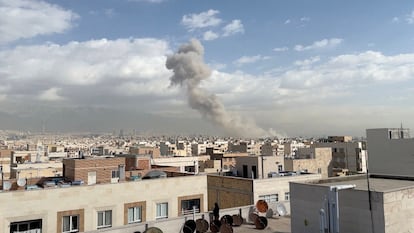
Eight months after the last war—that short-lived one—in the region, Israel and the United States launched an extensive and powerful military attack against Iran on Saturday. This is an unprecedented episode in the history of the Middle East, both because it is a joint operation from the outset and because, this time, its stated objective is to overthrow the Ayatollah’s regime: the first bombings, early on Saturday, targeted some 30 regime leaders and military chiefs, according to Israeli media. The most important of these was the supreme leader, Ali Khamenei, whose death was announced by US President Donald Trump in the afternoon. Tehran has neertheless denied this through its official news agency. Netanyahu has said that the operation will last “as long as it takes.” The death toll in Iran exceeds 200, including dozens of girls who were attending classes at a primary school, according to the Red Crescent.
U.S. President Donald Trump confirmed that it is a “major” joint operation and has urged the Iranian people to take power once it ends. Israeli Prime Minister Benjamin Netanyahu, who had been pressuring Trump for a regime change in Iran, has stated that this war will be more powerful than the one that began in June and aims to eliminate the “existential threat regime” in Tehran. The consequences of the strikes are still unknown, and Iran has been left without telephone or internet connection.
“[Iran] rejected every opportunity to renounce their nuclear ambitions, and we can’t take it anymore,” Trump said in a video released through the Truth Social network. “The lives of courageous American heroes may be lost and we may have casualties that often happens in war, but we’re doing this, not for now. We’re doing this for the future, and it is a noble mission.”
A source from the U.S. administration told Reuters that the operation will last several days.

According to the U.S. president, Iran “attempted to rebuild their nuclear program and to continue developing long range missiles that can now threaten our very good friends and allies in Europe, our troops stationed overseas, and could soon reach the American homeland.”
The ultimate goal appears to be regime change, as both the U.S. president and the Israeli prime minister have stated in their respective addresses. Donald Trump has promised to “annihilate” the Iranian Navy, the country’s nuclear and missile programs, and “certain death” for members of the armed forces, the police, and the Islamic Revolutionary Guard Corps if they do not surrender.
The U.S. president also issued a call to the Iranian people to rise up against their government. “The hour of your freedom is at hand,” he declared. “ When we are finished, take over your government. It will be yours to take. This will be, probably, your only chance for generations.” And he reiterated: “This is the moment for action. Do not let it pass.”
Along the same lines, Netanyahu made a direct appeal to Iranians in general to take power: “Our joint action will create the conditions for the courageous Iranian people to take their destiny into their own hands.”
“Help has arrived,” he said in English — in the middle of a speech in Hebrew — echoing the message that Trump sent to demonstrators in Iran in January, during the days of repression that followed the protests in December.
Iran’s Ministry of Foreign Affairs responded to the military aggression by stating that the country “will not hesitate” to respond.
“The time has come to defend the homeland and confront the enemy’s military assault,” the ministry said in a statement posted on X. “Just as we were prepared for negotiations, we have been even more prepared for defense at all times. The armed forces of the Islamic Republic of Iran will decisively respond to the aggressors with full authority.”
Israel has declared a state of emergency and closed its airspace, as has Iraq. In different parts of Israel and in neighboring countries such as Lebanon, Syria, and Jordan, Iranian missiles were intercepted. In Jerusalem, air-raid alerts sounded twice within five minutes, followed by explosions. No injuries have been reported.
A long-standing enmity
After decades of covert warfare — involving cyberattacks, assassinations of nuclear scientists, and strikes carried out through allies — Israel has entered its fourth direct confrontation with Iran in just two years, and, by all indications, the one in which no side appears willing to settle for a stalemate.
The operation had been in preparation for months, with the date decided weeks ago, despite negotiations between Washington, D.C. and Tehran, an Israeli official told Reuters.
Another senior Israeli commander told public television that the military is not only bombing infrastructure and missile launchers, but also Iranian leaders. Although he has not explicitly stated it as an objective, Netanyahu intends to take advantage of the current — internal and external — weakness of the ayatollahs’ regime and of the militias it sponsors in the region (chiefly Hezbollah) in order to bring it down.
The Israeli population learned of the start of the bombardment through the sound of air-raid sirens and a cell phone alert declaring a state of emergency. It was not a warning of an incoming attack, but rather a caution and a call to remain close to shelters in anticipation of a likely response from Tehran.
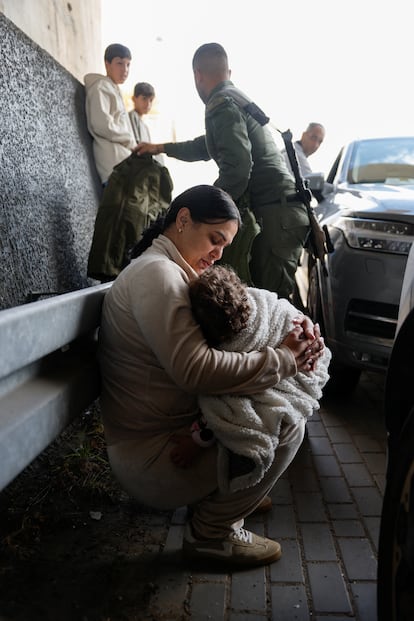
Since 2024, the end of each confrontation between Israel and Iran has, in turn, marked the start of the countdown to the next one. Israel had therefore been preparing for months, with its military on the highest alert and in close coordination with the United States.
“The Middle East is at a crossroads. The extremists refuse to give up. […] We are prepared for any scenario,” he said at an IDF cadets graduation ceremony. “And one thing is certain — if the ayatollahs make a mistake and attack us, they will face a response they can’t even imagine.”
On Tuesday, 12 F-22 aircraft — a fifth-generation U.S. stealth fighter and one of the most advanced in the world — arrived in Israel. U.S. fighter jets rarely land in Israel — and the arrival of F-22s is rarer still. They add to the also unusual presence of U.S. refueling and cargo aircraft at Ben Gurion Airport, the airport near Tel Aviv that serves as the main gateway for almost all civilian air traffic.
Netanyahu’s government also sent a clear warning to Lebanon that, if Hezbollah enters the conflict in support of its Iranian patron, Israel will bomb key infrastructure, including the country’s only functioning airport. This was acknowledged on Tuesday by Lebanon’s foreign minister, Youssef Raggi.
Earlier this week, Ramon International Airport, in southern Israel, carried out a drill involving fire engines, police, ambulances, and military vehicles. And the municipality of Haifa, the country’s third-largest city and home to its most important port, had been calling for the “immediate” preparation of public shelters that were being used for other purposes.
Israel’s arms industry has been producing Arrow-3 interceptors at an accelerated pace since August. This is the missile-defense system most heavily used during the war with Tehran that began in June and in which the United States eventually joined by bombing Iranian nuclear facilities.
The political and military consensus in Israel is that the 12-day conflict in June was a success, despite the ayatollahs’ regime killing more than 30 people and despite the interception rate of the 550 ballistic missiles reaching only 86%, exposing deadly gaps in the country’s defenses. To this day, authorities have also kept secret the extent of the damage to military installations — the main targets of Iranian missiles and drones.
All the same, Israel’s military once again showed why it is by far the most technologically advanced in the Middle East — not only because it caused more casualties and damage, but above all because of the air superiority it demonstrated. In its initial strike, it used more than 200 drones, not a single one of which was intercepted. Two days later, the armed forces boasted of having as many as 50 fighter jets over the skies of Tehran.
This was partly the result of the damage inflicted in two lower-intensity confrontations in 2024. The seed of the first was Netanyahu’s decision to kill three senior Iranian commanders in an airstrike on Iran’s embassy in Damascus. The Islamic Republic responded with more than 300 drones and missiles against Israel, but attacks that were announced — and almost choreographed — to save face domestically without triggering a regional escalation. Netanyahu had the final word, with a strike on the air-defense system protecting a nuclear facility.
Israel humiliated Iran again in July by killing the political leader of Hamas, Ismail Haniyeh, in a guesthouse in Tehran where he had been invited to stay. Two months later, it killed Hassan Nasrallah, the leader of Hezbollah — the Lebanese ally that Tehran saw, within just a few days, go from feared militia to disoriented loser. All of this led Tehran to launch a new attack — this time less calculated — involving around 180 ballistic missiles.
Testing the waters
This was back when Israel and Iran were still feeling each other out — measuring their respective strength with one eye already on the next round, like the conflict that began on Saturday.
“Israel is very much in favor of war and in favor of regime change,” but it is also aware that this would entail “a great deal of risk and chaos, especially in a prolonged campaign, in which it would likely be the main victim,” said Mairav Zonszein, a senior Israel analyst at the International Crisis Group, during a panel organized by the think tank before the outbreak of hostilities.
Bringing down the Islamic Republic would further cement Israel’s undisputed regional supremacy, by removing its main nemesis after gradually weakening or subduing its key regional backers. Israel considers Reza Pahlavi, son of the former Shah of Iran, a desirable leader to assume power in a post‑regime Iran. His father forged a close alliance with Israel until his fall in 1979, during the Islamic revolution from which the current regime emerged.
Netanyahu would also gain a valuable political calling card with voters ahead of the October elections. For now, the numbers do not allow him to re-form his current coalition with radical nationalist and ultra-Orthodox parties, according to recent opinion polls.
Sign up for our weekly newsletter to get more English-language news coverage from EL PAÍS USA Edition









































