
The unlikely path of a disabled athlete to the top of Mexico’s parasurfing scene
Isaac Rendón, who has spina bifida, found his passion in adaptive surfing. But his story highlights how inaccessible Mexican beaches are to people with disabilities
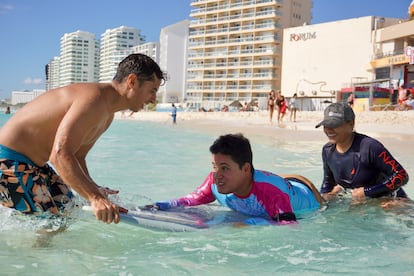
After overcoming 19 surgeries to fix his spina bifida and countless therapies, but above all, a battle against the inaccessibility of the public beaches of the Mexican Caribbean for athletes with disabilities, Isaac Rendón thought he was ready to participate in the World Surf League, to be held in Baja California Sur, and which this year, for the first time, included an adaptive surfing category, but it was not so.
Isaac, 33, originally from Cancún, was born with a disability. The condition is called spina bifida myelomeningocele. “He was born with a kind of sore on his back. His spine was exposed; you could see everything inside. He had to have surgery right after birth to close the meninges [the protective membranes surrounding the spinal cord],” says Huguette Rendón, his mother.
Since there were no specialists in Quintana Roo, they traveled to Puebla, and that’s where the ordeal began: the first six surgeries, four months in the hospital, a huge amount of money, a six-month life expectancy, and a string of misguided comments from the urologist, the ophthalmologist, the nephrologist, and every specialist involved. “The doctors kept asking me why we were still trying,” his mother recalls.
But Isaac survived, although he had no mobility in his legs. He went to kindergarten on an adapted skateboard. Over the years, he got a walker. Thirteen more surgeries followed, most to replace the valve he’d had in his brain since birth to regulate cerebrospinal fluid.
In one of those procedures, when he was still a child, he was in a coma for two weeks. When he regained consciousness, the left side of his body was unresponsive, and he had to leave the operating room in a wheelchair. So his right hand remained his only functional limb. And so, with his right hand, he achieved more than any of his classmates: he graduated with a degree in culinary arts, and his knowledge of textures and colors led him to paint on canvas. Later, his restless spirit took him to archery, shot put, boxing, cycling, running, dancing, and swimming.
“He was going to swimming lessons as part of his rehabilitation, but one day he was swimming with other people with mental disabilities and, in an accident, they almost drowned him. He told me he didn’t want to train there anymore,” says Huguette.
Learning how to surf
During one of his regular physical rehabilitation sessions, when he was 25, he met Javier Ortiz, who, in addition to being a sports physiotherapist, is part of the Quintana Roo Surf Association. One day, he suggested taking him to the sea to surf. “That’s where I found my true passion,” Isaac says.
—What does surfing have that other sports don’t?
“It’s therapeutic. The contact with the sea and the sand relaxes you. It’s very good, very therapeutic, both physically and mentally. Think of it like yoga, but in the water. You don’t think about anything other than enjoying yourself, training, and getting tired,” Isaac replies.
They started going frequently to Cancun’s hotel zone to train, but they encountered inaccessible beaches. Tourism development in this famous vacation destination has come at the expense of public beaches: where there were once parking lots, urban amenities and access points, the space is now occupied by bars, hotels and nightclubs.
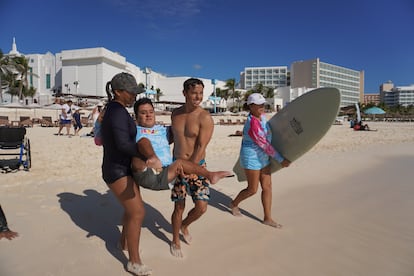
“We train at Delfines and Forum beaches, but neither is accessible. Delfines has a very steep ramp, which is super dangerous, but it only goes as far as the restrooms; after that, there’s nothing. We can’t go any further because there are only steps. And at Forum, the access walkway doesn’t reach the sea. There could be a wooden path that wouldn’t damage the beach, but there’s nothing. Every time we train, several of us come to carry him to the sea. It’s incredibly heavy to carry him, in addition to bringing the boards and the wheelchairs,” says Javier, Isaac’s therapist and surf coach.
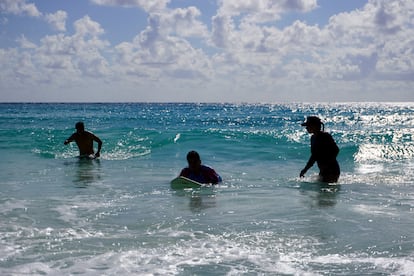
One November morning, Isaac and Javier are accompanied by Daniel Landaverde, whose leg disability stems from a motorcycle accident. Their routine consists of warming up their muscles, reading the sea to determine the best entry point, and devising the best strategy for riding the waves. At this beach, the waves break every seven seconds. They are fast and low.
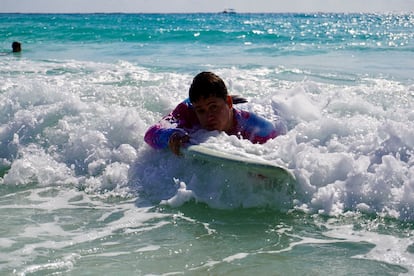
Isaac is carried in, helped into the sea, and the board is brought to him. He climbs on, and Javier takes him about 100 meters out, from where he surfs with a certain grace to the shore. There, another person must be waiting to catch him and help him get back on the board so he can repeat the feat. This time he did well; he only came out with red eyes, unlike other times when he ends up with a bloody nose from hitting the board. “That’s what I like, that it’s a challenge, that it’s not easy. I like the public to see that we have no limits, that we can do this,” Isaac says.
The team’s dedication has led Isaac to victory in the Quintana Roo surf tournaments of 2019, 2022 and 2024. Last year, he also won the National Championship organized by the Mexican Surfing Federation in Colima. And this year he had his sights set on the World Surf League, held from November 20 to 23 in Mexico, and which included adaptive surfing for the first time, in an exhibition format. “We had been invited, but we didn’t go. We couldn’t raise the money we needed,” Isaac laments.
A world not designed for them
People with disabilities not only struggle in a world not designed for them, resulting in a life expectancy 12 years shorter than average, due to the high cost of medical care, the risks of navigating cities that don’t consider their needs, and the likelihood of developing other health conditions over time, as revealed in a recent study by The Lancet. They also lack employment opportunities that might guarantee some economic independence, and allow them, for example, to showcase their skills and stories of overcoming adversity in an international surfing competition.
In 2023, only 1.5% of the 100,000 establishments in Mexico employed people with disabilities, according to data from the National Institute of Statistics and Geography (Inegi).
“Isaac’s case is very complicated. He studied gastronomy, but there isn’t a single kitchen adapted for him. He could work in an office, but he only has one functional hand. It’s very complicated. At one point he sold the paintings he made, but for now he’s not working. His sister and I take care of him,” says Huguette, his mother.
Perhaps next year they’ll raise enough money for the international competition, perhaps by then the beaches will be more accessible, or perhaps everything will remain the same. What Isaac does know for sure is that he won’t give up his passion for the waves.
Sign up for our weekly newsletter to get more English-language news coverage from EL PAÍS USA Edition









































