
The mystery surrounding Cuba’s next ruler: The man who is emerging as the ‘Delcy Rodríguez of Havana’
Amidst a gerontocratic leadership, younger and lower-profile politicians are emerging. Some are already occupying positions of power, such as the great-nephew of Fidel and Raúl Castro
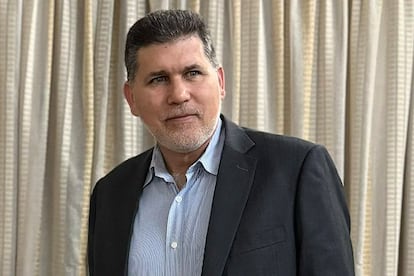

He doesn’t have an X account. He’s not on Facebook. Nobody knows where he lives or what kind of life he leads. In fact, people don’t have a clue who he is. “I’ve never heard of him,” says a bakery worker in Bauta, a municipality west of Havana. “No idea who he is,” a housewife from Pinar del Río shrugs, when asked if she knows Óscar Pérez-Oliva Fraga, the great-nephew of Fidel and Raúl Castro. According to several analysts, he could play the same role in Cuba as Delcy Rodríguez did in Venezuela. He’s a technocrat who has the qualifications to become president of Cuba in the event of negotiations with Washington. And his low profile is a good sign for the survival strategy of the Castro dynasty, should they decide to back him.
Pérez-Oliva Fraga is a 54-year-old electronics engineer. In recent months, he has risen rapidly through the ranks of Havana’s power structure. There are several reasons why some experts consider him to be a political pawn amidst the current tensions. Firstly, he’s the son of Mirsa Fraga Castro and the grandson of Ángela Castro, the older sister of Fidel and Raúl. He possesses – almost compressed into his very being – the physical traits of his surname: well-defined, somewhat severe features, small eyes, as well as a warlike air. He lacks, however, the charisma that someone like Fidel possessed.
Sergio López Rivero – a professor of Cuban history who has studied the historical process of Castroism – believes that the man “lacks the connection with the masses that populist leaders require, [as well as] the mythical [presence] that originally surrounded his ancestors.”
That being said, he does possess other attributes that make him a candidate: he’s relatively young (compared to the aging leaders in Havana) and his name isn’t one that many associate with the Cuban government’s hardline policies, likely because he comes from the economic sector. He has experience leading the trading company Maquimport – which imports machinery – and working on projects in the Mariel Special Development Zone. Currently, he holds the positions of deputy prime minister of the Republic of Cuba and minister of Foreign Trade and Foreign Investment, which directly connects him to the economic and military structure of the Armed Forces Business Enterprises Group (GAESA). According to comments made by Cuban Prime Minister Manuel Marrero Cruz some time ago, he’s “a well-prepared individual who has all the qualities to assume the new tasks assigned to him.” Clearly, he enjoys the approval of the regime.
According to Rivero, it’s still “risky to predict a replacement [for President Miguel Díaz-Canel], given the authoritarian logic and the evident leadership crisis of the Cuban regime.” However, he notes, Pérez-Oliva Fraga has risen to a key position that could lead him to the post. At the end of last year, he was appointed as a deputy to the National Assembly of People’s Power. “This is the necessary step for him to assume the presidency of the island, according to current legislation,” Rivero points out.
From the beginning of the Cuban Revolution, Fidel Castro was the figure who held absolute power in the country. First, starting in 1959, he was prime minister. Then, after his official appointment on December 3, 1976, he became the president. It wasn’t until 2006 that, faced with his declining health, Raúl assumed leadership of Cuba. Two years later, Fidel formally “resigned” from his position as president of the Council of State and as commander-in-chief, but not before ensuring that power remained in the hands of the family dynasty.
Afterward, there was a significant leap, to April 19, 2018: in a symbolic photograph, Raúl, 86, is seen grasping the hand of the then-vice president of the Council of State, Miguel Díaz-Canel, (almost 30 years his junior), thus declaring him the next president of the island.
For nearly seven decades, the position has been passed from hand to hand. “These three figures have exercised power without a direct vote from society, but rather via a ratification vote of their candidacies by the [National Assembly],” says Dr. Carlos M. Rodríguez Arechavaleta, a political scientist specializing in the institutional history of the Cuban republic, political transitions and democratization.
Giving the vote back to the people
The capture of Nicolás Maduro has led to threats of a political squeeze on Havana by Washington. Since the operation, some have wondered who would be in a position to engage in dialogue with the Trump administration.
Alejandro Castro Espín – a colonel in the Interior Ministry, former head of Cuban counterintelligence and Raúl Castro’s only son – is believed to be leading the alleged negotiations with the Americans in Mexico, despite Cuba’s denial of such talks. However, other candidates are considered more suitable for the position.
In addition to Pérez-Oliva Fraga, several experts consulted by EL PAÍS mentioned various prominent figures in Cuban politics, such as Prime Minister Manuel Marrero, or Roberto Morales Ojeda, secretary of Organization of the Communist Party of Cuba (PCC). No one sees female leadership as being possible in a country where men have historically dominated high-ranking positions. Sergio Ángel Baquero – a professor and researcher with the Cuba Program at Sergio Arboleda University, in Bogotá, Colombia – believes that the aforementioned individuals “have been very close to Díaz-Canel’s current model of government and could hardly represent any kind of change.” He asserts that “they would maintain the logic of continuity” of Castroism.
The 2019 Constitution of the Republic of Cuba established a two-term limit. The text stipulates that the president must be a Cuban citizen who is at least 35 years old and that they must have previously been elected to the National Assembly of People’s Power. The president must also receive votes from the members of that Assembly to assume office. “It’s not a direct vote by the people, but an indirect one, and it must be by an absolute majority. That is, more than 50%,” the researcher says. The person holding the office must also be a member of the PCC, which is the only political party in the country.
Arechavaleta, for his part, insists that “the election of the president depends little on the preferences of the average citizen. Rather, it’s a top-down ‘election,’ based on criteria of ideological loyalty and the regime’s continuity.”
Amid this uncertain situation, Cuba’s leadership has been discredited. Its limited capabilities – as well as the disadvantages of the aging core group that has governed for years – have become evident. Experts continue to highlight Pérez-Oliva Fraga as an emerging figure amidst a leadership vacuum. Baquero believes that he “could even represent a transformation,” due to “his more business-oriented profile.” This is in a context, he emphasizes, where a “profound economic transformation” is necessary.
Previously, the government was positioning General Luis Alberto Rodríguez López-Calleja – Raúl Castro’s former son-in-law and head of the military conglomerate GAESA – for the position. But in 2022, he died suddenly, at the age of 62.
“I believe that Pérez-Oliva Fraga’s technocratic background and experience in trade diplomacy [mean that he has] firsthand knowledge of the new geopolitical dynamics and the rules governing foreign trade and investment,” Arechavaleta opines. “[This] could lead him toward a reformist stance, in the face of the rigid structure of the Cuban regime’s leadership.” The academic maintains that Cubans “know very little about his political profile, which, I believe, is only just beginning to develop.”
Despite President Trump’s assertion that this is the last year of the Cuban dictatorship, Washington’s plans for Havana – beyond the economic embargo – remain unknown. Experts believe that “Trump’s governing style inevitably leads to coerced negotiations,” which his administration has advocated in favor of since cutting off fuel supplies that were going from Venezuela to Cuba.
“In this context,” Baquero argues, “perhaps the question isn’t whether there are other figures in Cuba, but rather what forms of transformation might emerge, or what kind of openings could occur in this new scenario.”
Sign up for our weekly newsletter to get more English-language news coverage from EL PAÍS USA Edition









































