
María Corina Machado and Delcy Rodríguez: Two Scheherazades in Trump’s backyard
If I were to write a chapter of this story, I would imagine that both leaders are capable of building a free and sovereign country
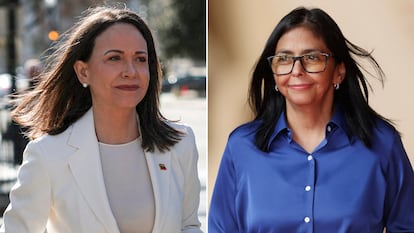
Before Hugo Chávez came to power, Venezuela was known worldwide for its beauty queens, soap operas, and oil. Today, in Venezuela’s shocking and chaotic political drama, two women lead the opposing political blocs. Delcy Rodríguez and María Corina Machado are not characters in a television melodrama innocently vying for the affections of a leading man; rather, they are two figures who have had to resort to cunning, like modern-day Scheherazades, to survive in a landscape dominated by an external “sultan”: Donald Trump.
There is something extraordinary about this story. For the first time, the most visible leadership roles in the Venezuelan conflict are held by women who don’t ask permission to speak of their ambitions, but who must maneuver against the weight of a superpower whose president has decided to treat Venezuela as the gateway to his backyard.
Delcy Rodríguez, the first woman to hold the highest office in Venezuela even though she was never elected, had to wait for Hugo Chávez to die to rise within the Socialism of the 21st Century, a project that in discourse vindicates the “people” and women, but in practice reproduces patriarchal logics, privileges and inequalities.
María Corina Machado, for her part, challenged the traditional parties, all led by men who seemed stuck in a time warp. She overwhelmingly won opposition primaries on October 22, 2023, winning over 90% of the vote, only to face disqualification and relentless persecution that cut short her candidacy.
Their trajectories, though opposite in origin, reveal some of the tensions within Venezuelan society. Rodríguez comes from a left-leaning family marked by tragedy: the murder of her father, tortured after his involvement in the kidnapping of U.S. executive William Niehous. Machado, on the other hand, is heir to an industrial tradition that stretches back three centuries. In a country where corruption has eroded public trust, she embodies the oxymoron of being perceived as “rich, but honest.”
One had her father, Jorge Rodríguez, taken away during the democratic era; the other lost the family business, Sivensa, and her rights, during the Chávez era.
Both women break the mold. Rodríguez is not a mother; Machado has three children, but has dedicated much of her life to public life. Both have partners but are not married, another sign of how they also defy conventions in their private lives.
If the United States were governed by a woman, the metaphor would be different. But Trump makes the exercise easier: a powerful, misogynistic white man who, according to press reports, so desperately wants the Nobel Peace Prize that he accepts the gesture Machado was forced to make. In the same way, he covets Venezuelan oil and mineral resources so intensely that he has even threatened Rodríguez, only to later claim they get along very well.
The blond man is faced with two women with mestizo features, who must deploy strategies to navigate an environment full of flatterers and the fearful. He has belittled both of them.
Neither of them has it easy. Machado, despite her close ties to conservative sectors in the United States, is a figure with nationalist convictions. Rodríguez, although educated in the anti-imperialist tradition, is comfortable with the privileges of the champagne socialists. Neither fits entirely into the classic left-right spectrum, because in Venezuela there is a cultural egalitarianism that transcends ideological categories.
It’s as if Trump had two Scheherazades. Each must survive night after night, while also navigating internal power struggles. Rodríguez sustains, and is the architect of, an authoritarian structure. Machado persists in a near-suicidal mission: to restore democracy to a country without controling its territory, and without significant influence in the Armed Forces, the true pillar of the regime.
While Trump observes them with the condescension of a colonizer, they play their cards. Rodríguez attempts to present herself as the moderate of the authoritarian regime, who can negotiate with Washington and buy time — a constant tactic of the dictatorship. Machado, for her part, is trying to get on Trump’s radar and be considered in a potential democratic transition. Her recent visit to the White House extended her political lifespan.
Both are playing hard, have capable teams, and based on their performance, are talented and hardworking.
Of course, given what I’ve told you, it’s clear that I hope Machado succeeds in leveling the playing field to pave the way for a democratic transition, and thereby also serve as a global example that democracy is indispensable — and that in the face of authoritarianism, one must not only be brave and bold but also firm when the nation’s interests are at stake. Like many others, I support the wish of Jørgen Watne Frydnes, president of the Norwegian Nobel Committee, for Venezuela to once again be a peaceful and democratic country.
But above all, and knowing full well that Venezuelan history has more twists and turns than the best Latin American soap opera, I only hope that neither Machado nor Rodríguez are disposable, and much less that they marry the sultan. If I were to write a chapter of this story, I would imagine — as the writer Federico Vegas did — that both leaders meet and are able to agree on an agenda to build a free and sovereign country.
Sign up for our weekly newsletter to get more English-language news coverage from EL PAÍS USA Edition









































