
Delcy Rodríguez and María Corina Machado vie for Trump’s favor
The Republican will receive the leader of the Venezuelan opposition at the White House Thursday after speaking by phone with the interim president
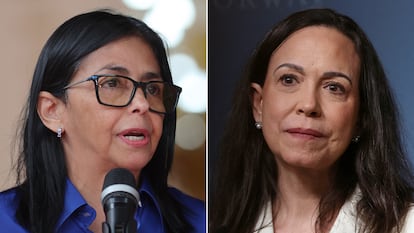

Donald Trump’s advisors know they have a volatile boss. In Confidence Man: The Making of Donald Trump and the Breaking of America, White House correspondent Maggie Haberman recounts how they keep watch day and night outside the Oval Office to see who goes in to speak with the president of the United States and what their intentions are, like a spy game. Now, Delcy Rodríguez, Venezuela’s interim president, and María Corina Machado, the opposition leader who aspires to succeed her, have entered this power struggle, trying to convince Trump — an unpredictable man — that they are the right person to lead the transition in Venezuela.
Machado will hold a working lunch this Thursday, according to the White House schedule. At the same time, Félix Plasencia, a diplomat highly trusted by the Venezuelan president, is in Washington building bridges with the U.S. government. Plasencia was key in enabling the Chavista movement to get ahead of the opposition by a few hours and secure a phone call between Trump and Rodríguez. After hanging up, the Republican said the conversation had been “excellent,” while she found it to have been conducted in a “courteous” tone. Obviously, Machado doesn’t want to be outdone and has offered to “share” her Nobel Peace Prize with the U.S. president during their meeting. With Nicolás Maduro no longer in the picture, both women are trying to curry favor with Trump.
The hours following the capture of the Chavista leader were dizzying. A power vacuum emerged that both women wanted to fill. Machado held a winning card: the endorsement of Secretary of State Marco Rubio, considered in the halls of the White House to be the most influential U.S. diplomat since Henry Kissinger. After the bombing of Caracas, she said she felt prepared to assume control of the Venezuelan government; however, Trump held an unexpected press conference in which he said that this would not happen in the short term. “I think it would be very tough for her to be the leader. She doesn’t have the support within or the respect within the country. She’s a very nice woman, but she doesn’t have the respect,” he said.
Much of Venezuela was in shock. With Maduro gone, they saw no other successor than the leader of the opposition. “Machado and her people are the ones who encouraged Trump’s deep involvement, but not the beneficiaries. For now,” says an analyst who requested anonymity while in Caracas. The White House has suggested that Machado’s Nobel Peace Prize — an award Trump himself aspired to — was key in sidelining her.
Trump has left this first phase of the post-Maduro era in the hands of Delcy Rodríguez, the Chavista leader’s vice president. The confusion over that decision was so great that many thought he had confused the names of the two women, something that occasionally happens with the U.S. president. Two important factors tipped the scales in favor of Rodríguez: a CIA report advising against appointing Machado for fear of an armed uprising by the military — controlled by Chavismo — and the advice of Richard Grenell, a Trump advisor who had established a close relationship with Jorge Rodríguez, the vice president’s brother and, at the same time, the most important political operative in the ruling party.
Delcy Rodríguez faces a daunting task. On the one hand, she must appease Trump, and on the other, the most hardline Chavista faction, those who refuse to relinquish sovereignty and consider yielding to Washington a betrayal of Hugo Chávez’s legacy. This faction is led by Diosdado Cabello, who controls Venezuelan security and intelligence. The Rodríguez family — the politicians — cohabit with the armed wing. There are many fronts to contend with. Simultaneously, the interim president is negotiating with the Trump administration over the sale of 50 million barrels of oil at market price, the release of political prisoners (which is happening very gradually), and the opening of the U.S. embassy in Caracas, a building visible from almost anywhere in the city.
These gestures haven’t stopped Trump’s bullying, the Republican now emboldened by a military intervention that has intimidated the rest of Latin America. On the very day of the bombing of Caracas, January 3, the White House released a video in which Maduro called Trump a coward and challenged him to come after him. In the next scene, the Chavista leader appeared in shackles. The video ended with the phrase: “If you didn’t know, you know now.” Trump makes no secret of enjoying the moment. When asked, he claims to be in charge of the country and has shared — with a mixture of provocation and mockery — a doctored image of a Wikipedia entry that presents him as the interim president of Venezuela.
However, anyone who considers Machado to be defeated doesn’t know her well. Astute and determined, in an extremely difficult political context, she has overshadowed the rest of the opposition, and no one doubts her leadership anymore. Those anti-Chavistas not aligned with her — especially those living in Caracas who maintain a political presence from within, however small — accuse her of being radical and of despising them. The fact is that the opposition leader plans to offer Trump the Nobel Prize this Thursday, even though the Norwegian institute has warned that it is not officially possible. The gesture will be, above all, symbolic.
Opposition figure Antonio Ecarri is active in politics from within Venezuela. He says it’s time for the opposition to unite, both those inside and outside the country. “This year is complicated, but we’re going to have more rule of law, more democracy, and significant improvements.” Ecarri has studied the Spanish Transition in depth; in fact, he has a book on the subject in front of him during a conversation with this newspaper. He would like the process to culminate in the same way, although he believes the fact that Venezuela holds the world’s largest oil reserves and valuable rare minerals makes the circumstances different. “The elections have to be the result of a national consensus. Otherwise, they will be the source of conflict. For that, income needs to be stabilized. There is no democracy amid poverty and violence. Elections shouldn’t be used to trample over others or seek revenge; they have to be used to consolidate coexistence.” In his opinion, Machado should reach out to other opposition leaders.
Machado and her inner circle believe that a successful transition is impossible under Chavismo. U.S. oil companies share this view and are demanding greater guarantees before investing. The Venezuelan government owes them enormous debts. The opposition leader has the support of Rubio, a friend. The secretary of state has scored the biggest victory of his career by removing what he considered a tyrant — the dream of Miami conservatives. Rubio must now contend with Grenell and ensure he doesn’t gain easy access to the Oval Office.
Sign up for our weekly newsletter to get more English-language news coverage from EL PAÍS USA Edition









































