
Marco Rubio, Trump’s ‘viceroy’ in Venezuela
Trump’s Secretary of State, the mastermind behind the intervention, has fulfilled his great ambition with the fall of Maduro
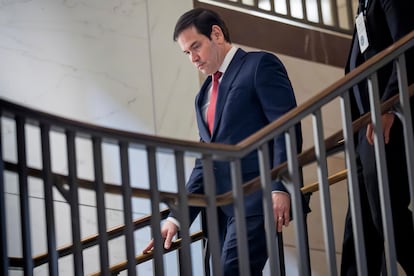

In the photographs released by the White House documenting the monitoring of the U.S. operation against Nicolás Maduro, President Donald Trump is constantly accompanied by a very serious Marco Rubio, his eyes fixed on what appears to be a screen. The secretary of state is Trump’s key figure in foreign policy, already holding the three top diplomatic posts in Washington (he is also national security advisor and administrator of what remains of USAID, the federal development agency). Now he assumes a fourth, and perhaps the riskiest: coordinating the U.S. response in Venezuela.
Rubio was the main architect of the increasingly tight encirclement of the Chavista leader over the past six months. He also closely followed the development of the military operation in and around Caracas.
The 54-year-old former senator, the son of Cuban exiles, is one of the key figures in the process. On Saturday, at a press conference at his Mar-a-Lago residence in Florida to announce the capture of the Venezuelan president, Trump revealed that Rubio had already been in contact with the new leader of the South American country, Delcy Rodríguez, holding a “very long” conversation, and that he had just conveyed to the Chavista vice president Washington’s demands — access to oil, the arrest of criminal gangs, an end to drug trafficking, and an end to collaboration with regimes hostile to the United States — in order to allow her to remain in office.
Rubio will maintain that prominent role. He will be part of the president’s four trusted advisors tasked with remotely overseeing the Venezuelan government’s actions. This quartet is completed by Secretary of Defense Pete Hegseth, Vice President J.D. Vance, and the White House Deputy Chief of Staff and advisor for domestic policy, Stephen Miller, the author of the administration’s anti-immigrant strategy. “They have all expertise, different expertise,” Trump noted in an interview broadcast Monday on NBC.
But Miller confirmed to reporters covering the White House on Monday that Rubio will be in charge of the group; Trump “has asked him to lead the efforts to enforce the directives issued by the president.”
In this role, Rubio will have to decide how to restructure Venezuela’s energy sector, the country’s greatest asset, control of which is the target of U.S. intervention. His fluency in Spanish, decades of experience in Latin America, and contacts with the Venezuelan opposition make him the key liaison for dealing with the new-old authorities in the South American country during the path to the “safe, proper and judicious transition” that Trump promised.
It’s a monumental task. The president has spoken of 18 months to rebuild an oil sector reconstructed by U.S. companies. A new economic and financial strategy, a new security and military strategy, and a new government strategy must be implemented. And it’s unclear how the process will unfold in a country with numerous paramilitary groups, where cartels are present, and where even within Rodríguez’s government, different factions are aligned.
“It’s unclear how stable this government will be in Maduro’s absence. To a certain extent, Maduro was the consensus builder, the one who brought the different factions together, and without him, they may split,” says Phil Gunson, an analyst for the Andean region at Crisis Group, an organization specializing in conflict prevention, speaking from Caracas.
One of Rubio’s main missions will be to ensure that Rodríguez strictly adheres to the directives coming from Washington. The threat is a second round of U.S. attacks and a future “worse than Maduro’s,” according to Trump. Rubio clarifies that, before reaching that point, the United States has a whole range of persuasive tools at its disposal, starting with the “quarantine” — the blockade — against ships exporting Venezuelan crude, which it has been implementing since last month, and the massive military deployment it maintains in the Caribbean, which it has no intention of withdrawing at the moment.
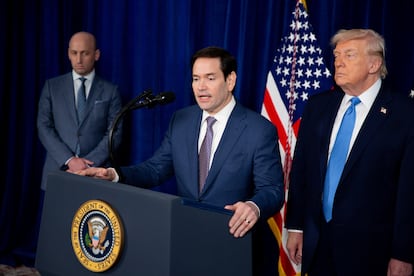
“It’s a tremendous amount of leverage that will continue to be in place until we see changes that not just further the national interest of the United States, which is number one, but also that lead to a better future for the people of Venezuela,” Rubio said in an interview Sunday on CBS’s Face the Nation.
For Rubio, reaching this point represents a tremendous victory, the fulfillment of his goal of ending leftist dictatorships in Latin America and the vindication of the hardline positions he defended during his time as a senator, when he lashed out at Maduro, calling him a “narco-terrorist.” There, Trump’s former rival in the 2016 primaries became the president’s go-to person for matters related to the region; the then-legislator tried to pressure the Republican to force the removal of the Chavista leader.
It was a stance he continued to hold after becoming secretary of state, though with little success at first. His arguments in favor of democracy and human rights found little receptiveness with the U.S. president, who initially favored a strategy of negotiation with the regime. This was the approach advocated by his original envoy to Venezuela, Richard Grenell, who, during his visit to Caracas just under a year ago, secured the release of Americans from Venezuelan prisons.
Rubio managed to capture Trump’s attention when, instead of emphasizing democracy, he pointed out to the president that Maduro had been indicted in New York on drug trafficking charges. This narrative was more to the president’s liking, a teetotaler who despises drugs after the death of his brother from alcoholism. In July, the State Department added the Cartel of the Suns, the alleged drug trafficking group that it accuses the Venezuelan leader of heading, to its list of foreign terrorist organizations. In August, it doubled the reward for his capture to $50 million. That same month, the United States began its naval deployment in the Caribbean.
Since then, Rubio has been a constant presence in the White House, meeting with Miller to devise the strategy for ousting Maduro and for post-Chavismo Venezuela, only visiting the State Department for bilateral meetings with other foreign ministers in Washington. The travel that characterized his first stint as head of U.S. diplomacy has taken a backseat. With a few notable exceptions — such as rescuing the negotiations on the war in Ukraine in Geneva in November — his trips have consisted primarily of accompanying Trump to Florida and continuing to plan the intervention there.
Rubio, whose dream is to see his parents’ homeland, Cuba, free from the Castroist regime, has framed the intervention in Venezuela as a warning to Havana and the “incompetent and senile men” running the island. “If I lived in Havana and I was in the government, I would be concerned, at least a little bit,” he declared Saturday at Trump’s press conference.
For now, the task before him in Venezuela is immense. The success, or failure, of the U.S. administration of the country will rest on Trump and him as the ones ultimately responsible. As one of his Republican predecessors at the head of the State Department, Colin Powell, liked to remind us when speaking about the last major American attempt to restructure a country — the Iraq War — “if you break it, you pay for it.”
Sign up for our weekly newsletter to get more English-language news coverage from EL PAÍS USA Edition









































