
Trump presses a new button in his strategy against Maduro: Economic strangulation through oil
The seizure of tankers points to a gradual plan to cripple the finances of Nicolás Maduro’s regime
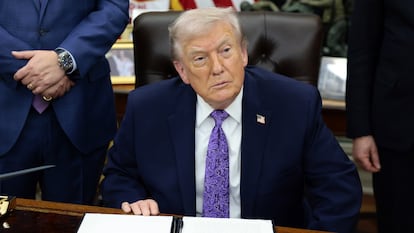
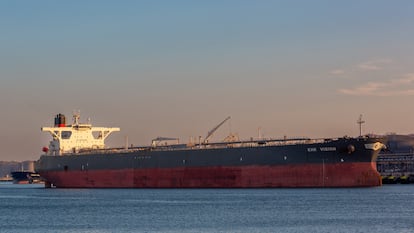
Last week’s military operation against the Skipper, an oil tanker off the Venezuelan coast, was a declaration of intent from the White House. And, following Donald Trump’s announcement of a “total blockade” against all sanctioned cargo ships attempting to enter or leave Venezuela, everything seems to indicate that there will be more. Venezuela must return “the oil, land, and other assets that they previously stole from us,” the magnate has insisted. And so, what began three months ago as an ambitious anti-drug operation has now mutated into a direct attack on the Venezuelan government’s finances.
Washington’s strategy is intensifying and has included sanctions against six shipping companies and six vessels they own, businessmen linked to the Chavista regime, and three nephews of the presidential couple. This is shaping up to be a new phase of economic strangulation for the Maduro government, which relies primarily on oil exports and is struggling with a shortage of foreign currency to contain inflation. The intensive interception of Venezuelan crude oil tankers could seriously affect the cash flow of Caracas and some of its most dependent allies, such as Cuba.
Of the 1,400 ships sanctioned worldwide by the United States, 600 are oil tankers, according to an AFP analysis using data from the Office of Foreign Assets Control (OFAC) and the International Maritime Organization. While not all of them transit the Caribbean, dozens of vessels could be affected by increased U.S. surveillance. During Trump’s first term, between 2019 and 2020, sanctions were imposed on 62 vessels linked to Venezuela. Half a dozen more were added to the list in 2021, and last week the Treasury Department added another six, according to the Vendata database.
Transparency International, in its chapter on Venezuela, has indicated that 40% of the ships arriving at Venezuelan ports to load crude oil are irregular, according to monthly monitoring by the NGO specializing in tracking corruption, which has been operating in exile since 2025.
In a report last week, the organization noted the presence of about six U.S. Navy destroyers and missile ships a few dozen nautical miles off the Venezuelan coast, a factor that could be responsible for the decrease in the arrival of “dark tankers”— those that operate with their radars turned off to avoid being tracked — in the last month.
Following the seizure of the Skipper, which was carrying 1.9 million barrels of Venezuelan oil, panic has spread and other cargo ships bound for the South American country have begun to turn back. Even so, in November, 23 sanctioned or illegally operating tankers were detected in Venezuelan ports through satellite image analysis.
But Chavismo has already learned to operate in this underground economy, thanks to its experience with the sanctions imposed by the first Trump administration, which were in force between 2019 and 2023. During those years, Venezuela sold its crude oil through opaque intermediaries, using barter, cryptocurrencies, and steep discounts — up to 35%, at least before Trump’s order — because it was sanctioned oil. The result was a massive embezzlement: more than $23 billion was lost in what became known in 2023 as the PDVSA-Crypto case. The scheme led to a violent internal purge and the downfall of one of the most powerful men in Chavismo, Tarek El Aissami, then-president of the state oil company and Minister of Petroleum.
Since the consolidation of economic sanctions against Venezuela — which imposed severe restrictions on Petróleos de Venezuela (PDVSA) in terms of oil production and sales — the Maduro regime, with Iranian support, has resorted to using tankers that operate clandestinely. These vessels sail covertly under the flags of third countries, without declaring their destination, and carry out commercial transfers on the high seas in the Indian, Pacific, and Atlantic Oceans. These are the so-called “ghost fleets,” also used to trade sanctioned crude oil from Russia and Iran.
Following the initial sanctions, and with an industry crippled by corruption and lack of maintenance, production plummeted to historic lows, falling below 400,000 barrels per day. With considerable effort, the Maduro government has gradually managed to recover to around one million barrels per day this year, but this remains far from the production levels of previous years.
Vice President and Minister of Petroleum Delcy Rodríguez reported last week that production increased in November to 1.17 million barrels per day, up from 1.13 million the previous month. Part of this recovery was made possible by the Biden administration’s oil licensing policy, which, since 2013, has eased the Chavista regime’s financial burden and prevented a collapse in revenue. This year, however, with crude oil prices falling — which particularly affects heavy crudes like Venezuelan oil — Trump has reimposed sanctions and has allowed only the U.S.-based Chevron to operate, under limited conditions, since July.
These trading conditions have a direct impact on the country’s finances. A Reuters report, based on industry sources, indicated this week that Asian buyers “are demanding deep discounts on Venezuelan crude due to a flood of sanctioned oil from Russia and Iran on offer and the heightened risk of loading in the South American country” because of the growing U.S. military presence in the Caribbean. According to the agency, this year China has accounted for between 55% and 90% of Venezuelan crude exports, compared to 40%-60% in 2024. Trump’s announcements have already had an upward impact due to the anticipated reduction in supply.
The threat of further cargo ship seizures and the intensification of fighter jet overflights are adding pressure to an already strained relationship. The Chavista regime has used the seizure of the Skipper to reinforce its narrative that Washington is seeking to take control of the country’s natural resources by force and has denounced the incident as an act of “international piracy.” Meanwhile, Maduro, speaking a few days ago at a televised event with his supporters, sang Bobby McFerrin’s classic Don’t Worry Be Happy in response to Washington’s renewed threats.
Sign up for our weekly newsletter to get more English-language news coverage from EL PAÍS USA Edition









































