
Chevron’s return offers temporary relief to Venezuela’s struggling economy
The multinational intends to produce 1.2 million barrels per day in the short term
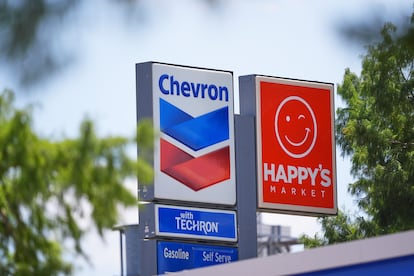
Chevron is returning to Venezuela to extract oil, and although the conditions of this new license from the U.S. Treasury Department are still unknown, experts who spoke to EL PAÍS assume that the agreement will bring net benefits that could help balance, at least partially, the country’s deficient public accounts in 2025.
A few days ago, two tankers from the company went to collect Venezuelan crude to sell at Texas refineries, where it is highly valued.
With Chevron’s contribution, expected to be around 200,000 barrels per day, experts estimate that national oil production would reach 1.2 million barrels in the short to medium term. And the Venezuelan economy, which was facing the prospect of a recession, could grow by 2%.
It’s still a very modest outlook for bankrupt Venezuela, once one of the world’s oil giants, but it’s a much more favorable scenario than the one that suggested three or four months ago.
Washington is looking to address its immediate energy needs. Meanwhile, U.S. Attorney General Pat Bondi announced that the reward for information leading to the capture of Venezuelan President Nicolás Maduro would be increased to $50 million.
With enormous efforts, and contrary to what many predicted, Caracas had managed to maintain its daily oil production volume — which today averages one million barrels per day — after the initial announcement of Chevron’s departure three months ago.
The political impact of the end of that license heightened nervousness among financial players and limited the flow of dollars into the economy, causing a currency shock that has worsened the country’s chronic inflation crisis. This year, triple-digit inflation is once again expected.
Chevron’s return is now taking shape as the Venezuelan government is about to finish paying off the massive debt it had accumulated with the corporation. Some preliminary reports have suggested that the multinational’s comeback would come with very specific restrictions that would prevent it from paying royalties or making cash payments.
According to this interpretation, Chevron would return to its partnership with the state-owned oil company PDVSA — operating through the joint ventures Petropiar, Petrobocán, or Petroindependencia — and through these entities would fulfill its tax obligations to the state, probably through payment in kind: either with additional crude that can be sold later, or with diluents that PDVSA needs to refine its extra-heavy oil (which it currently does not produce). This would be within the flexible provisions of the Anti-Blockade Law.
“Neither OFAC, nor the Secretary of the Treasury, nor the State Department in the United States, nor the Ministry of Petroleum, nor PDVSA, nor the vice presidency of the republic have said anything, not the slightest, about the conditions of this new license for Chevron,” says Rafael Quiroz, an oil economist and professor at the Central University of Venezuela, who nonetheless assumes that the company will pay royalties.
“It’s stupid to think that Chevron is going to come here, take Venezuelan oil, and not pay anything for it,” said Diosdado Cabello, the regime’s second-in-command, a few days ago, attempting to settle the controversy. “We don’t live off Chevron,” he added, trying to downplay the news. “Just as they gave them the license today, they’ll take it away tomorrow. That’s a commercial transaction like any other. This country lives off the efforts of Venezuelans.”
Sources report that commissions from both countries are negotiating the conditions. Other international companies are also interested.
“It seems this license will be different from the previous one,” says Francisco Monaldi, an energy economist and professor at Rice University. Monaldi believes the current political circumstances are determining the resolution. “The previous license was designed to pay off Venezuela’s debt, which has already fallen significantly. This license comes with different conditions, with Marco Rubio reluctant to adopt Joe Biden’s model.”
Monaldi does consider it likely that the terms of this license will be framed within a non-monetary exchange. “This way, Venezuela obtains the diluents it has to seek from Iran or Russia. Chevron’s license would allow Venezuela to sell oil directly in the United States, without discounts or intermediaries, and have diluents on hand to refine its oil. These surpluses can then be exported to Europe, India, or the United States.”
Monaldi argues that while a potential in-kind agreement with Chevron has advantages for Venezuela, as it expands its productive muscle and sales capacity, it would leave the country without liquid cash dollars that could be injected into the economy — something the national treasury currently lacks.
Venezuela has been laboriously recovering its oil production since 2021, following a historic collapse in production in the previous decade — caused by rampant corruption, currency pegging, the politicization of its objectives, and international sanctions — which had reduced national production to a mere 350,000 barrels per day.
Since 2022, under the leadership of Vice President Delcy Rodríguez, who is also Minister of Hydrocarbons, PDVSA has implemented a managerial restructuring that has sought to empower young operational staff. This has restored some of the company’s former dynamism. The Venezuelan government is also promoting domestic capital investment.
At the end of the 20th century, Petróleos de Venezuela’s average production was 2.8 million barrels per day of crude, with full refining capacity of its derivatives. According to experts, the country would need a multi-billion dollar investment in its industrial infrastructure to return to those old production levels — money that is currently unavailable.
Sign up for our weekly newsletterto get more English-language news coverage from EL PAÍS USA Edition









































