
Mojtaba Khamenei, son of the deceased ayatollah, emerges as frontrunner to become Iran’s new supreme leader
The 56-year-old cleric is neither a renowned jurist nor an elected politician, but he has close ties to the hardline wing of the Revolutionary Guard
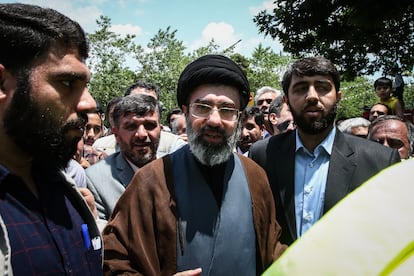

Motjaba Khamenei, 56, the son of Iran’s former supreme leader, is considered the leading candidate to succeed his father. Relatively unknown to the public, but wielding enormous influence, his potential rise threatens to escalate internal and regional tensions.
At a time when the debate over succession to the top of the Islamic Republic has become one of the most sensitive and decisive issues in Iranian politics, the name of Mojtaba Khamenei is resonating more than ever in the media and in analytical circles both inside and outside Iran. This is not due to his social popularity or an official career in executive positions, but rather to his deep ties with the most hardline commanders of the Revolutionary Guard and with the security apparatus and the inner circle of power; ties that have made him the symbol of continuity for Ali Khamenei’s policies.
For more than two decades, Mojtaba Khamenei has deliberately remained out of the public eye. He is not a well-known imam, an elected politician, or even a cleric with widespread recognition among the system’s social base. This absence is not accidental: it is part of a pattern that has made him a completely behind-the-scenes figure within the system, a man who operates in the shadows, makes decisions, but is not held accountable. Even among many supporters of the Islamic Republic, his face and his true role remain unknown or unclear. This situation is unusual for someone mentioned as a possible future leader of the country.
From war to power
Mojtaba Khamenei, a cleric born in Mashhad, had a brief presence in the Iran-Iraq War in 1986, when at just 17 years old he joined the Habib ibn Muzahir Battalion of the 27th Mohammad Rasulullah Division. At the time, his participation was more symbolic than operational. Its importance lies not in the military role he played, but in the network that was subsequently formed from those same units.
After the war, the Habib Battalion and its affiliated formations became a hub for hardline security and ideological forces; a network that, following the shift in the balance of power in 1989, gained direct access to the highest levels of the system. That year, Ayatollah Hossein Ali Montazeri was first removed from the line of succession to Ruhollah Khomeini; a few months later, Khomeini died, and Ali Khamenei was designated as his successor.
During the summer of that same year, a constitutional reform referendum was held, in which the requirement that the supreme leader be a marja’ (source of emulation) was reduced to the mere capacity to practice ijtihad (Islamic jurisconsult). These events led to the collapse of the traditional succession model, the election of a leader who was religiously weak but reliable from a security standpoint, and the shift of the center of gravity of power from the clergy to the Revolutionary Guard and the security apparatus.
With Ali Khamenei’s rise to power in the Islamic Republic, his sons — and Mojtaba in particular — assumed a position unprecedented until then. Unlike his older brother Mostafa, Mojtaba gradually demonstrated an interest in practical politics and the intricacies of power, eventually becoming a link between the leader’s office, the Basij (the Islamic militia), and the security agencies; a role that would become especially prominent during the political crises of the 2000s and 2010s.
Religious legitimacy
Mojtaba Khamenei completed his secondary education at the Alavi school and subsequently entered the religious seminary. He studied with figures such as Seyed Mahmoud Hashemi Shahroudi, Muhammad Taqi Misbah Yazdi, and Lotfollah Safi Golpaygani. For years, his teaching of a course in dars-e jarey (advanced level class in jurisprudence and principles), the highest academic level at the seminary and a key requirement for aspiring to religious authority, was presented as his main doctrinal qualification.
However, in September 2024, news broke of the suspension of this course, which had been offered for over a decade, mostly online. It was claimed to be a “personal decision,” but its timing, coinciding with the surge in succession speculation, further intensified existing doubts. For some time now, numerous Shia clerics have questioned Mojtaba Khamenei’s capacity to serve as an Islamic jurist. For his critics, the closure of the advanced course is a clear sign of the weakness of his religious legitimacy, a deficiency that even the backing of the power structure cannot easily compensate for.
Elections and repression
The turning point in Mojtaba Khamenei’s public image came with accusations of interference in the 2005 and, especially, the 2009 presidential elections. International media reports and statements from domestic political figures identified him as a key player in organizing the Basij and supporting candidate Mahmoud Ahmadinejad. Following the mass protests of 2009, his name became associated in the public eye with the apparatus of repression.
In that context, he is credited with creating the Ammar Barracks — with figures like Mehdi Taeb — an ideological and propaganda arm designed to repress critics of the system. Numerous reports describe his extensive influence within the Revolutionary Guard Intelligence Organization, the Basij militia, and even state broadcasting. The U.S. Treasury Department accused him of close collaboration with the elite Quds Force of the Revolutionary Guard and the Basij and sanctioned him in 2019.
Gray areas
In February 2026, a Bloomberg investigative report revealed a complex network of investments and properties in Europe and the Middle East attributed to Mojtaba Khamenei; a structure based on shell companies and the movement of capital through banks in the U.K., Switzerland, and the UAE, with its origins allegedly linked to the sale of Iranian oil. Although this information has been rejected by sources close to the regime, the scale and level of detail of the report has reignited questions about the relationship between political power and wealth accumulation.
For many observers, the designation of Mojtaba Khamenei as leader would simply be a continuation of the path laid out by his father: a continuation of the hardline approach, a security-focused and repressive strategy, and a greater concentration of power in unelected institutions. However, this scenario faces serious obstacles: the historical rejection of hereditary succession, the lack of social legitimacy, and deep doubts within the Shia clergy itself.
Added to this is the external dimension. Israeli authorities have openly declared that any new leader of the Islamic Republic will be considered a legitimate target. Israeli Defense Minister Israel Katz stated this Wednesday: “Any leader appointed by the Iranian terror regime to continue leading the plan to destroy Israel, threaten the U.S. and the free world and the countries of the region, and oppress the Iranian people, will be an unequivocal target for elimination.” This unprecedented warning underscores that the succession in Iran is not merely an internal matter, but carries direct regional and security consequences, evoking the targeted elimination of Hezbollah leaders.
Mojtaba Khamenei thus embodies the power behind the throne of the Islamic Republic: a figure of enormous influence who, at no point in recent history, has been publicly challenged. He is neither a recognized nor an accepted jurist, nor a politician elected by the people, nor a technocrat familiar with the complex administrative machinery of the state. Nevertheless, the commanders of the Revolutionary Guard, the security networks, and the power structure have made him a plausible option for leadership, with the stated objective of preventing an internal fracture and ensuring the ideological continuity of the system.
Indeed, this gap between power imposed from above and the lack of legitimacy from below makes his possible succession one of the most controversial and costly scenarios for Iran; a scenario that could define the country’s political course in the coming months.
Sign up for our weekly newsletter to get more English-language news coverage from EL PAÍS USA Edition









































