
CIA tracked Khamenei for months, waiting for the moment to launch the attack that killed him
The US intelligence agency identified a meeting between Iran’s supreme leader and his top officials in Tehran and shared the information with Israel, which then bombed the compound

The joint U.S.–Israeli attack that killed Ali Khamenei was an operation planned over months while waiting for the right moment, which finally came on Saturday.
During that entire period, the CIA had been monitoring the movements of Iran’s supreme leader, Ali Khamenei, to identify behavioral patterns, according to reconstructions published by U.S. media based on anonymous sources within the Israeli and U.S. militaries. When it became clear that Khamenei — whose death was announced by U.S. President Donald Trump and confirmed hours later by the regime’s television from Tehran — was going to participate in a meeting with his inner circle at a government building in the center of the capital, U.S. intelligence gave the signal, and the Israeli military machine was set in motion.
As a result of Operation Epic Fury — the name the Pentagon, with its customary bellicose fervor, gave to the start of a military campaign in the Middle East — 48 leaders of the regime died. Trump gave that figure to Fox News on Sunday, but offered no evidence to support it.
Before dropping the bombs, Israel had concluded, according to The New York Times, that Saturday morning’s meeting would gather the top brass of the regime’s repressive apparatus, which, during the most recent protests last January, killed around 30,000 people, according to sources on the ground. Among those present were Mohammad Pakpour, commander‑in‑chief of the Islamic Revolutionary Guard Corps; Defense Minister Aziz Nasirzadeh; Admiral Ali Shamkhani, head of the Military Council; Seyyed Majid Mousavi, commander of the IRGC Aerospace Force; and Mohammad Shirazi, deputy intelligence minister. All of them died alongside Khamenei.
On Sunday night, Trump — who spent the entire day speaking to reporters by phone, though he did not make a single public appearance for 48 hours — told ABC News reporter Jonathan Karl that Washington had candidates to succeed the supreme leader (he did not specify who), but that all of them were dead.
The bombing took place in broad daylight, a decision intended to maximize the element of surprise. The last time the United States attacked Iran, this past June, the bombs fell before dawn on three storage and enrichment facilities belonging to the Islamic Republic’s nuclear program. This time, the planes took off at 6:00 a.m. Israel time (seven hours earlier in Washington) and dropped at least 30 bombs 160 minutes later, at around 9:40 a.m.
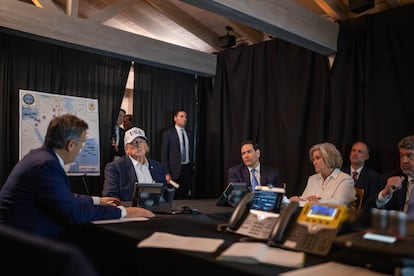
The White House released images at the end of the day showing Trump following the operation — live, according to the U.S. government. The photos were taken in an improvised room inside his private residence at Mar‑a‑Lago, which he nevertheless traveled to on Friday after visiting Texas and stopping at a hamburger joint in Corpus Christi.
His administration also published a photo taken in a setting more fitting for moments as consequential as this one: the White House Situation Room. In that image, U.S. Vice President J.D. Vance is seen presiding over a meeting attended, among others, by the Director of National Intelligence Tulsi Gabbard and Secretary of Energy Chris Wright and Treasury Secretary Scott Bessent.
In Mar‑a‑Lago, Trump was accompanied by his chief of staff, Susie Wiles; the chairman of the Joint Chiefs of Staff, General Dan Caine; and Secretary of State Marco Rubio. The photo lacks the epic feel — perhaps intentionally sought — of the one released by the Obama administration on the night U.S. forces killed Osama bin Laden. The president appeared wearing the same red cap with the blue “USA” initials that he wore in the prerecorded address to the nation posted on his social network, Truth Social, at 2:30 a.m. Florida time — nearly two hours after the missiles struck the Tehran compound where Khamenei was killed.
In a twist that can only be described as ironic, The Wall Street Journal reported that the attack was carried out with the help of Claude, the artificial‑intelligence system developed by Anthropic — the same company Trump had penalized and excluded from the lucrative Pentagon contracting business just hours earlier.
The showdown came after the tech company held its ground in a dispute with Defense Secretary Pete Hegseth, who has been conspicuously absent since the start of Operation Epic Fury, a campaign of still‑uncertain duration (Trump has variously described it as lasting a week, four weeks, or “four or five”). Anthropic demanded some control over how the Pentagon would use its tools. According to the Journal, U.S. Central Command in the Middle East had been instructed to use Claude “for intelligence assessments, target identification, and simulating battle scenarios.”
The Washington Post, for its part, reported on the role played by Saudi Crown Prince Mohammed bin Salman. The newspaper revealed on Saturday that he had spoken repeatedly with Trump to support the option of a U.S. strike, despite publicly advocating a diplomatic way out. Meanwhile, Israeli Prime Minister Benjamin Netanyahu was pushing for a military blow of the kind that ultimately took place.
Among the reasons Trump has offered for an attack that bypassed Congress and was barely explained to the U.S. public, the U.S. president cited a series of long‑standing grievances dating back to the ayatollahs’ rise to power in 1979. In his prerecorded video, Trump also said that Iranians should carry forward the regime‑change effort begun by U.S. airstrikes, since Washington has no intention of deploying ground forces.
Trump, like Netanyahu, also invoked the destruction of Iran’s nuclear program, even though that justification contradicts U.S. intelligence assessments, which consider it unlikely that Tehran would be capable of launching an attack on the U.S. mainland within the next decade. After learning the details of the military operation, it seems clear that both leaders saw an opportunity to eliminate Khamenei and believed it was one they should not let slip away.
If Trump has demonstrated anything in his second term, is the concern of someone who senses that his time in Washington may be nearing its end and wants to cement his legacy. Going down in history as the U.S. president who killed Khamenei — who had ruled with bloody determination since 1989 — is almost as important to Trump as being remembered as the only one who had the nerve to take on Iran, a problem that has plagued for the United States for 47 years. A meticulous CIA operation and the involvement of Israeli aircraft were the first step.
What happens next in a region pushed to the edge of uncertainty will determine everything else. Knowing Trump, only one thing is certain: whatever the outcome, he will find a way to present it as a personal victory if it succeeds — and to blame others if it fails.
Sign up for our weekly newsletter to get more English-language news coverage from EL PAÍS USA Edition









































