
The key to Iran’s military response: ‘Missile cities’ hidden inside the mountains
Tehran possesses a significant arsenal of these weapons, whose launch sites Israel and the United States want to disable

Iran possesses one of the largest missile arsenals in the Middle East, with more than 3,000 ballistic missiles, according to a 2022 estimate by the U.S. Central Command. Over the past decade, the country has also improved one of the main shortcomings of these Iranian projectiles: their accuracy. The West, and especially Tehran’s regional nemesis, Israel, which on Sunday continued its attacks on military and religious regime targets, along with the United States, are concerned about this. The Islamic Republic’s weaponry is conventional. Tehran does not yet have nuclear weapons and does not possess an intercontinental ballistic missile capable of reaching U.S. territory, nor is it as close to acquiring one as U.S. President Donald Trump has claimed.
With its skies defenseless due to its lack of modern fighter jets — it only possesses obsolete MiG-29s and Gunman Tomcut F-14s, the iconic fighter-bombers from the film Top Gun (1986) — and with its air defenses decimated by the 12 days of strikes in June, this arsenal is key to Tehran’s conventional response to Israeli and U.S. attacks. Aware of this, in the summer bombing campaign, Israel destroyed much of the equipment that allows these missiles to be fired: mobile launchers, usually mounted on trucks, as well as fixed launch ramps.
Precisely to prevent such attacks, Iran has built so-called “missile cities” in recent years — underground bases “excavated in the mountains” at great depths, even 500 meters below ground, emphasizes military analyst and expert on this type of weaponry, Guillermo Pulido. These facilities, scattered throughout the country, can house long-range missiles such as the Shahab-3, or the Sejil and Khorramshahr models, with ranges of up to 1,242 miles (2,000 km). The Islamic Revolutionary Guard Corps Aerospace Force, which controls the arsenal of these projectiles in Iran, has previously released videos filmed in the tunnels of these bases as part of its deterrence strategy.
Of those approximately 3,000 missiles, according to military analyst and expert on this type of weaponry Guillermo Pulido, “some 2,000 can reach other countries in the Middle East.” Furthermore, Tehran possesses “a large number of kamikaze drones and cruise missiles.” Since Saturday, Iranian missiles have struck Israel, Bahrain, Qatar, the United Arab Emirates, Kuwait, Jordan and Saudi Arabia — countries allied with Washington that host U.S. military bases. According to a report published Sunday on its Twitter account by the Tasnim news agency, linked to the Revolutionary Guard, Iran had already attacked 27 U.S. bases. It also added Oman, the country that acted as mediator in the failed nuclear agreement negotiations with Washington, to the list of targeted countries.
Even though Tehran already used several hundred missiles to respond to the Israeli and U.S. airstrikes in June — and is believed to have manufactured more since then — Iran still in theory possesses “a large quantity of munitions” with which it could continue attacking those countries, U.S. bases, and military vessels or oil tankers in the Strait of Hormuz, a vital artery through which a quarter of the world’s oil passes. On Sunday, the first direct attack on an oil tanker was also recorded in the Strait of Hormuz. One of its crew members was killed, according to the ship’s shipping company. On Saturday, the Iranian Revolutionary Guard announced that it considered traffic through the strait “dangerous,” but without officially closing it.
However, Pulido emphasizes that the effectiveness of the Iranian response will depend on whether these first two days of Israeli and American attacks manage to destroy or seriously damage “the bases from which the missiles are launched.”
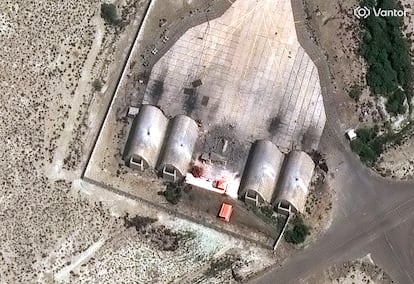
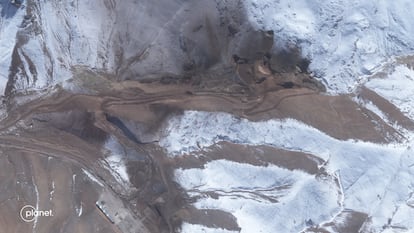
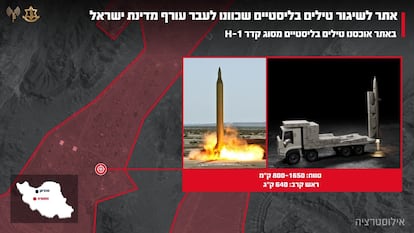
If Israel and the United States manage to damage the easily identifiable “entrances and exits of these underground cities,” or the “openings” through which the projectiles are launched, these “missile cities” would become “graves,” Pulido explains. The missiles would then be unable to take off, nor would the trucks “on which the mobile launchers are mounted” be able to leave. The Israeli army announced on Saturday that one of the targets attacked in the Tabriz area was an “Iranian ballistic missile unit” base, from which “dozens of missiles were planned to be launched toward Israel.” Satellite images later showed some of the tunnels of the collapsed facility.
The attacks by Israel and the United States on Iran, and the subsequent Iranian retaliation, which intensified this Sunday after the confirmation of the assassination of the Iranian Supreme Leader, Ali Khamenei, are, in fact, for Guillermo Pulido a “perfect example” of a new type of armed conflict: the “war of salvos” whose key element is the exchange of missiles.
This concept, coined by this military analyst, describes a conflict that “is not decided by conquering enemy territories, but by neutralizing the large quantities of the adversary’s projectiles that can destroy your state. These are wars” fought by “armies based on missiles, instead of tanks, frigates and airplanes, in a rather radical paradigm shift.”
For now, this “war of salvos” continues, demonstrating that Tehran retains at least some of its missile-launching capabilities. Some of these attacks have been successful in Iran’s eyes, as its objective is to increase the cost of the strike campaigns for the United States and Israel, especially in lives. On Sunday, Washington announced the deaths of three of its soldiers in an attack, which also left five other service members seriously wounded. An Iranian missile that struck a shelter in the town of Beit Shemesh, in central Israel, killed at least nine people and injured more than 20.
Intelligence information
Among the missile cities targeted by Israel and the United States, the largest is Khorramabad in Iran’s Lorestan province. It serves as a storage and launch site for surface-to-surface and cruise missiles, including the Shahab-3. This base was already targeted by Israel in its June airstrikes. In East Azerbaijan province lies the Tabriz facility, Iran’s second-largest missile silo complex, likely the same base the Israeli military claimed to have bombed on Saturday. The missiles stored there have a longer range. Some are theoretically capable of reaching the easternmost countries of Europe.
The Tehran region also hosts numerous missile launch sites and command centers. Other such facilities are located in Kermanshah, 326 miles (525 km) from the capital. That is the site of the Kenesht and Bakhtaran gun bases, both near the country’s western border and strategically positioned to reach targets in Israel and the Gulf.
The central province of Isfahan is home to the country’s largest missile assembly and production site, according to the non-profit NTI (Nuclear Threat Initiative), which did not specify its exact location. Built with North Korean and Chinese assistance in the late 1980s, the facility produces components, solid and liquid propellants, and assembles models such as the Shabab medium-range missile, capable of reaching Israeli territory at a distance of less than 1,242 miles (2,000 km). Isfahan also hosts two missile deployment sites, according to a report by the International Institute for Strategic Studies in London.
“Attacking those bases isn’t very complicated,” Guillermo Pulido emphasizes, but as long as Israeli and U.S. attacks fail to “destroy the launch vehicles,” Iran will retain the capacity “to inflict damage.” The key in this war, notes military analyst Jesús Pérez Triana, will lie especially “in intelligence” to locate and destroy those “missile cities.”
Sign up for our weekly newsletter to get more English-language news coverage from EL PAÍS USA Edition









































