
The incessant noise of the Shahed drone is driving Ukraine to despair
The Russian army has upgraded this weapon, produced under Iranian license, to make it the mainstay of its attacks
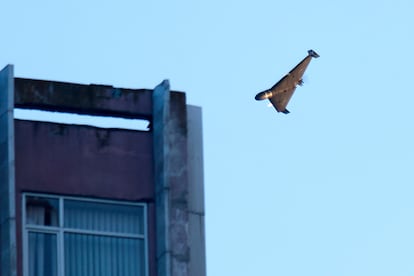

The Shahed bomb drone is a familiar threat in the Ukrainian war. Manufactured by Russia under Iranian license under the name Geran, its use in long-range attacks has been a daily occurrence since the first year of the invasion, in 2022. But it is this year that it has become the pillar of Russian pressure against Ukraine’s rearguard. It is now produced on a massive scale, and its technology has taken a leap forward, putting Ukrainian defenses in a difficult position. Russia is launching three times as many Shahed drones today as it did six months ago. Its distinctive buzzing sound is now even common in downtown Kyiv. Whereas before, they were easily shot down before reaching the outskirts of the Ukrainian capital and other cities far from the front lines, now they arrive by the dozen.
It’s currently one of the most discussed topics in the Ukrainian media and on military forums: How to stop the new Shaheds? The initial problem is the number of units used in a single attack. Ukrainian President Volodymyr Zelenskiy stressed last week that while in 2024 it was unheard of for the enemy to use more than 100 in a single day, it is now commonplace. In the first 24 days of June, between 100 and 480 Shaheds were fired over 13 nights. In four early morning attacks, more than 400 were used. The intelligence services of the Ukrainian Ministry of Defense (GUR) estimate that Russian industry is producing 170 long-range bomb drones per day, and the forecast is for this number to rise to 190.
Russia is producing the same number of Shahed and Garpiya [another drone with similar functions] in three days in 2025 as it produced in one month in 2024, according to Ukrainian and Western military intelligence. This is why Ukrainian long-range drones are targeting Russian production plants for these unmanned aerial vehicles. But the results are not sufficient, as Igor Romanenko, a reserve lieutenant general, noted on TSN, Ukraine’s main television news outlet, on June 23: “We don’t have enough long-range weapons to destroy drone production and storage centers. If we fire 50 drones, 10 will hit the target, but they don’t do much damage to the Russians; they have many production centers.”
Kyrylo Budanov, head of the GUR, announced on June 7 in the military analysis outlet The War Zone that Russia had reached an agreement with Pyongyang, one of its few international allies, to also produce these drones on North Korean territory.
In October 2022, a video of a police officer shooting down a Shahed with his assault rifle in Kyiv made its way around the world. Today, this image would be practically impossible. First, because the bombing now occurs at night, and second because those early Shahed-136s were slower, flew lower, and had a more predictable trajectory.
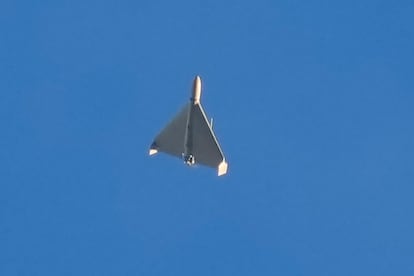
One of the main changes is altitude: Shahed drones used to fly at very low altitudes to avoid radar detection. Now, Russia chooses to fly them at altitudes of over 3,000 meters to keep them out of range of anti-aircraft machine guns. Not only that, they also change their trajectory during flight to confuse anti-aircraft systems and hit their target from different positions.
The new Shaheds are also programmed with artificial intelligence to coordinate their attacks autonomously. The most advanced version moves not with a propeller engine, but with a jet engine that increases its speed, from 190 kilometers per hour to over 450 kmph. These jet-powered aircraft are still in the minority because they significantly increase the cost of the drone. The cost to manufacture a basic Shahed is estimated to range between $17,000 and $44,000, a much lower outlay for a long-range weapon than for a missile.
Ukraine does not use missiles to shoot down drones due to the limited number of these weapons it has, such as the American Patriot or the German Iris-T. One of the last packages of U.S. military aid approved by former president Joe Biden was precisely 20,000 missiles specialized in shooting down drones. His successor, Donald Trump, halted their shipment to Ukraine and instead allocated them to the Middle East.
The so-called “mobile groups,” vans with large-caliber machine guns positioned in the path of the drones, have a 40% success rate in shooting down Shaheds. This was explained on June 22 by the head of the Armed Forces of Ukraine, Oleksandr Syrskyi. Despite this, according to Syrskyi, they remain the most important piece of the anti-aircraft defense shield. To improve their effectiveness, Reserve Colonel Oleg Zhdanov explained on TSN on June 24 that larger-caliber machine guns are needed. The problem is that there are very few units in Ukrainian hands, and its most effective ammunition is also limited.
A military officer with the anti-aircraft defense system in Zaporizhzhia, in southern Ukraine, told EL PAÍS this week, on condition of anonymity, that the best way to shoot down Shaheds is with cannons larger than 20 millimeters in caliber, firing the projectile remotely, without having to hit the target. This caliber can reach an altitude of 2,000 meters, according to this military officer.
Larger anti-aircraft guns, such as the German 35-millimeter Gepard, can reach altitudes of 3,000 meters; and the Soviet ZU-23 can reach more than 2,000 meters. When close to their target, the Shaheds descend to an altitude of between 1,500 and 500 meters, military analyst Alexander Kovalenko explained on his Telegram channel.
Syrskyi also confirmed that fighter jets such as the American F-16 and the Soviet MiG-29 are being used to intercept the drones. These operations, however, pose a high risk to such valuable aircraft, of which Ukraine has few units. Kyiv’s priority option is to invest in interceptor drones. Zelenskiy stated this on June 21, establishing their effectiveness in shooting down the Shaheds at 70%.
Ukraine, according to its president, has signed agreements with Germany and Canada for the large-scale production of these interceptor drones. These devices are detonated remotely when they are near the Shahed. During nighttime bombing raids, they can be identified by their positioning lights. According to the Zaporizhzhia military officer, this is so that anti-aircraft units can recognize them as their own drones.
Another change, according to Zhdanov, is that they now concentrate their attacks on a few targets. Dozens of Shahed drones descend on their targets to overwhelm anti-aircraft defenses. More than 80% of these drones are shot down, but a few make it past the barrier. The Russian military continues to operate combined bombing operations to further saturate anti-aircraft systems: after several waves of Shahed drones, they fire cruise and ballistic missiles that reach the target area just as the drones do.
Russia also uses Gerber drones as a diversion, an unmanned aircraft similar to the Shahed but without explosives and whose sole function is to confuse anti-aircraft guns. Nearly half of all drones Moscow deploys in attacks are these diversionary devices.
Another variation on the Shaheds is that they are now more lethal. The Ukrainian army has identified one Shahed armed with a thermobaric bomb and several carrying cluster munitions. Zhdanov adds that while they could previously carry 30 kilos of TNT explosive, they can now carry 100 kilos. This allows them to travel shorter distances, between 700 and 1,000 kilometers, sufficient to be fired from Russia or the occupied territories to reach most of Ukraine.
The toll of civilian casualties is growing. The last two major attacks on Kyiv left 40 people dead. On June 24, a bombing raid on the city of Dnipro and its outskirts caused 20 deaths and 300 injuries. Russia claims these civilian casualties are due to their homes being located in close proximity to military targets.
Sign up for our weekly newsletter to get more English-language news coverage from EL PAÍS USA Edition









































