
Ukraine breathes sigh of relief at Trump’s pledge to resume US military aid
Politicians and media outlets celebrate the US president’s decision to provide the weapons agreed on under Biden, as well as new shipments
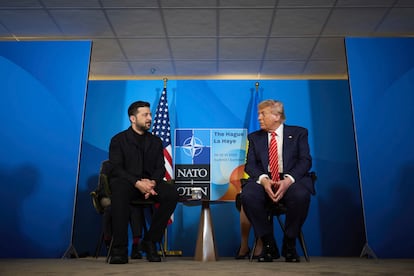

“Trump didn’t lie, the Pentagon announced good news for Ukraine.” This headline, from the Ukrainian outlet Telegraf, sums up the relief with which the invaded country has greeted the change of script written in recent hours by Donald Trump. The U.S. president stated on Monday that Ukraine would receive weapons for its own defense. That same day, the U.S. Department of Defense announced that it would unblock the transfer of military aid to Ukraine. Just a week earlier, Washington had announced that it was suspending the funds pledged by former President Joe Biden.
“There will be U.S. weapons. Despite the many discussions and publications about the U.S. withdrawal, there should have been less fuss, most of what was written was false,” Andrii Kovalenko, a member of Ukraine’s National Security Council, communicated on social media. The truth is that it was his own government that was on alert. Last week, alarm bells went off when the Pentagon confirmed to the U.S. media that it had suspended the delivery of key weapons for the Ukrainian Armed Forces, resources that had been agreed upon in the final stages of the Biden era. These included Patriot anti-aircraft missiles, Stinger man-portable anti-aircraft missiles, anti-drone rockets, precision missiles, and artillery ammunition, among others.
The Ukrainian Foreign Ministry recalled the acting U.S. ambassador to Kyiv, John Ginkel, for consultations on July 2 to express its concern. Ukrainian President Volodymyr Zelenskiy held a conversation with Trump on July 4 to explain that his country would be helpless in the face of large-scale Russian strikes without U.S. air defenses. Zelenskiy obtained a commitment from the Republican leader to find ways to support Ukraine. “It was probably the best conversation we’ve had to date, the most productive one,” Zelenskiy added.
The relationship between the two has been marked by multiple snubs from Trump, who until now has sought above all to be conciliatory with Russian President Vladimir Putin. But the American leader has reversed his position on the war in Ukraine following a July 3 telephone call with Putin, in which the Russian autocrat confirmed that he has no intention of accepting an unconditional ceasefire and wants to carry on with the invasion. “I’m very disappointed with the conversation I had today with President Putin, because I don’t think he’s there,” Trump said. “I don’t think he’s looking to stop, and that’s too bad.”
Trump’s promise to assist the attacked country was confirmed on Monday by the Pentagon’s announcement. Delegations from both governments are expected to meet in the coming days to determine what weapons might be available to Ukraine, as agreed by Trump and Zelenskiy. Pentagon spokesman Sean Parnell specified in the statement that “our framework for [the president] to evaluate military shipments across the globe remains in effect and is integral to our America First defense priorities.”
Trump has reiterated his criticism of Biden in recent days, accusing him of being overly generous with Ukraine, leaving, according to him, U.S. stockpiles at a minimum.
Ukraine’s priority will be to obtain air defense equipment from Washington, specifically Patriot missiles, Kyiv’s best option against Russian ballistic missiles. Military analyst Ivan Stupak also indicated in Telegraf that Stinger surface-to-air missiles should be another top priority, because “they haven’t been seen on the front lines for a while” and are essential for repelling Russian helicopter and aircraft attacks on Ukraine’s first line of defense.
Last June, during the NATO summit in the Netherlands, Zelensky proposed to Trump that military aid for Ukraine could be purchased by its European partners. Germany, in particular, has begun negotiations with Washington to acquire Patriot missiles and their launch batteries. This was one of the key issues raised with Trump by German Chancellor Friedrich Merz in a July 4 phone call.
Ukrainian diplomatic pressure on the White House also seeks to force Trump to approve new economic sanctions against Russia. Kyiv’s main ally in this battle is Senator Lindsey Graham. This veteran Republican politician assumes the U.S. president will support new measures this month.
Sign up for our weekly newsletter to get more English-language news coverage from EL PAÍS USA Edition









































