
Judge blocks Trump’s attempt to restrict congressional visits to ICE detention centers for the third time
Judge Jia M. Cobb believes that the policy promoted by Kristi Noem is likely illegal and violates budget restrictions imposed by Congress
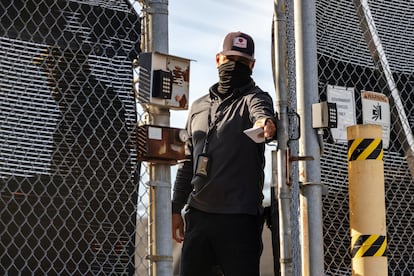

A federal judge in Washington dealt another blow to the Department of Homeland Security (DHS) by blocking its latest policy requiring members of Congress to give seven days’ notice of any visits to Immigration and Customs Enforcement (ICE) detention centers. The decision marks the third time the court has intervened to halt attempts by President Donald Trump’s administration to limit unannounced inspections by lawmakers.
Judge Jia M. Cobb of the U.S. District Court for the District of Columbia concluded on Monday that the policy pushed by Homeland Security Secretary Kristi Noem is likely illegal. The requirement forced lawmakers to give a week’s notice before entering immigration detention facilities.
Cobb argued that Congress has been clear in prohibiting the use of annually allocated funds to prevent or restrict lawmakers’ access to DHS facilities for oversight purposes. In her ruling, she said: “The power of the purse rests with Congress, and even a deep-pocketed agency must comply with Congress’s restrictions on the permissible uses of appropriated funds.”
The judge considered it “highly likely” that the administration would use restricted funds to create and implement the pre-negotiation policy. She rejected the Justice Department’s argument that the measure would be funded exclusively from Trump’s “Big, Beautiful Bill,” passed last year. According to the government, any spending related to the policy could subsequently be accounted for as coming from that budget package.
However, Cobb dismissed those arguments as “unpersuasive” and determined that the oversight language included in the annual appropriations laws is “undoubtedly broad” and “extends to the most incidental, but nonetheless necessary, expenditures that make the creation and implementation of the notification policy possible.” In other words, the prohibition on using funds to limit congressional visits applies not only to direct expenses, but also to indirect costs necessary to create and implement the policy, such as the salaries and resources of DHS officials and ICE congressional relations office staff who coordinate visits by lawmakers.
The decision blocks the application of the notification requirement against any member of Congress while litigation filed by 13 House Democrats continues. The lawmakers sued after an earlier version of the policy was reinstated in January, just one day after an ICE agent shot and killed U.S. citizen Renee Good in Minneapolis.

Three days after the shooting, three Democratic congresswomen in Minnesota — Ilhan Omar, Kelly Morrison, and Angie Craig — were barred from entering an ICE facility near Minneapolis. According to the plaintiffs’ attorneys, DHS did not disclose the new version of the policy until after the lawmakers were turned away.
In her most recent ruling, Cobb acknowledged that the plaintiffs are frustrated by the government’s repeated attempts to reimpose the advance notice requirement and stated: “Defendants are required to abide by the terms of the Court’s order and act consistently with the legal principles announced in this opinion.”
The judge also questioned the administration’s argument that the measure was necessary for security reasons. She noted that the government did not present “concrete examples of safety issues posed by congressional visits without advanced notice.” In addition, she determined that lawmakers have demonstrated a “significant need for real-time, on-the-ground information about conditions in facilities, the status of detainees, and Defendants’ practices.”
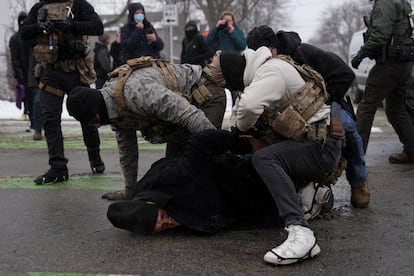
The ruling comes amid growing scrutiny of immigration operations and conditions in detention centers. The controversy also coincides with a partial government shutdown that affects DHS funding. However, Cobb said that situation does not change his decision and that the department remains obligated to comply with budget restrictions that guarantee Congress access to the facilities.
For its part, the administration announced its intention to appeal. In a statement, the Department of Homeland Security defended the policy as “a commonsense measure to ensure the safety of staff, law enforcement, visitors, and detainees alike.”
Sign up for our weekly newsletter to get more English-language news coverage from EL PAÍS USA Edition









































