
In Argentina, corruption scandals encircling Milei’s government come before Congress
Cabinet Chief Manuel Adorni will have to answer questions about his expanding assets and an economy showing signs of stagnation
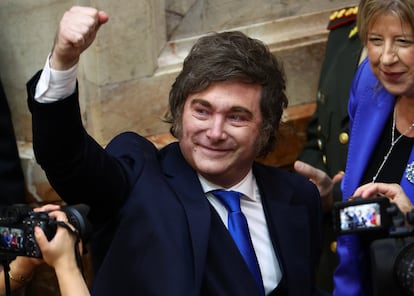

Argentina’s chief of Cabinet, Manuel Adorni, has become a liability for President Javier Milei. The luxury trips he took with his family and the properties he purchased after entering government are under judicial investigation and have tanked his public image, which is now the worst among all ministers: seven in 10 Argentines disapprove of him.
The fact that he has remained in his post despite suspicions of illicit enrichment is also dragging down Milei’s popularity, which has fallen 12% in the past month, according to the Torcuato di Tella University Confidence Index. But Milei has made it clear he will not sacrifice one of his closest allies and one of the few who enjoys the trust of “the Boss,” as the president calls his sister, Karina Milei. They will show that again this Wednesday: both will be present in Congress when Adorni delivers his management report.
It will be a trial by fire. The opposition is waiting for him with knives out, ready to subject him to a tough interrogation. They will question him about his growing assets, as well as other corruption scandals affecting the government, and the direction of an economy that shows signs of having stalled. The steady rise in inflation in recent months is once again eroding wages, unemployment is at its highest level since the end of the pandemic, and in February, the economy contracted 2.1% year-on-year, breaking a streak of growth.
Adorni was the presidential spokesperson during the first half of Milei’s term and earned the nickname “journalist tamer” for the sharp answers he delivered during press briefings at the Casa Rosada, the seat of government in Argentina. His public reactions have been far clumsier since it emerged that his wife, Betina Angeletti, traveled with the presidential delegation to the United States in March.
“I came to New York for a week to deslomarme [work myself to the bone],” were the first words he used to justify his wife’s presence on the trip. The phrase spread like wildfire. Deslomado became a meme on social media, graffiti on city walls, and even an improvised song in the Buenos Aires subway, where rappers ask commuters for words to freestyle with.
Since then, Adorni has been caught in a whirlwind of media revelations and ongoing judicial investigations. His press conference a month ago didn’t go well either. He left abruptly after refusing to explain who paid for the private jet trip he took to Uruguay and the apparent inconsistencies between his high standard of living and his income, once again becoming the target of widespread criticism and mockery. The reports of new expenses and witness statements that further implicate him have kept him on the front pages almost every day.
Adorni has thoroughly prepared for his appearance before Congress. He will deliver an opening statement and then take questions. The opposition aims to expose him without falling into provocations that might justify an early exit from the chamber. With Milei in the audience, they plan to demand explanations about the “morality as a matter of state policy” the president proclaimed in his address opening the legislative year on March 1. For the president — who was a goalkeeper in his teens — there aren’t enough hands to stop all the corruption scandals coming his way.
The judicial cases involving Adorni are the ones that have resonated most with Argentine society. It’s easy to suspect something doesn’t add up. In 2023, he was paying for a $500 suit in 12 installments, as reported by the Argentine newspaper Clarín. Yet the following year, earning a $2,500 monthly government salary, he paid nearly $15,000 in cash for flights and accommodation to take his family to Aruba.
More questions have been raised following the revelation that, since joining the government, Adorni has bought two properties — a 200‑square‑meter apartment in Buenos Aires and a house in a gated community 80 kilometers from the city — financed with generous loans from retired women and police officers.
These are striking cases, but not the only ones — nor the most serious — linked to the government. The courts are still investigating the $Libra cryptocurrency that Milei promoted on his social media accounts on February 14, 2025, which left a trail of victims when its price collapsed within minutes. Another case is also moving forward, seeking to determine whether bribes and overpricing were involved in the purchase of medications for the National Disability Agency (ANDIS).
In the past week, Milei dismissed Carlos Frugon, the secretary of infrastructure coordination at the Ministry of Economy, after it emerged that he had failed to declare seven properties and two business entities in the United States. Argentina’s tax chief, Andrés Vázquez, is also on shaky ground. The courts are investigating the alleged “malicious omission” in his sworn statement of three luxury residences in Miami valued at more than $2.1 million.
Many theories have emerged about why Milei is keeping his Cabinet chief in place while others have been dismissed over similar suspicions. The position Adorni holds is typically seen as a presidential lightning rod — when a crisis erupts, it is usually the first to go. Milei has done it before: he fired Nicolás Posse after five months and then his successor, Guillermo Francos, as the midpoint of his term approached. The difference here, according to people who have spent time around the president, is less rational than emotional.
Adorni is one of the few people who has been with Milei from day one and one of the few in whom the president and his sister have absolute trust. The president refuses to let him go because he believes it would hand a trophy to a press he despises and has just barred from the Casa Rosada. He also lacks heavyweight figures of his own to replace him. And he thinks that if his Cabinet chief falls, it will be seen as a sign of weakness both inside and outside the government — and that he will be the next target.
He is counting instead on Adorni emerging unscathed from the congressional hearing. At the very least, it would buy him time. If the economy picks up in the coming months, public discontent may ease, and the corruption cases could lose relevance. If not, keeping his Cabinet chief will become increasingly risky.
Sign up for our weekly newsletter to get more English-language news coverage from EL PAÍS USA Edition









































