
Manuel Adorni, Milei’s spokesman silenced by the scandals closing in
Since joining the Argentine government, the current Cabinet chief has acquired properties and taken trips that appear inconsistent with his income level. He is being investigated by the courts for alleged illicit enrichment
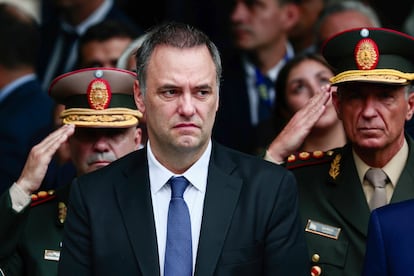
“There’s nothing more,” officials in Javier Milei’s government insisted after Cabinet Chief Manuel Adorni found himself at the center of controversy over a video showing him boarding a private plane to Uruguay — an extravagant expense that contrasts sharply with his income level. Guided by that premise, the official strategy was to let time pass and bet that Argentines would shift their attention to something else. But there was more.
As the days went by, the existence of two undeclared properties belonging to Adorni came to light, along with a curious method of acquiring them — with loans offered, in at least one case, by the very sellers of the property. Even as the pressure on him grows and new revelations continue to surface, Milei continues to back the official in a show of support he made explicit during Monday’s Cabinet meeting. Adorni, who until taking on his new role had been an energetic and combative presidential spokesperson, is now relying on discretion to avoid giving explanations.
The first incident that thrust Adorni into the center of controversy was the official trip to New York, in which his wife, Bettina Angeletti, joined the delegation despite having no official role. That revelation opened the door to even more compromising ones. Just hours later, a video surfaced showing him boarding a private plane to Punta del Este in Uruguay with his family — a round‑trip flight that cost around $10,000 — and the 2024 purchase of a house in his wife’s name in the Indio Cua Golf Club gated community, 50 miles from Buenos Aires, which is not included in Adorni’s asset declaration.
At a press conference where he attempted to put the scandal behind him, Adorni ended up admitting that he currently lives in an apartment in the Buenos Aires neighborhood of Caballito, which also does not appear in the documentation submitted so far to the Anti‑Corruption Office (OA). It later emerged that he bought it in November 2025 for $230,000 — and that the same two women who sold it to him, retirees aged 72 and 64, lent him $200,000 to complete the transaction. In other words, nearly 90% of the recorded purchase price.
In recent hours it also emerged that he mortgaged the apartment he previously lived in — the one that does appear in his asset declaration and is located in the Buenos Aires neighborhood of Parque Chacabuco. The unit has an initial mortgage, taken out in 2014, for $75,000 and signed by the same woman who sold him the property. The second mortgage, from 2024, is for $100,000 and in favor of two other women, according to official information accessed by the Argentine newspaper La Nación. That second mortgage was executed on the same day his wife purchased the house in the Indio Cua gated community.
There may be more revelations to come. Rumors are circulating about a family vacation in the Caribbean, which — combined with other elements, such as the fact that Adorni added a Jeep Compass SUV to his assets without selling his previous vehicle — raise further questions about whether he can justify his lifestyle with his income or whether he may have committed the crime of illicit enrichment. Until early this year, when he received a nearly 100% raise, Adorni earned around 3.5 million pesos, roughly $2,500 a month. The notary who handled Adorni’s various real‑estate transactions, Adriana Mónica Nechevenko, is scheduled to testify in court this Wednesday at the request of prosecutor Gerardo Pollicita.
A trusted figure
Manuel Adorni is 46 years old and was born in La Plata, 37 miles from Buenos Aires. Before entering public service, he worked as a commentator on various television channels, where he met Javier Milei, a frequent guest. Once elected, Milei appointed him as his spokesperson, a role from which his supporters built up his reputation as a “journalist tamer.”
Known for his mocking style, he often ends his arguments with a curt “fin” (“the end”). At his most recent press conference, cornered by the roomful of accredited reporters, he could only try to defend himself. “I spend my money on whatever I think is best, and I’m not going to discuss my spending decisions with you, who are just a journalist,” he snapped when asked about his trips.
Javier Milei and his sister Karina, the presidential chief of staff, trust Adorni so deeply that when the presidential duo travels abroad, they leave him as their stand‑in in the country. The person who holds that institutional responsibility is Vice President Victoria Villarruel, but she has effectively been sidelined from the administration, with Milei accusing her of being a “traitor.”
The scandal over his assets has forced Adorni to retreat from view and pushed Milei into the foreground. Over the Easter weekend, he unleashed a barrage of insults at journalists from his X account. It amounted to nearly 1,000 posts targeting the press in four days: 86 of his own tweets and 874 reposts, according to a tally by La Nación, which calculated that it took Milei more than 14 hours of screen time. The president revived — and repeatedly used — his slogan “NOLSALP,” short in Spanish for “we don’t hate journalists enough.”
What triggered the president’s anger was an investigation that revealed a Russian campaign in Argentine media aimed at discrediting Milei in 2024. As of Monday, the government has barred accredited journalists from some of the outlets mentioned in the investigation — conducted by an international consortium — from entering the Casa Rosada, the seat of government in Argentina. Promoting the idea of a corrupt press is useful to Milei at a moment when journalistic revelations are outpacing the courts and putting a key figure in his power structure in a difficult position.
Sign up for our weekly newsletter to get more English-language news coverage from EL PAÍS USA Edition









































